


Three of the most influential AI labs have quietly moved deeper into medicine, rolling out tools that plug directly into health data and clinical workflows. OpenAI’s ChatGPT Health and Anthropic’s Claude for Healthcare target patients and care teams with record-connected assistance, while Google’s MedGemma 1.5 arms developers with a multimodal model for medical text and images. Together, they preview a near-term future where AI supports triage, paperwork, and patient education—without replacing clinicians.
What ChatGPT Health Actually Does for Users
OpenAI’s new Health feature lets users link apps such as Apple Health and Function Health, then query their own data in plain language. Think of it as a personal health brief on demand: the assistant can summarize vitals, trends from wearables, and lab results, flag out-of-range values, and draft questions to bring to a doctor visit. OpenAI says the feature was developed with physicians, keeps health conversations isolated in a dedicated space, and does not use personal health data to train future models.
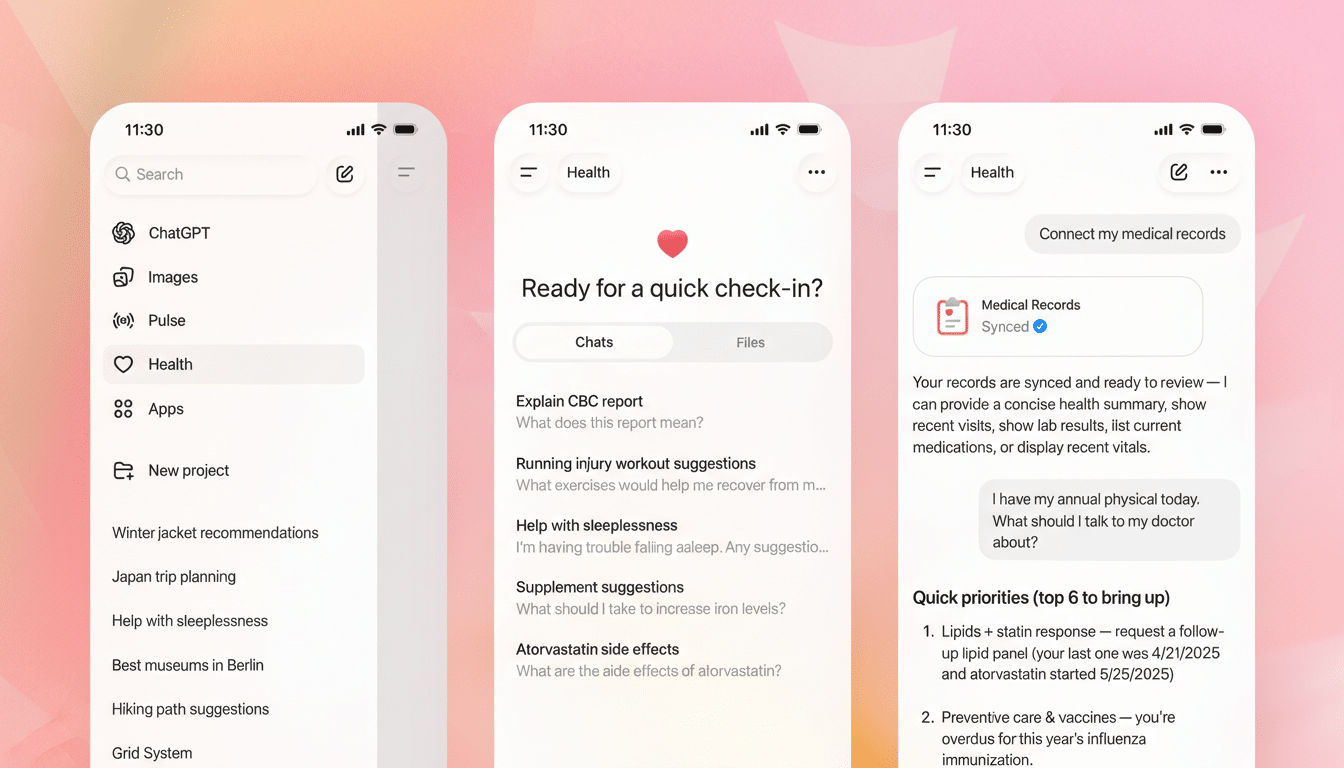
Under the hood, connectors normalize data from disparate sources so the model can reason across steps, meds, and metrics. The output is tuned for clarity—explaining A1C or eGFR in non-technical terms and highlighting what typically warrants follow-up. Importantly, it’s framed as augmentation, not diagnosis: users are reminded to treat responses as educational guidance, not medical orders.
Claude for Healthcare Targets Patients and Payers
Anthropic’s Claude for Healthcare offers a similar patient-facing experience for Pro and Max subscribers in the US, with connectors that ingest health records and fitness data. Claude can produce a concise medical history, translate lab reports into everyday language, spot patterns (for example, sleep dropping as resting heart rate rises), and generate an appointment checklist to make clinician time more productive.
Where Claude diverges is on the enterprise side. Anthropic is packaging connectors and “skills” for providers and insurers, including tools to accelerate prior authorization, draft denial appeals, and summarize charts. The pitch is speed plus auditability: standard forms and letters are auto-generated, while organizations retain control over which data is shared, and sharing is off by default. Like OpenAI, Anthropic says health data is not used for model training.
MedGemma 1.5 Gives Developers a Medical Foundation
Google’s MedGemma 1.5 is not a consumer assistant—it’s a foundation model designed for teams building health applications that analyze medical text and imagery. Available via Vertex AI and the Hugging Face ecosystem, MedGemma supports tasks such as clinical note classification, entity extraction, and basic image interpretation workflows (for example, categorizing findings from dermatology photos or simple imaging tasks) when fine-tuned on domain data.
Because it’s freely accessible, MedGemma 1.5 lowers the barrier for startups and research groups to prototype tools like triage aids, radiology quality flags, or chart-review bots that sit behind the scenes. As with all medical AI, real-world deployment still demands rigorous validation and compliance with institutional and regulatory requirements.
How These Systems Work in Real Clinical Practice
The patient tools center on three jobs: summarization, translation, and preparation. Summarization condenses long records into timelines and key problems; translation turns jargon into readable explanations; preparation outputs checklists and forms that help patients and clinicians make the most of a visit. On the enterprise side, prior authorization is the headline use case—assembling medical necessity rationales from notes and guidelines to reduce time-to-decision.
Developer-facing models like MedGemma complement those assistants by powering the back office: de-identifying notes, auto-coding encounters, or flagging documentation gaps. This division of labor—consumer assistants at the edge, domain-tuned models under the hood—is emerging as a common pattern across health systems piloting generative AI.
Safety, Privacy, and Oversight in Health AI
Hallucinations remain the chief risk. A study in JAMA Internal Medicine found chatbot answers to patient questions were preferred for quality and empathy 79% of the time, but preference is not the same as clinical accuracy. The World Health Organization has urged health developers to subject large models to transparent evaluation and post-deployment monitoring, especially in high-stakes use.
On privacy, both OpenAI and Anthropic emphasize opt-in data connections, granular controls, and policies that exclude user health data from training. That said, consumer chatbots are typically not covered by HIPAA unless offered under a healthcare organization’s compliance program. Regulators like the FDA continue to refine guidance for adaptive AI/ML software as a medical device; until clearer rules arrive, organizations are leaning on internal governance and external audits.
Early Impact and What to Watch in the Months Ahead
The near-term value is pragmatic: faster paperwork, clearer communication, and better appointment prep. For patients, that could mean a personalized brief before a cardiology visit. For clinicians, fewer clicks assembling prior authorization packets. For developers, MedGemma 1.5 opens a path to build specialized tools without starting from scratch.
Adoption is already widespread—industry analyses estimate tens of millions of people have tried chatbots for health questions—and the economic stakes are large, with consulting firms projecting multibillion-dollar savings from automating administrative tasks alone. The next phase will hinge on measurable outcomes: reductions in denial rates, shorter cycle times, improved patient understanding scores, and rigorous error tracking.
The message from these launches is consistent. AI is not replacing clinicians, but it is moving into the workflows around them. If developers keep models tight to data, transparent in operation, and conservative in claims—and if health organizations validate and govern them—these tools could make care feel more coordinated, more comprehensible, and a little less time-consuming for everyone involved.
