


On a spring afternoon in April 2026, a satellite called YAM-9 looked at a stretch of railway track and told its owners, on its own, what it was seeing. Nobody on the ground had opened the raw imagery or scrolled through pixels looking for a pattern. The spacecraft, built by Loft Orbital, had already sorted through the picture and flagged what mattered. That quiet act ran on a chip most people will never hear about: the on-board computer satellite engineers had spent years shrinking, hardening, and teaching to work alone.
What Is an On-Board Computer Satellite, Really?
Most of us picture a satellite as a camera bolted to some solar panels, drifting in silence. That picture is outdated. Every working spacecraft has a small, dedicated system managing it from the inside, much like a car’s engine control unit keeps dozens of parts synchronized without the driver noticing. The European Space Agency calls this unit the on-board computer: the part responsible for a satellite’s health checks, its command processing, and every piece of software the mission depends on.
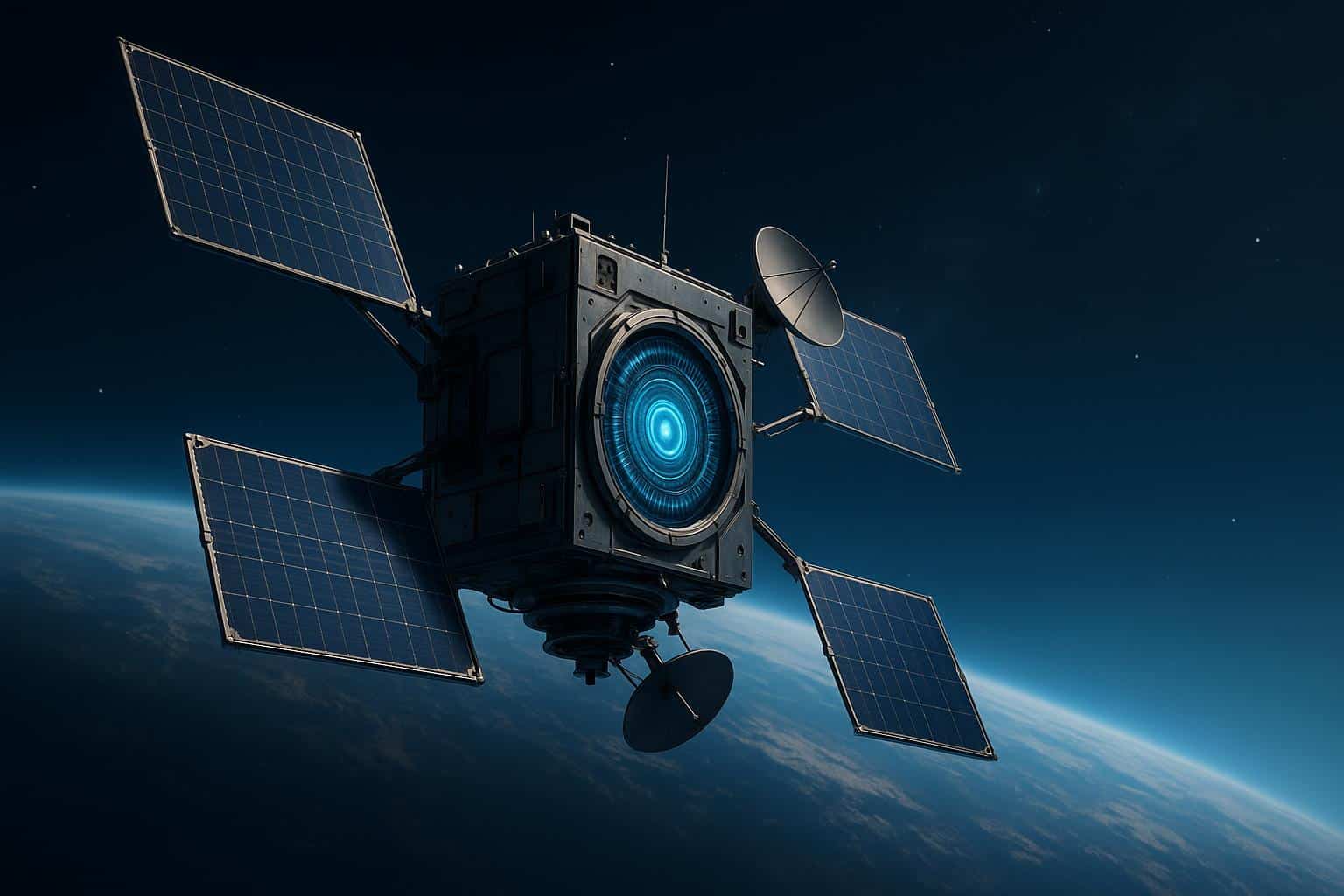
It is not glamorous work. An on-board computer satellite spends most of its life reading temperature gauges, checking battery voltage, and confirming a solar panel unfolded the way it should. But when something needs a decision, whether that’s tilting an antenna, firing a thruster, or flagging a wildfire, this is the hardware that makes the call.
From Passive Relay to Independent Thinker
For most of the space age, satellites worked like a courier with no opinion of their own: collect imagery, store it, wait for a ground station, then hand over everything, sorted or not, for humans on Earth to pick through. That worked fine when missions were slow and patient. It works less well when a fire is spreading or a ship has gone dark.
YAM-9 is the clearest break from that pattern so far. NASA’s Jet Propulsion Laboratory wrote software that could take a plain-language request and turn it into a task the spacecraft could carry out on its own, using a compact vision-language model running on hardware no bigger than a deck of cards. Planet Labs is testing similar chips for narrower detection jobs. Kepler Communications, which runs one of the largest GPU clusters currently in orbit, has said only that there are projects it can’t discuss yet. None of these companies are chasing novelty for its own sake; they’re chasing minutes, sometimes hours, shaved off the time between a satellite seeing something and a person finding out about it.
Why the Hardware Choice Matters So Much
None of that autonomy happens without a reliable on-board computer satellite at the center of the design. Space punishes electronics in ways a data center never will: radiation flips bits it shouldn’t touch, temperatures swing by more than a hundred degrees between sunlight and shadow, and if a chip locks up, there’s no technician to walk over and unplug it.
That’s why picking an on-board computer in satellite design is rarely just about clock speed. Engineers argue over power budgets, thermal limits, and how much radiation shielding a board can carry before it gets too heavy to launch affordably. Some cubesats fly with little more than a stripped-down microcontroller; others carry radiation-tolerant processors strong enough to run machine learning models mid-orbit. The right on-board computer satellite depends entirely on what the mission needs to survive.
Dragonfly Aerospace is one of the companies building for that second category. Its on-board computer satellite hardware gives operators who could never have afforded a flagship mission access to processing power that used to belong only to major agencies. Smaller teams, smaller budgets, and suddenly, real autonomy in orbit.
The Ripple Effect Across the Industry
Once a computer on satellite hardware can make sense of its own sensor data, mission planning starts to look different. Instead of downlinking everything and sorting it out later, a constellation can filter first and transmit only what’s useful. That trims bandwidth costs, but it also trims something harder to measure: the lag between an event happening and someone learning about it.
None of it comes free, though. Every watt spent on computation is a watt not spent on the payload, and every extra chip adds heat that has to go somewhere. Software running on a machine nobody can walk up to and fix by hand demands more caution before launch than a typical office update ever would. A peer-reviewed look at orbital data-handling systems makes a similar point: reliability, not raw speed, tends to decide whether a spacecraft lasts the length of its mission.
What Comes Next for Autonomous Spacecraft
Loft Orbital has said it would take somewhere between 50 and 100 satellites like YAM-9 for something close to real-time global coverage. Right now, it flies twelve. That’s the honest state of the industry: the demonstration worked, but scaling it up is still mostly ahead of us. Each satellite added to that fleet will lean on a dependable on-board computer satellite doing the unglamorous work no headline ever mentions.
None of this arrived overnight. On-board computer systems have gone from simple command relays decades ago to genuinely capable decision-makers today, largely because the software running on top of them finally caught up to the hardware underneath. What matters here isn’t the milestone itself but what it signals: mission planners are starting to trust an on-board computer satellite with judgment calls that used to belong strictly to people.
That trust will only be tested further as the hardware keeps improving. So we’ll ask you directly: should satellites be given more room to decide things on their own, or does the risk of one unsupervised mistake in orbit outweigh what’s gained in speed? Tell us where you land in the comments below.

