


The Norte Fire prompted mandatory evacuations in parts of San Juan Capistrano and San Clemente on Friday as strong Santa Ana winds and heat helped drive flames toward homes in south Orange County. Later reports put the fire at more than 450 acres, after an earlier estimate of roughly 250 acres, while firefighters worked from the ground and air to slow its spread.
The emergency disrupted schools, damaged or destroyed an undetermined number of homes and injured one firefighter, according to news reports citing fire and school officials. The fire also brought a smoke forecast that called for air quality unhealthy for sensitive groups in several coastal and inland south Orange County communities through Friday evening and into Saturday morning.
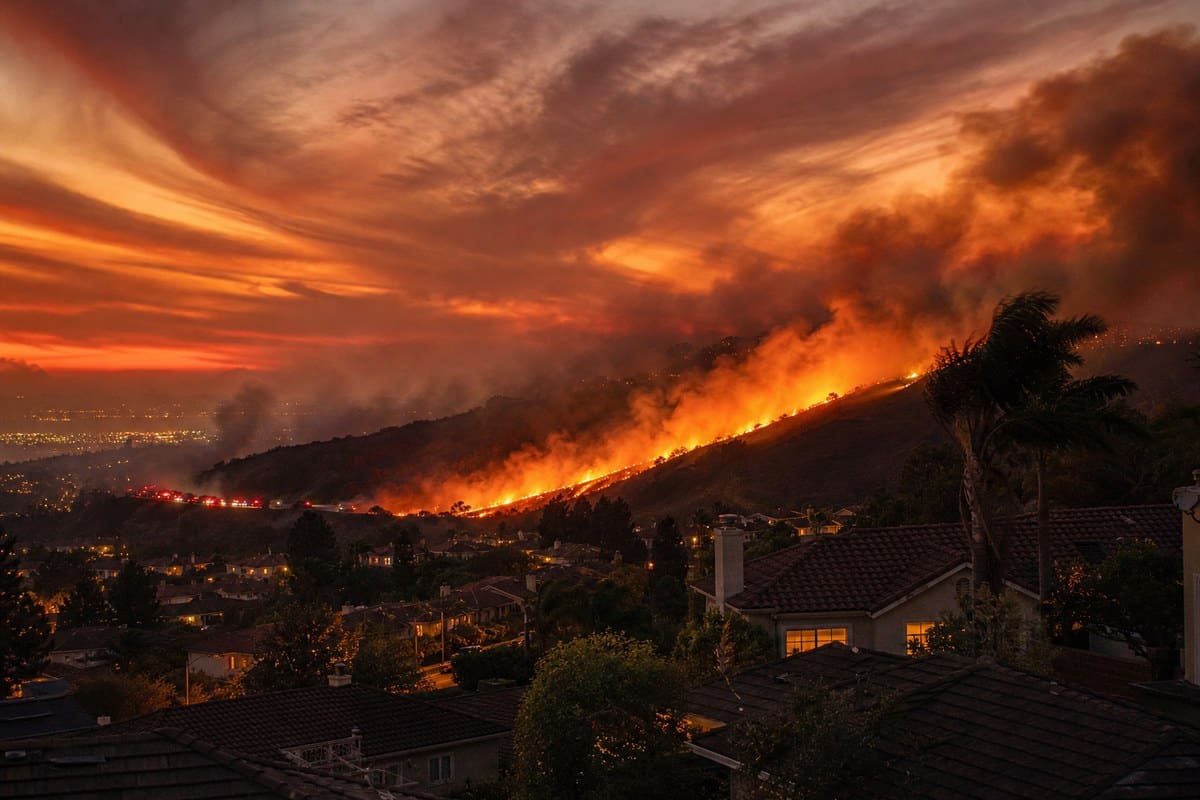
Evacuations ordered near San Juan Capistrano and San Clemente
Evacuation orders covered San Juan Capistrano Zones 4, 5 and 10 and San Clemente Zones 12 and 13, according to the Los Angeles Times’ report on the fire response. The zones were issued during an active, fast-changing incident, and residents were advised to rely on local emergency authorities for current evacuation instructions.
Capistrano Unified School District campuses dismissed students early because of the fire, the Times and other outlets reported. The fire burned in the Interstate 5 and Ortega Highway area, where residential communities were among those threatened as crews deployed engines, aircraft and other resources.
Accounts of property damage were still preliminary Friday. ABC News reported that at least six homes had been damaged or destroyed, citing fire officials. CBS News, citing the Orange County Fire Authority, reported that six homes had been impacted. Those descriptions do not establish a final count or determine how many structures were destroyed rather than damaged.
Fire size rose sharply in reports through the afternoon
The differing acreage figures reflect the pace of the incident and the times at which they were reported. The Los Angeles Times, citing the California Department of Forestry and Fire Protection, reported that the fire was about 250 acres at 2 p.m. Later Friday, ABC News said it had burned at least 450 acres. CBS News reported a 465-acre estimate and said officials believed crews had knocked down most of the fire by 5:45 p.m.
Those figures should not be read as competing final totals. They document a blaze that expanded substantially over the course of the afternoon as officials updated public information. By late Friday, officials had not announced a final acreage, final containment figure or a confirmed cause of the fire in the reports reviewed.
Fire weather was a major concern during the response. Santa Ana winds and high temperatures were reported in the area, conditions that can make suppression more difficult and carry embers ahead of a fire. The reports described those conditions as factors in the operational hazard, but did not identify what ignited the blaze.
One firefighter was injured. CBS News reported that the firefighter was hospitalized and expected to recover quickly; ABC News reported that officials described the injury as heat exhaustion. Both accounts agree that one firefighter was hurt, while the more specific diagnosis and subsequent medical status had not been detailed in a direct public agency release cited in the reports.
Smoke forecast raised a separate health concern
The South Coast Air Quality Management District forecast that smoke and particles from the Norte Fire could make air unhealthy for sensitive groups in San Clemente, Dana Point, San Juan Capistrano and Laguna Niguel by Friday evening, according to CBS News. The forecast called for conditions to improve to good to moderate for most of south Orange County by Saturday afternoon.

As reported by CBS, the district advised people to remain indoors with doors and windows closed when possible, use air conditioning or an air purifier, and avoid devices that draw outdoor air inside. For people who needed to be outdoors, the guidance included using an N95 or P100 respirator. The warning was specifically directed at the expected smoke conditions, which can shift quickly with wind and fire behavior.
The air-quality outlook added another practical concern for people outside evacuation zones: a fire can disrupt daily life well beyond the areas directly threatened by flames. For residents of affected communities, official evacuation notices and local air-quality updates remained more useful than an acreage figure alone, because both the footprint of the fire and the direction of smoke were still changing Friday.

