


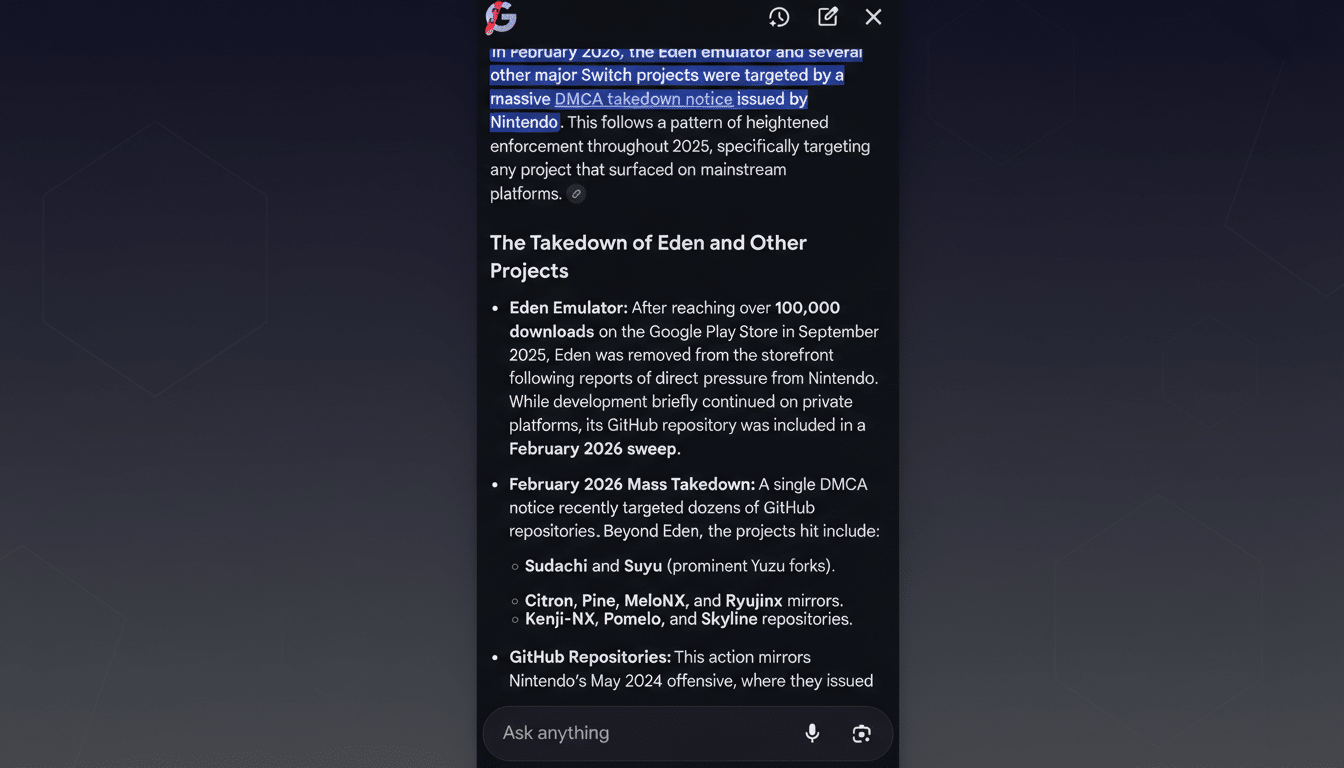
Nintendo has issued broad DMCA takedown notices targeting Switch emulators and their forks hosted on GitHub, naming projects such as Eden, Citron, Kenji-NX, and MeloNX, as well as dormant efforts like Sudachi and Skyline. While many repositories remain visible for now, they are squarely in the crosshairs, and maintainers expect swift removals once GitHub completes its review process.
What Changed After DMCA Notices And Why It Matters
Switch emulation development surged after the shutdown of the popular Yuzu project, with multiple forks and successors quickly taking shape. Citron and Eden in particular organized active teams and resumed rapid development, maintaining momentum even as legal pressure mounted. The breadth of Nintendo’s latest DMCA notice signals a coordinated effort to push the scene off a major distribution platform all at once, rather than whack-a-mole individual forks.
GitHub typically follows a structured DMCA process: when it receives a properly formatted complaint, it may disable or remove content, and it allows maintainers to file a counter-notice that can restore content if no lawsuit follows within a statutory window. The company also publishes transparency reports tracking takedown activity, underscoring how central it has become to open-source collaboration—and how disruptive a mass takedown can be to niche development communities.
The Legal Arguments And Remaining Gray Areas
Nintendo’s claims hinge on the anti-circumvention provisions of the Digital Millennium Copyright Act, especially Section 1201, which prohibits bypassing technological protection measures. Switch games are encrypted with keys stored on the console, so even if an emulator does not ship those keys or copyrighted game files, Nintendo argues the software’s purpose is inseparable from defeating protections.
Emulation itself is not illegal under U.S. law; courts have previously recognized the legality of independently developed emulators, as seen in historical cases involving PlayStation emulators. What remains unsettled is how anti-circumvention rules apply to modern consoles with deeply integrated cryptographic systems. The high-profile lawsuit against Yuzu ended in a settlement—reportedly including a $2.4 million payment and permanent shutdown—leaving no firm legal precedent. Digital rights advocates such as the Electronic Frontier Foundation have long argued that broad readings of the DMCA chill legitimate interoperability and preservation work, while platform holders stress that robust enforcement is essential to combat rampant piracy.
Developers Pivot As Mirrors Multiply Across Platforms
Anticipating DMCA scrutiny, several emulator teams mirrored their code off GitHub to self-hosted Git services and private servers, making a complete purge far more difficult. Citron, Eden, and Kenji-NX are among the active efforts maintaining official websites and alternative repositories. This decentralization keeps development alive but fragments the community’s information flow and reduces the safety net that large platforms provide.

In practice, code will continue to circulate through mirrors, archives, and community channels. For researchers and preservationists, that means continued access; for platform holders, it complicates enforcement. Historically, Nintendo has pursued a multi-pronged strategy—lawsuits against high-profile targets, DMCA removals against distribution channels, and public messaging that games should be played only on official hardware. Previous actions against ROM sites, including a notable judgment against RomUniverse, preview how aggressive that enforcement can be.
User Risks Grow Across The Wider Emulator Ecosystem
Driving projects off GitHub raises a different concern: safety. When official repositories vanish or scatter, users often turn to search results and social platforms, where impersonators and malware thrive. After past takedowns, fake installers and trojanized builds circulated widely, preying on users who couldn’t distinguish legitimate releases from lookalikes. Security-minded maintainers now emphasize reproducible builds, cryptographic signatures, and verified release channels—practices that become harder to enforce as projects diffuse across smaller hosts.
There is also collateral damage to legitimate development and research. Homebrew creators, security analysts, and archivists often rely on similar tooling and documentation. While none of the targeted emulators distribute game ROMs or console keys, the chilling effect pushes related technical discussion out of mainstream venues, making collaboration and oversight more challenging.
What To Watch Next As GitHub Reviews DMCA Takedowns
Key questions now revolve around process and persistence. Which repositories will GitHub remove outright, and will any maintainers file counter-notices to force a legal test? Will Nintendo escalate with new lawsuits against specific teams, or focus on sustained DMCA enforcement across platforms? And how effectively can emulator projects maintain discoverability and safety standards as they migrate away from centralized hosts?
For now, the immediate effect is clear: visibility on the world’s largest code platform is in jeopardy. Yet the emulator scene has already adapted, and history suggests it will continue to evolve in response to each new takedown. Whether this latest sweep becomes a turning point or just another cycle in a long-running standoff will depend on what happens after the repositories go dark.
