


NASA has redirected its near-term lunar strategy toward building infrastructure on the Moon’s surface, laying out a phased plan for a South Pole base, more frequent missions and expanded use of commercial spacecraft. The agency also said it intends to pause the Gateway lunar-orbit station in its current form, a significant shift for an Artemis architecture that had treated the outpost as a major element.
The initiative, announced March 24 at NASA’s Ignition event, turns broad ambitions for a sustained human presence on the Moon into a procurement and mission-planning agenda. But much of the plan remains contingent on future appropriations, contracts, hardware tests and the performance of commercial providers. NASA Administrator Jared Isaacman said the agency would invest about $20 billion over seven years, according to ABC News and Aerospace America. NASA’s public announcement did not provide a line-by-line allocation for that total.
What NASA has actually set in motion
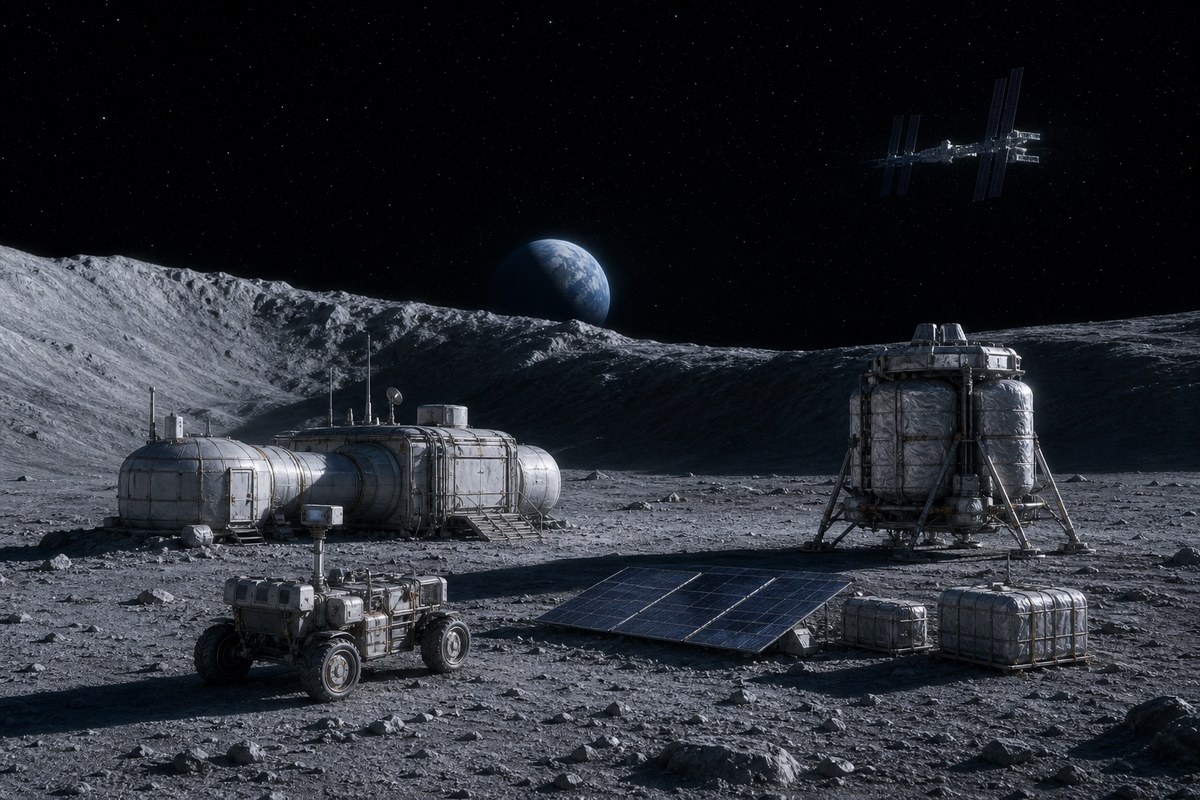
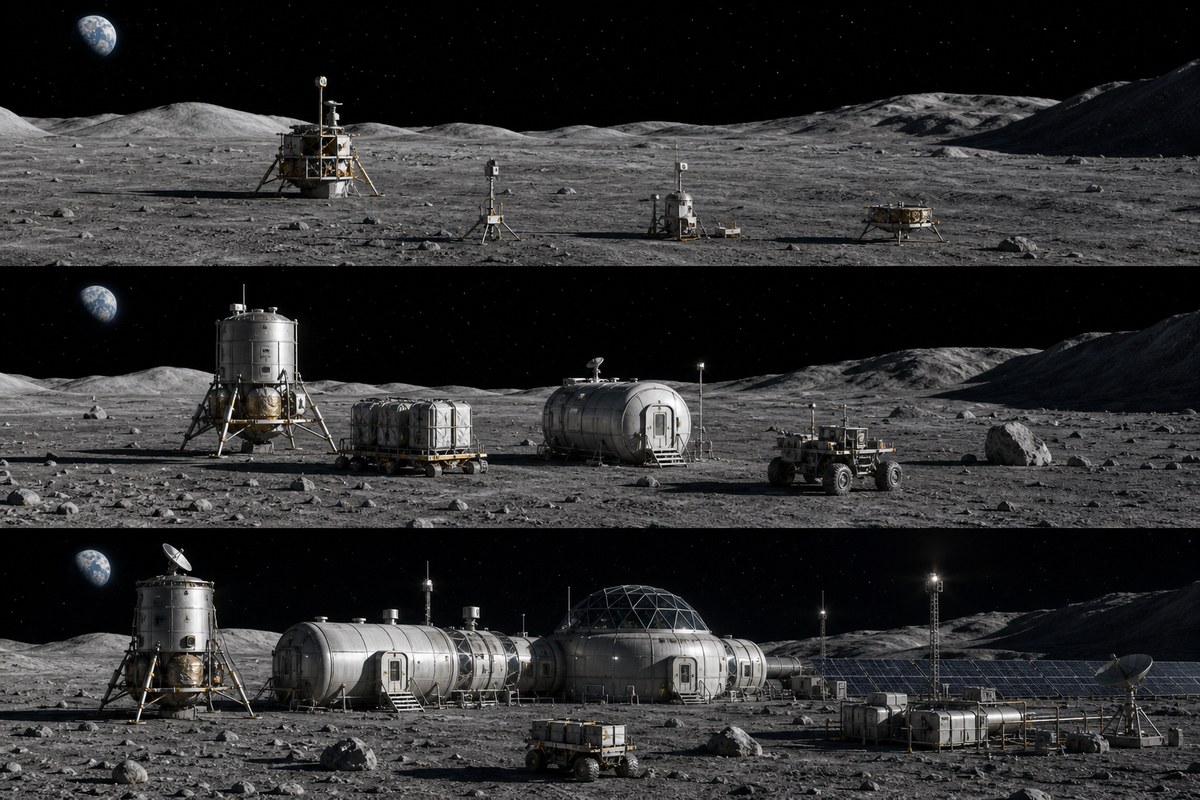
In its March 24 announcement, NASA described a three-phase Moon Base approach. The first phase centers on technology demonstrations and robotic activity. The second calls for semi-habitable infrastructure and regular cargo deliveries. A later phase would add heavier systems intended to support long-duration human operations.
The agency identifies the lunar South Pole as the base region. NASA’s Moon Base program page describes the project as an effort to create an enduring human presence, rather than a single landing campaign. The South Pole is a strategic target for exploration because NASA expects it to offer locations of scientific interest and possible resources that could support future operations, although the announcement does not establish that those resources can be extracted or used at the required scale.
NASA is now seeking industry input on commercial lunar transportation, surface-base capabilities, payload delivery and lunar terrain vehicles. Those requests are practical early steps, but they are not awards of contracts or evidence that a particular vehicle, habitat or power system has been selected. The agency says it wants initial terrain-vehicle operating capabilities by 2028 and plans to rely increasingly on commercially procured and reusable hardware after Artemis V.
Its stated target is to begin working toward crewed lunar surface landings every six months as those capabilities mature. That is a cadence goal, not a committed launch schedule. Maintaining it would require dependable launch vehicles, landers, spacesuits, life-support systems, cargo deliveries and surface operations across repeated missions.
Gateway is paused, not declared canceled
NASA’s language on Gateway is narrower than accounts that describe the lunar-orbit project as canceled. The agency said it intends to pause Gateway “in its current form,” while looking to repurpose applicable hardware and use international-partner commitments where possible for other objectives. It did not announce a final disposition for every element of the program.
The change reflects a decision to emphasize surface logistics, mobility, habitats and power systems sooner. Gateway had been conceived as a small station orbiting the Moon that could support crew transfers, science and lunar missions. Under the revised architecture, NASA is signaling that infrastructure needed for repeatable operations on the surface should take priority.
That leaves substantial programmatic questions. NASA has not publicly detailed how existing Gateway hardware and partner contributions would be reassigned, nor has it published a complete budget or procurement breakdown in its announcement and cited accounts. The agency’s ability to preserve useful work while changing the architecture will depend on technical compatibility, agreements with partners and congressional funding.
A 2030 outpost goal and a longer investment horizon
NASA’s Ignition plan sets a goal of a permanent lunar outpost by 2030. That should not be read as a completion date for every part of a continuously supplied, fully developed base. The reported seven-year, roughly $20 billion investment horizon can coexist with a 2030 initial-outpost objective: one describes a long span of planned spending, while the other identifies an earlier milestone.
The agency’s immediate Artemis sequencing is also more incremental than the image of an imminent settlement suggests. NASA says Artemis III, scheduled for 2027, is intended to test integrated systems and operations in Earth orbit. Artemis IV is then identified as the planned lunar landing. The proposed base would follow a series of demonstrations, robotic activity and increasingly regular transportation missions rather than emerge from one crewed expedition.
Commercial Lunar Payload Services, or CLPS, is one piece of that strategy. NASA says a planned CLPS 2.0 contract vehicle is expected to have a 10-year ordering period and a 15-year execution timeline, with a ceiling of $6 billion. That ceiling is not comparable dollar-for-dollar with Isaacman’s reported $20 billion Moon Base investment figure: CLPS covers a defined procurement mechanism, while the larger number was described as the broader investment in the base effort. Even so, the figures show the scale of the commercial-delivery role NASA is contemplating; the $6 billion ceiling is roughly 30 percent of the reported $20 billion total, not a stated share of its budget.
The plan creates a clearer destination for Artemis spending, but it does not resolve the engineering and financial risks that have complicated lunar exploration for decades. NASA’s next tangible tests will be its solicitations, contract decisions and the performance of the missions meant to turn surface operations from occasional expeditions into a recurring capability.

