


Elon Musk is reframing his artificial intelligence ambitions around the Moon just as xAI loses co-founders and investors gear up for a landmark public listing tied to SpaceX. In an all-hands meeting reported by The New York Times, Musk outlined a plan for a lunar manufacturing site that would assemble AI-focused satellites and launch them using a mass-driver-style “catapult,” arguing the approach could unlock compute capacity unmatched on Earth.
The pitch arrives amid flux: two more xAI co-founders, Tony Wu and Jimmy Ba, have departed, bringing the tally to six of the original 12. It also lands as expectations build for a SpaceX IPO that, according to multiple reports, could target a valuation around $1.5 trillion. The narrative now merging lunar infrastructure, orbital compute, and AI supremacy is bold by design—and carries real execution and governance questions.
- Why the Moon Is Musk’s Near-Term Focus for AI and Space
- The Compute Imperative Behind The Pitch
- Founder Departures and the Leadership Equation at xAI
- IPO Stakes and the Broader SpaceX Growth Narrative
- Law and Logistics on the Lunar Frontier for Industry
- What to Watch Next as the Moon Strategy Takes Shape
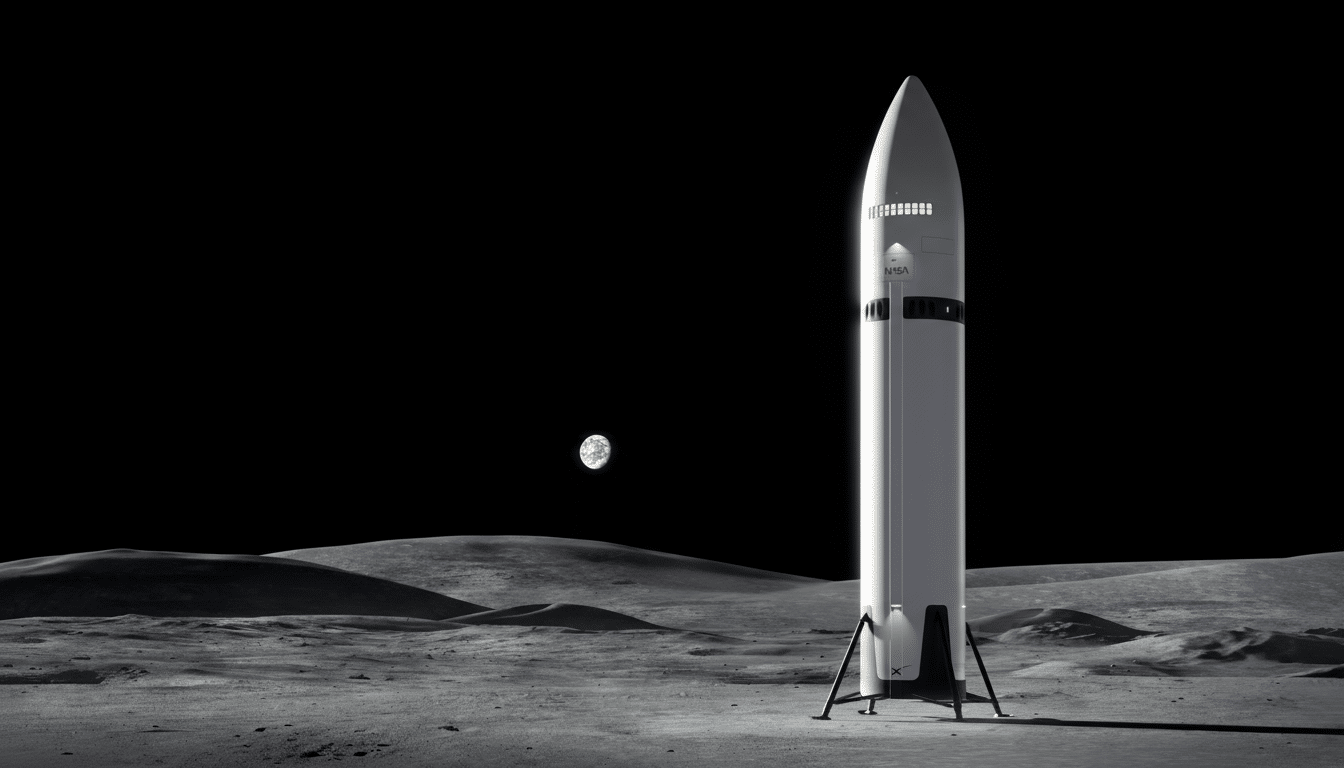
Why the Moon Is Musk’s Near-Term Focus for AI and Space
For years, Mars was the lodestar. But Musk recently signaled a near-term pivot, saying a self-sustaining city on the Moon is achievable on a shorter timeline than a Martian colony. Strategically, the Moon offers shorter logistics cycles, persistent line of sight to Earth for communications, and a proving ground for off-world industry. It’s also more legible to public markets: investors understand factories, power budgets, and supply chains, even in low gravity.
Crucially, a lunar facility could serve a compute-first agenda. If satellites are optimized for AI inference and data collection, assembling and flinging them from the Moon cuts launch energy needs and capitalizes on the Moon’s 1/6th gravity. Concepts like electromagnetic mass drivers—studied by NASA and physicists since the 1970s—move from science fiction to engineering programs once a permanent industrial footprint exists.
The Compute Imperative Behind The Pitch
Musk’s core argument is about scale. Training and serving frontier AI models now demand hundreds of thousands of high-end accelerators, along with gigawatts of reliable power and vast cooling capacity. Industry estimates from research groups tracking compute trends show AI training demand doubling on a cadence measured in months, not years. Earthbound data centers are racing to keep up; in orbit, the constraints and opportunities shift.
Here, the strategy interlocks Musk’s ecosystem: Tesla contributes energy systems and rich perception data; Neuralink provides neurophysiological insights; SpaceX supplies orbital logistics and comms; The Boring Company offers subsurface engineering; and xAI unifies the modeling stack. A lunar factory would add proprietary off-world data and on-orbit manufacturing to that flywheel—an advantage competitors could find difficult to replicate.
Founder Departures and the Leadership Equation at xAI
The brain drain is notable: half of xAI’s founders have exited within a short window. Musk has framed the turnover as natural as companies shift from zero-to-one to scale-up mode. Still, losing senior technical voices during a capital-intensive pivot adds operational risk. Recruiting replacement leaders with deep space systems, AI infrastructure, and manufacturing experience—while maintaining velocity—will be a decisive test.

Another open question is structure. xAI and SpaceX already work closely; aligning incentives, IP ownership, and governance across units will matter even more if lunar manufacturing becomes mission-critical to both AI and space businesses. Investors will look for clear reporting lines and a durable operating cadence rather than personality-driven decision-making.
IPO Stakes and the Broader SpaceX Growth Narrative
Reports suggest SpaceX is preparing for a blockbuster listing, buoyed by Starlink’s revenue trajectory and a mature launch franchise. A lunar-industrial roadmap could expand the total addressable market beyond connectivity into in-space compute and manufacturing—categories that public investors have scarcely priced. The risk is obvious: capital intensity and technology readiness levels are high, and timelines can slip. The reward, if milestones hit, is a narrative that underwrites multi-decade growth.
Expect buy-side diligence to focus on near-term cash engines (launch cadence, Starlink subscriber growth, enterprise contracts) while treating lunar plans as long-dated options. The tighter the milestone map—pilot manufacturing steps, power system demos, mass-driver prototypes—the easier it becomes to discount less of the moonshot.
Law and Logistics on the Lunar Frontier for Industry
Legally, the 1967 Outer Space Treaty bars national appropriation of celestial bodies, but U.S. law passed in 2015 recognizes private ownership of extracted space resources. The Artemis Accords, backed by NASA and dozens of partner nations, further support resource use and safety zones; notable non-signatories include China and Russia. Any lunar factory will need to navigate this patchwork while coordinating with U.S. regulators like the FAA, FCC, and NOAA for launch, spectrum, and remote sensing.
Logistically, building on the Moon demands dependable power (likely large-scale solar with energy storage or compact nuclear), autonomous construction, regolith processing, radiation shielding, and robust robotics. SpaceX has not conducted a proprietary lunar landing mission, though it has launched payloads for lunar programs. Demonstrating cargo delivery, precision landing, and surface operations will be prerequisites long before a mass driver lofts AI satellites into cislunar space.
What to Watch Next as the Moon Strategy Takes Shape
Key signals include a formal xAI–SpaceX roadmap for lunar manufacturing, retention and new executive hires after the founder exits, concrete GPU procurement and power plans for near-term AI scaling, and partnerships with NASA or commercial lunar providers for surface demos. If those pieces snap into place, the Moon pitch shifts from spectacle to strategy—and the IPO story gains a powerful, if audacious, second act.
