


I powered up MSI’s GeForce RTX 5090 Lightning Z and it is exactly what its price telegraphs: a no‑apologies, liquid‑cooled flagship built to batter limits and show off while doing it. Limited to 1,300 numbered units worldwide and stickered at $5,090, this GPU marries raw throughput with audacity—dual BIOS up to 1,000W, twin 12VHPWR feeds, a massive copper cold plate, and an 8‑inch side‑panel display. It’s equal parts fierce and bananas, and that’s the point.
What Sets the GeForce RTX 5090 Lightning Z Apart
MSI’s Lightning Z isn’t just a binned RTX 5090; it’s a platform. The card ships with an AIO liquid loop and a radiator whose power and fan control run through the GPU itself—no extra fan headers to wrangle. Beneath the shroud sits an outsized copper cold plate and a 40‑phase power design engineered for sustained current draw. A recessed switch toggles two BIOS profiles, lifting the power limit from 800W to 1,000W, while twin 12VHPWR connectors provide headroom up to 1,200W.
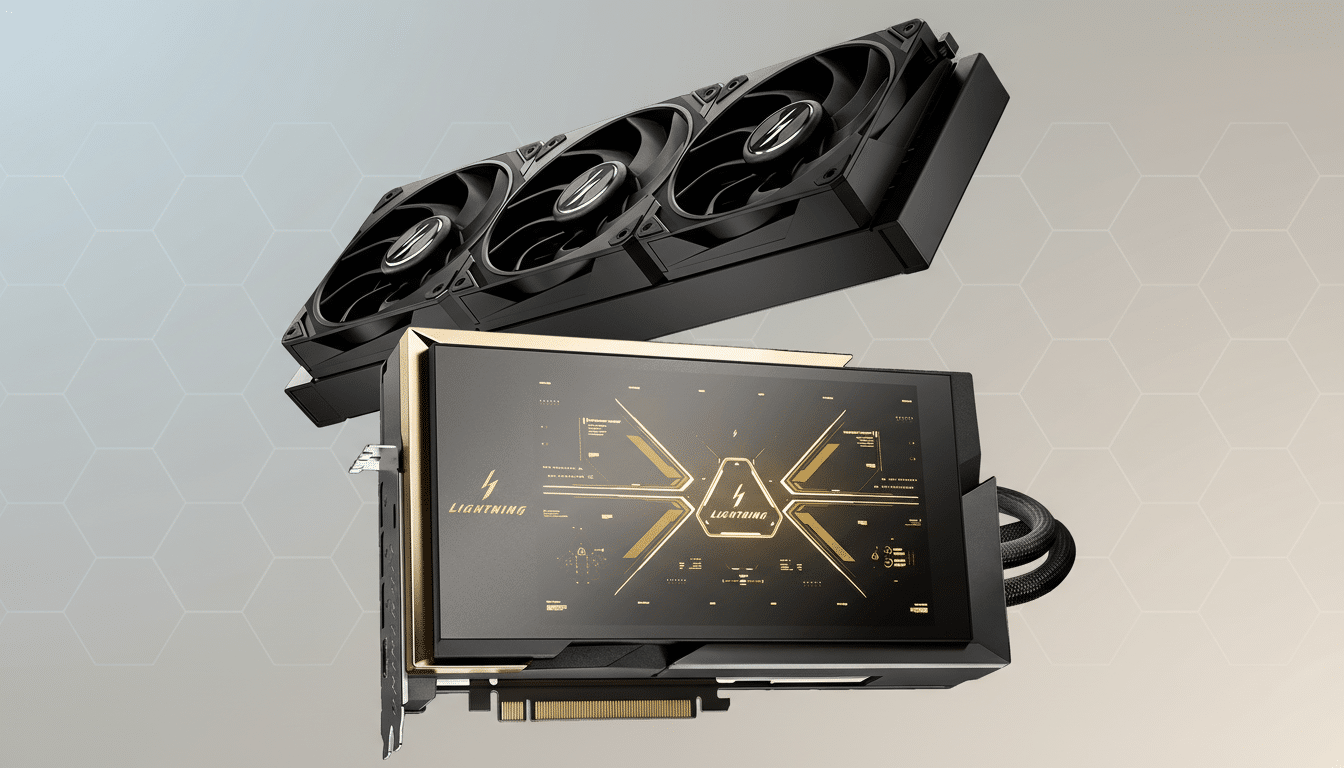
There’s also an “XOC” mode MSI reserves for record hunters that removes the muzzle entirely—rated to 2,500W—but enabling it voids the warranty and demands purpose‑built power delivery. That’s not for daily drivers; it’s for the overclocking circuit that lives on liquid nitrogen and glory.
I/O is familiar—three DisplayPort and one HDMI—plus a twist: a USB‑C port whose job is to power and feed the on‑card display via a simple USB loopback to the motherboard. It’s odd, but it works once you install the necessary USB display driver. MSI bundles a vertical mounting assembly, a brace, thermal probes, and a 12VHPWR‑to‑quad‑8‑pin adapter, though native dual 12VHPWR leads are strongly preferred for reliability.
Build Realities and the Required Power Budget
This GPU demands a showcase chassis and serious power. A quality 1,500W–1,600W ATX 3.0/3.1 PSU with two native 12VHPWR outputs is the practical starting point. MSI’s own 1,600W unit proved a clean match and minimized adapters. Keep cable runs gentle; past reports have tied stressed 12VHPWR connectors to failures. The vertical bracket is meticulously engineered but bulky, and not all cases accept it—cases with divided PCIe slot covers or tight bottom radiator clearance can complicate installs.
The card is heavy—think “small AIO plus thick PCB” heavy—so plan for a solid brace and unobstructed radiator placement. Expect to rework case fan layouts and front glass angles to give the loop clean intake and to keep the Lightning Z’s screen visible.
The On‑Card Screen Isn’t a Gimmick, It’s Useful
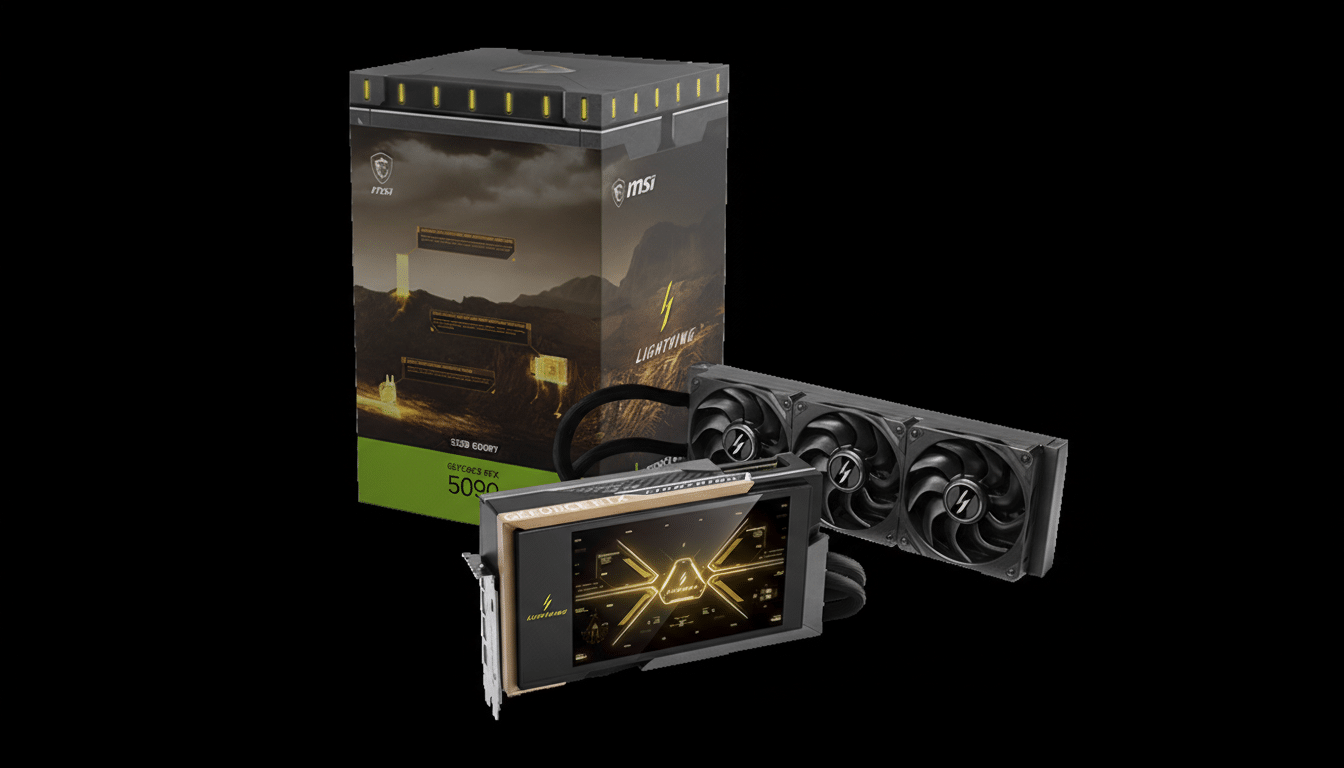
The 8‑inch panel is more useful than it sounds. After installing MSI’s USB display driver, Windows treats it as a second monitor. Through MSI Center or the new Lightning Hub, you can pin live telemetry—GPU and CPU load, temperatures, real‑time power draw—or toss video, dashboards, and streams onto it. It turns the GPU into a studio‑style status console or a tiny theater inside your rig. It’s a builder’s flex that also delivers practical visibility while you tune.
Performance in Early Testing and Initial Benchmarks
Against Nvidia’s RTX 5090 Founders Edition at stock, the Lightning Z’s factory overclocks delivered measurable gains. In UL’s 3DMark subtests, I saw uplifts roughly in the 6%–10% range, with one run spiking near 18%. In real games at 4K, most titles improved by 5%–10%; at 1440p, results were mixed, and a few runs showed parity. Flipping the BIOS to the 1,000W profile didn’t move the needle because the card rarely sustained power draw high enough to be constrained in stock‑OC form.
Context matters. You’re paying far more than 2X a standard RTX 5090 for low‑double‑digit performance gains out of the box. Memory headroom on GDDR7 and silicon limits mean diminishing returns; dedicated tuners have eked out a few extra % with manual clocks and voltage work, but you won’t find linear scaling. On the competitive front, AMD’s Radeon RX 7900 XTX trails well behind at 4K in many raster and ray‑traced workloads, though its value calculus is dramatically different.
Who Should Actually Buy This MSI Lightning Z GPU
The Lightning Z targets three audiences: overclockers chasing leaderboards, collectors who value scarcity, and showcase builders who want the centerpiece PC part of the cycle. For pure frames‑per‑dollar, it doesn’t pencil out. For experiential builds—quiet thermals under load, overbuilt power delivery, a clean AIO loop, and that big screen—it’s unmatched.
Also budget for the ecosystem: a high‑wattage PSU, a spacious glass‑heavy case, and a flagship CPU that won’t bottleneck the card at lower resolutions. If you’re game to tinker, the hardware offers real runway. If you’re not, the out‑of‑the‑box uplift is polished but not transformative.
The verdict: MSI’s RTX 5090 Lightning Z is a statement piece that backs up its bravado with engineering depth. It’s excessive by design—yet executed with the kind of restraint that keeps the madness usable. If you want the GPU everyone stops to stare at, this is the one.
