


Micron is sending PCIe 5.0 storage toward widespread adoption with the 3610, a new M.2 SSD made for ultrathin laptops and budget desktops. The drive is oriented at OEM systems rather than retail shelves, combining high-end Gen5 throughput with a cost-effective and power-efficient design that may finally push more widespread adoption of Gen5 slots toward midrange PCs.
Key specs and design of Micron’s 3610 Gen5 SSD platform
Micron says the 3610 offers up to 11,000MB/s sequential reads and 9,300MB/s sequential writes, as well as 1.5M IOPS random reads and 1.6M IOPS random writes. It’s a DRAM-less drive with the company’s G9 QLC NAND and Host Memory Buffer (HMB), situated on a single-sided PCB that keeps things slim for thinner, smaller devices.
- Key specs and design of Micron’s 3610 Gen5 SSD platform
- Why a DRAM-less design and QLC NAND make sense here
- Performance context and real-world impact for users
- OEM-only approach and early market reactions to the 3610
- Thermals and form factors for compact laptops and PCs
- How the 3610 stacks up against other Gen5 and Gen4 SSDs
- What to watch next as Micron 3610 SSDs reach OEMs
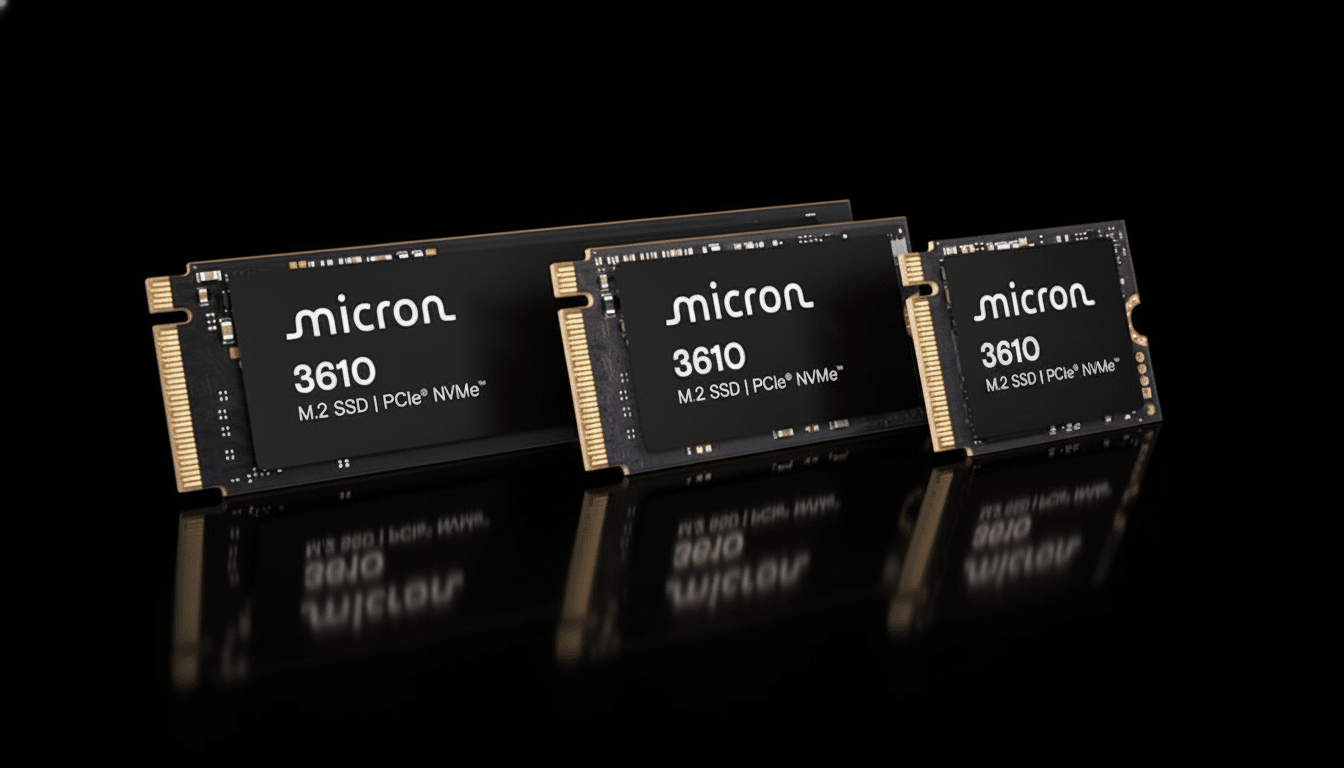
Capacity options will vary between 1TB and 4TB, and Micron says it’ll be the first Gen5 SSD in a single-sided M.2 2230 form factor to offer up to 4TB of storage. That’s a big deal for ultrathin laptops and small-form-factor systems where the dual-sided modules and chunky heat spreaders just won’t fit.
Why a DRAM-less design and QLC NAND make sense here
By forgoing onboard DRAM in favor of HMB, the 3610 keeps power draw and cost down — both desirable traits for laptops as well as bulk OEM builds. QLC reduces the cost per gigabyte even more, allowing for greater overall capacity without increasing the bill of materials. The trade-off here will be that QLC endurance and sustained write performance are typically worse than TLC parts, so it’s going to be important to keep an eye on how endurance ratings and SLC cache size in particular stack up once the full specs are published.
Nevertheless, for the workloads that most budget systems encounter — large media transfers, frequent app installations, game updates, and AI-enhanced tasks that can spike sequential bandwidth use — this design still has what it takes to deliver impressive real-world speed while managing thermals effectively.
Performance context and real-world impact for users
PCI-SIG puts the theoretical limit of PCIe 5.0 x4 at approximately 15.8GB/s, and many flagship Gen5 drives with flashy heatsinks can edge toward 12–14GB/s in ideal conditions. With up to 11GB/s reads, the 3610 falls into the “quick but sensible” category with an emphasis on getting shit done for your patience, rather than chasing down halo numbers. For gaming, we’ve seen Microsoft’s DirectStorage prove that faster NVMe can reduce load times and streamline asset streaming; for creators, scratch-disk performance and high-resolution proxy workflows often track with sequential throughput.
Random IOPS numbers higher than 1.5M will also be significant for multitasking and content pipelines that hop around between many small files. However, usual desktop use does not see us reaching the max QD, and buyers should expect the 3610 to “feel fast” in everyday use but without rewriting the book for light-duty work.
OEM-only approach and early market reactions to the 3610
Micron is targeting the 3610 largely at PC builders — your mainstream offerings from known brands — and won’t be selling it as a retail boxed SSD, but XPC shoeboxes would be perfect for these drives.
That matters. OEM deals can shake up the bottom-end configuration of mid-tier laptops and desktops, where Gen5 storage ideally should no longer be a high-end differentiator. Market watchers at TrendForce and IDC have observed that client Gen5 uptake has been trailing platform availability; a mainstream power-sipping option could help close the gap.
For AMD and Intel platforms with Gen5 lanes, the bottleneck has increasingly been SSD cost, thermals, and firmware maturity. Releasing a modest-thermal, low-BOM single-sided module provides OEMs with a drop-in route to marketing praise for “Gen5 speed” without redesigning chassis or introducing active cooling.
Thermals and form factors for compact laptops and PCs
Half-height construction is important when fitting smaller slots such as M.2 2230. Handheld gaming PCs and ultraportables have taken up 2230 NVMe drives for space reasons; offering a 4TB Gen5 option opens the door to bigger libraries or even local datasets on devices that used to top out at smaller capacities or slower Gen4 speeds. Lower power is also safer for throttling in fan-encumbered chassis.
How the 3610 stacks up against other Gen5 and Gen4 SSDs
Micron positions the 3610 as a mainstream option to its flagship Gen5 4600 series and its value-focused Gen4 products. Meanwhile, the broader market today includes ultra-fast TLC-based Gen5 drives (frequently with generous heatsinks) and efficient DRAM-less designs that leverage thin-and-light-mobile-focused controllers. The 3610 is clearly a play for the latter: sipping on sequential performance to focus on efficiency and thermals, but offering an aggressive capacity-per-dollar anyway.
What to watch next as Micron 3610 SSDs reach OEMs
Micron adds that the 3610 is sampling with “select” OEMs now. All eyes will be on sustained write behavior, cache dynamics, endurance ratings, and any enterprise-lite features (such as TCG Opal encryption) that find their way into shipping systems. Pricing will be established by laptop and desktop manufacturers, though the DRAM-less QLC formula should result in significant cost savings compared to flagship Gen5 parts.
If PC manufacturers hammer on the 3610 throughout midrange configurations, anticipate Gen5 SSDs to slide from niche to default across a broad swath of new systems — delivering quicker game loads, snappier media workflows, and headroom for on-device AI, without the premium price or puffed-up heatsinks synonymous with early Gen5 drives.
