


A new class-action lawsuit filed in federal court in San Francisco accuses Meta of misleading users about WhatsApp’s privacy protections, alleging the company can store, analyze, and access messages that are marketed as end-to-end encrypted. The complaint, described in reporting by Bloomberg, claims whistleblowers have provided information suggesting Meta employees can review user communications.
Meta rejects the allegations, saying WhatsApp messages remain end-to-end encrypted by default and cannot be read by the company. The dispute strikes at the core promise of WhatsApp, which has built global adoption on assurances that only senders and recipients can see message content.
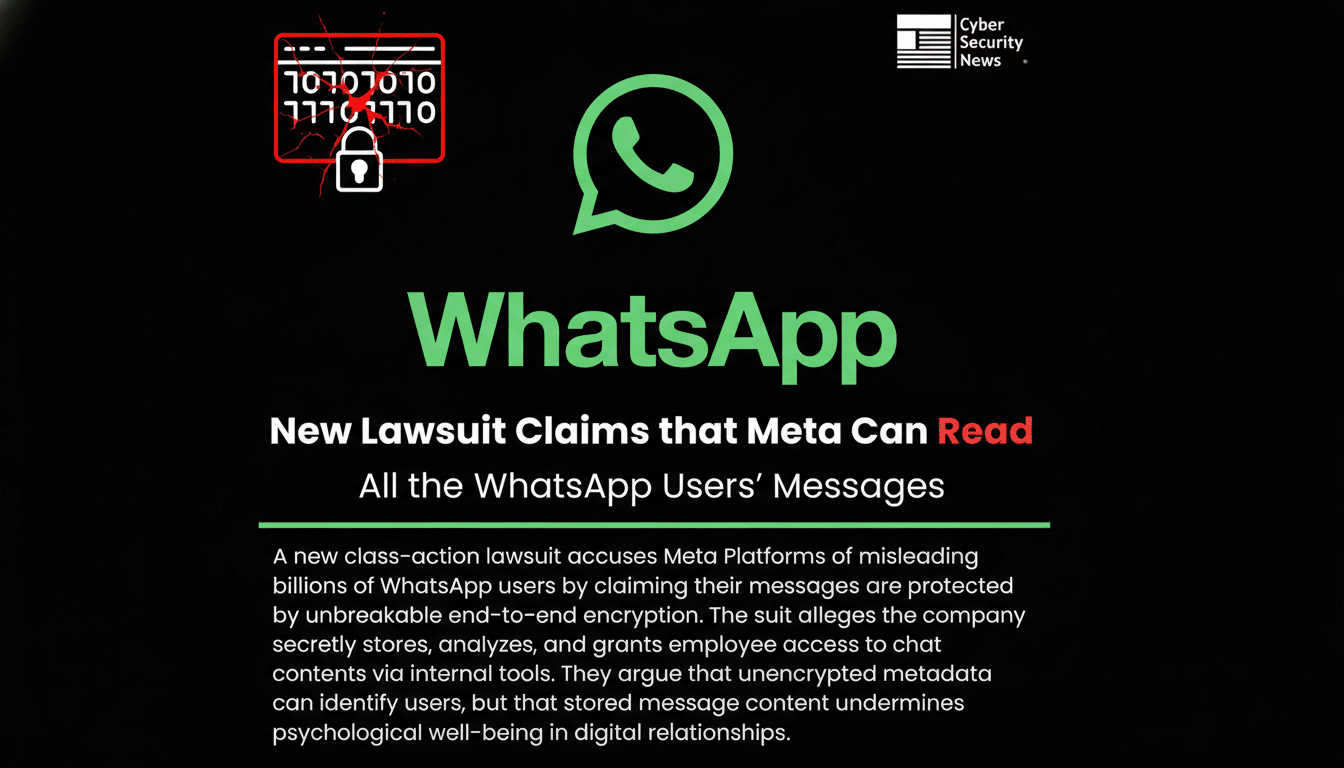
What the lawsuit alleges about WhatsApp encryption access
The complaint argues that Meta’s public statements create a false sense of security, asserting the company can access “virtually all” user communications. Plaintiffs from multiple countries—including Australia, Brazil, India, Mexico, and South Africa—say internal sources reveal practices that contradict the platform’s privacy messaging.
At stake is whether WhatsApp’s implementation of end-to-end encryption leaves undisclosed pathways for access. The filing suggests a gap between marketing claims and technical reality, raising the possibility of undisclosed data handling or exceptional-access capabilities.
Meta’s Response And The Encryption Reality
Meta has called the lawsuit baseless, reiterating that WhatsApp uses the Signal protocol, one of the most scrutinized encryption systems in consumer messaging. Under this model, messages are encrypted on the sender’s device and decrypted only on the recipient’s device, with keys that are not supposed to be accessible to the service provider.
Security researchers and organizations such as the Electronic Frontier Foundation have long regarded the Signal protocol as robust when implemented correctly. If WhatsApp could routinely read messages, it would imply either a break in the protocol, a flaw in implementation, or access occurring outside the encryption envelope—such as on the device itself or through backups.
WhatsApp says more than 2 billion people use the service worldwide. That scale makes any claim of systemic access particularly consequential, and also means any genuine backdoor would likely be detected by the security community over time.
Where Access Could Happen in Practice Despite Encryption
Even with strong encryption, there are scenarios where message content can legitimately reach WhatsApp’s servers. The most common is user reports: when someone reports a message, WhatsApp receives the recent messages in that chat so moderators can review potential abuse. The company discloses this mechanism in its help materials, but critics say many users don’t realize how it works.
Backups are another wrinkle. Historically, cloud backups stored with platform providers could undermine encryption if not protected end-to-end. WhatsApp later introduced end-to-end encrypted backups as an opt-in feature. Users who do not enable that option may leave content exposed to lawful access through cloud providers.
Business messaging adds complexity. Messages to certain business accounts can be processed by third-party providers or hosted through Meta’s cloud-based APIs, with disclosures indicating that businesses may manage and store those chats. While encryption is used in transit, ultimate storage and processing by external systems can change who can read content.
There are also non-content vectors. WhatsApp collects metadata—such as account information, device signals, and engagement patterns—to combat spam and fraud. While metadata is not message text, large-scale analysis can reveal behavior patterns. Privacy advocates have long argued that metadata deserves protections akin to content.
What Regulators And Courts Will Scrutinize
In litigation, discovery could probe internal documents, engineering designs, logging practices, and how moderation systems interact with encrypted content. The central questions: Are there undisclosed ways to access messages, and do public statements accurately describe the product as used in the real world?
Regulators in the United States and Europe have previously pressed Meta on privacy disclosures and transparency. An existing order from the U.S. Federal Trade Commission requires rigorous privacy safeguards across Meta’s products, and Ireland’s Data Protection Commission has repeatedly examined how WhatsApp communicates data practices to users. Any mismatch between claims and operations could trigger further scrutiny.
How Users Can Protect Their WhatsApp Chats Right Now
Users concerned about confidentiality can take several steps today.
- Enable end-to-end encrypted backups and use a strong passphrase for backup keys.
- Verify security codes with frequent contacts to ensure you are communicating with the intended device keys.
- Be mindful when reporting messages, since doing so shares recent chat content with WhatsApp moderators.
- For business chats, check the banner that indicates how the business processes messages and whether a third party might store them.
- Keep devices updated, since device compromise is a universal weak point: if malware controls the endpoint, it can read messages before or after encryption.
The bigger picture for messaging privacy and trust
End-to-end encryption remains a cornerstone of digital security, protecting journalists, activists, businesses, and everyday users alike. The lawsuit targets not the idea of encryption itself, but whether WhatsApp’s real-world practices and disclosures live up to its promises. With billions relying on the app, the outcome will resonate well beyond a single platform, shaping expectations for transparency and trust across the messaging ecosystem.
