


A rare one just came into secure storage. Encrypted cloud service Internxt is also selling a lifetime subscription to its 100TB plan for just $974.97 (a staggering 90% discount from the list price of $9,900). For makers, indie businesses and everyone facing down ballooning archives, the math and feature set make this one worth a close look.
Why This Deal Matters for Long-Term Cloud Costs
Cloud bills can increase rapidly when you rent space month after month. A one-time payment for 100TB — enough to last most people years of backing up 4K video, RAW photo libraries, or corporate backups — can come in at less than you would spend subscribing to smaller tiers indefinitely. By IDC’s predictions, the global datasphere will surpass 175 zettabytes later this decade, and ordinary users are increasingly feeling it in their own workflows as cameras, phones and collaborative processes create larger and larger files.
- Why This Deal Matters for Long-Term Cloud Costs
- What 100TB of Lifetime Cloud Storage Really Gets You
- Security Stack Focused on Privacy and Zero Knowledge
- How It Works Day to Day with Internxt Cloud Storage
- Real-World Cost Comparison Against Subscription Plans
- Who Stands to Benefit from a 100TB Lifetime Plan
- Practical Caveats to Weigh with Lifetime Cloud Deals
- Bottom Line on Internxt’s 100TB Lifetime Cloud Offer
What 100TB of Lifetime Cloud Storage Really Gets You
For context, 100TB could accommodate about 20,000 high-definition movies, approximately 20 million songs, or tens of millions of high-resolution photos, depending on the degree of compression and formats. A wedding photographer shooting a 50-session year in 45MP RAW could churn through 2–5TB of that storage without the added burden of video; documentary teams outputting in 4K ProRes or beyond are likely blowing past that number in weeks. With 100TB, you’re never in the position of juggling external drives, or pruning archives to free space for new work.
Security Stack Focused on Privacy and Zero Knowledge
Internxt’s pitch is security-first. With end-to-end encryption and a zero-knowledge process, files are encrypted on your device, meaning the provider can never read your data. Dithering restricts exposure in the event of a breach as well, since the service can’t decrypt your content server-side.
The company also advertises the use of post-quantum cryptography, a set of algorithms designed to resist future quantum attacks. The strategy is consistent with work being coordinated by the National Institute of Standards and Technology (NIST) in the US, which has identified candidates for new cryptographic standards to advance the industry beyond classical schemes. Forward-looking, the rise of quantum has certain elements preparing now, with the assumption that they will eventually need to seamlessly transport critical and valuable archives.
Internxt says its systems are GDPR-compliant and have been the subject of a third-party security audit by European cybersecurity firm Securitum. For businesses that have to operate under strict compliance regimes, or for individuals who want the security blanket of the most private thing yet, those checks bulk up privacy posture.
How It Works Day to Day with Internxt Cloud Storage
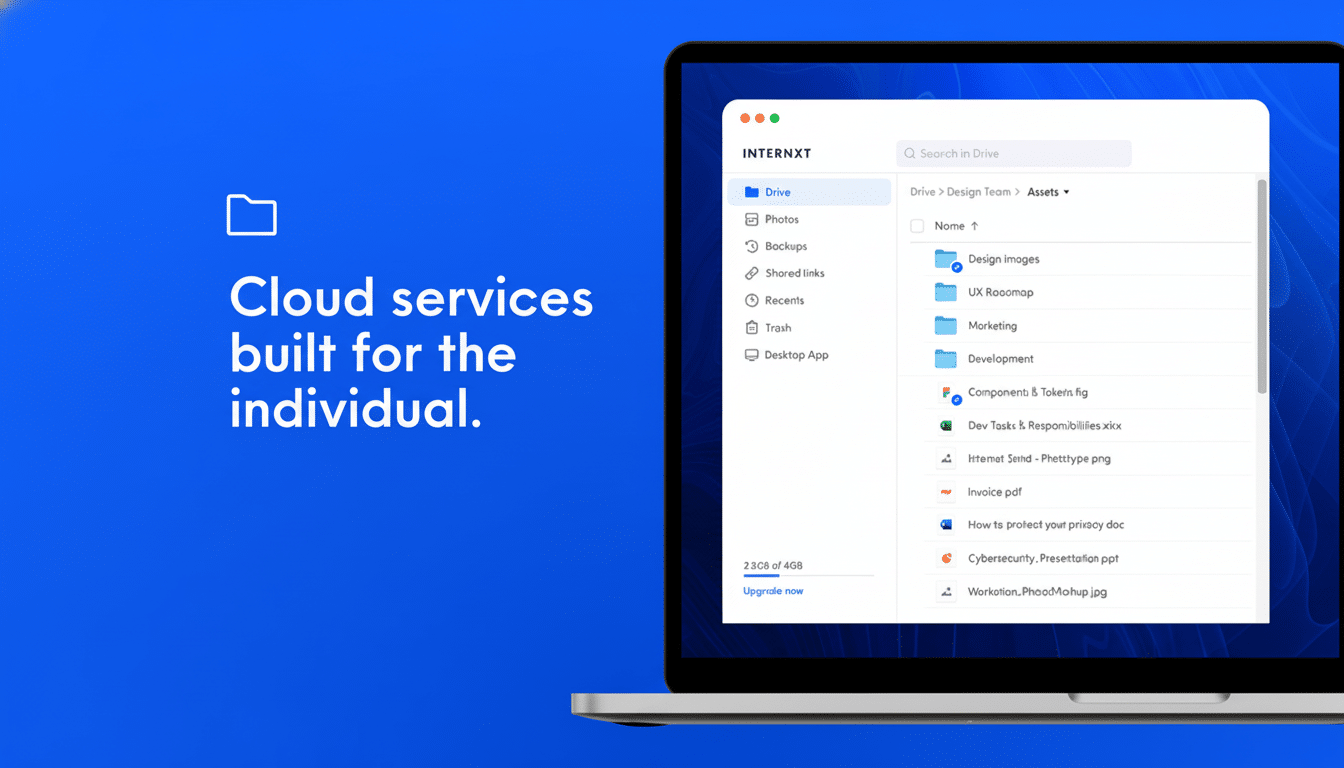
But despite the underpinning layers of security, the service functions in practice as a cloud drive, one that just happens to demand biometrics before letting you access your files. You can use Windows, macOS, Linux, Android and iOS for uploading, syncing and sharing your files (or do it through the web app). With encrypted sharing links, transfer massive files without worrying about email attachment limits or shipping physical media. In terms of performance, transfers are intended to max out your available connection, so bottlenecks often don’t arise from the platform but rather your ISP.
Real-World Cost Comparison Against Subscription Plans
Just think about how that compares with the consumer clouds you’re used to. A 20TB offering on the more popular services seems to cost in the vicinity of $100 per month or a little over $1,000 annually — you’d surpass this buy-up-front cost in just five years with that single tier and still be limited to one-fifth as much storage. Business tiers whose storage capacity gets into the double-digit terabytes typically impose per-user charges that grow with a team’s size. For backup-centric vendors, “unlimited” will be per computer and isn’t going to cut it with 100TB of mixed workloads.
That’s the basic appeal of a lifetime vault: prepay once, extirpate recurring overhead, and maintain headroom to scale projects without perpetually updating plans.
Who Stands to Benefit from a 100TB Lifetime Plan
Video producers, drone fliers, VFX teams shooting several terabytes will love predictable pricing and E2E-encrypted sharing. Photographers and archivists can bring some organization to sprawling catalogs. At a small business, you can be in control of centralizing endpoint and server backups and not worry about metering anxiety. Even a family who’s digitizing decades of home movies and photos gets enough space on one portal to future-proof their memories, for once.
Practical Caveats to Weigh with Lifetime Cloud Deals
Like any lifetime offering, long-term viability is a factor. “Lifetime” is, of course, lifetime for the product, not you, and long-term value hinges on the durability and after-sales service terms of the provider. Look at fair-use policies, bandwidth rules for large shares and restore workflows to make sure they fit what you need. Keep in mind, too, that end-to-end encryption adds even more responsibility for you — protect recovery keys and turn on strong authentication, or your data might be unrecoverable by design.
Bottom Line on Internxt’s 100TB Lifetime Cloud Offer
A 100TB encrypted, zero-knowledge cloud that will be yours for you guessed it less than a thousand bucks is an extraordinary proposition in terms of capacity, privacy and price.
If you’ve graduated beyond consumer tiers or want to clamp down on variable storage costs for a good long while, this Internxt deal is attractive — as long as you’re comfortable with lifetime’s pros and cons and take the time to research security and service terms relevant to your use case. As always, availability and pricing can change, so review before you click to buy.
