


The fruits of Intel’s Panther Lake generation on mobile are here at last, and the message is clear: Core Ultra Series 3 is made for AI-era laptops. Fabbed on the company’s cutting-edge 18A process, the new chips refresh the CPU (with attached integrated graphics) and NPU at once — for faster perf, longer battery life, and more powerful iGPU gaming in machines ranging from mid-tier to premium.
What’s New Under The Hood of Intel’s Panther Lake
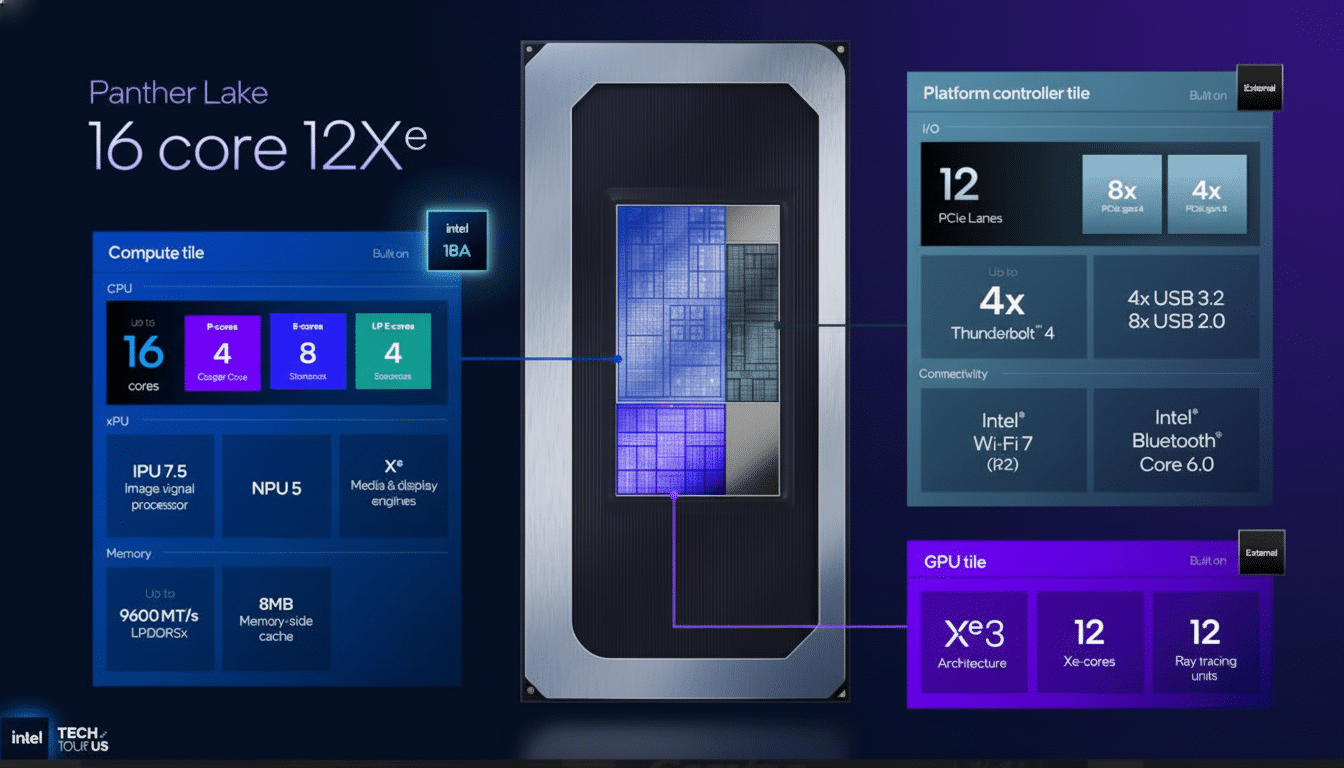
Panther Lake steps up to Intel’s 18A node, the chipmaker’s first broad “2nm-class” mobile platform. And beyond the manufacturing leap, Intel also alters the hybrid design here with a concoction that stitches together up to four Performance cores (P-cores), eight Efficient cores (E-cores), and four Low-Power Efficient cores (LPE-cores). The goal: more instructions per clock, at less power, with the LPE cluster handling background tasks in order to maintain thermals and battery drain.
- What’s New Under The Hood of Intel’s Panther Lake
- CPU Roster and Performance Claims for Panther Lake
- Integrated graphics take a huge step with Xe3 Battlemage
- AI acceleration blazes to a combined peak of 170 TOPS
- Connectivity and I/O trade-offs across Panther Lake SKUs
- Choosing the right SKU for your Panther Lake laptop
- What early systems built on Panther Lake will look like
CPU Roster and Performance Claims for Panther Lake
Leading the stack is the flagship Core Ultra X9 388H with a total of 16 cores and up to a full turbo frequency of 5.1 GHz, combined with a large 18 MB of L3 cache.
On paper, that is somewhat different than last gen’s peak mobile bin, which had more of the P-cores and a higher frequency. Intel pushes back against us-versus-them spec-sheet comparisons with bigger promises: better than 70% improved gaming performance over the Core Ultra 9 285H was the claim, versus more than a 60% improvement in multithreaded throughput of the Core Ultra 9 288V, facilitated via architectural tweaking and streamlined scheduling for enlarged on-die accelerators.
The initial stack dynamics are simple enough: the “X” badge indicates a quad-core, 8-thread CPU, and while it’s aimed at iGPU-first laptops, non-X parts swap out that larger graphics engine for platform I/O that better fits systems with dGPUs.
Integrated graphics take a huge step with Xe3 Battlemage
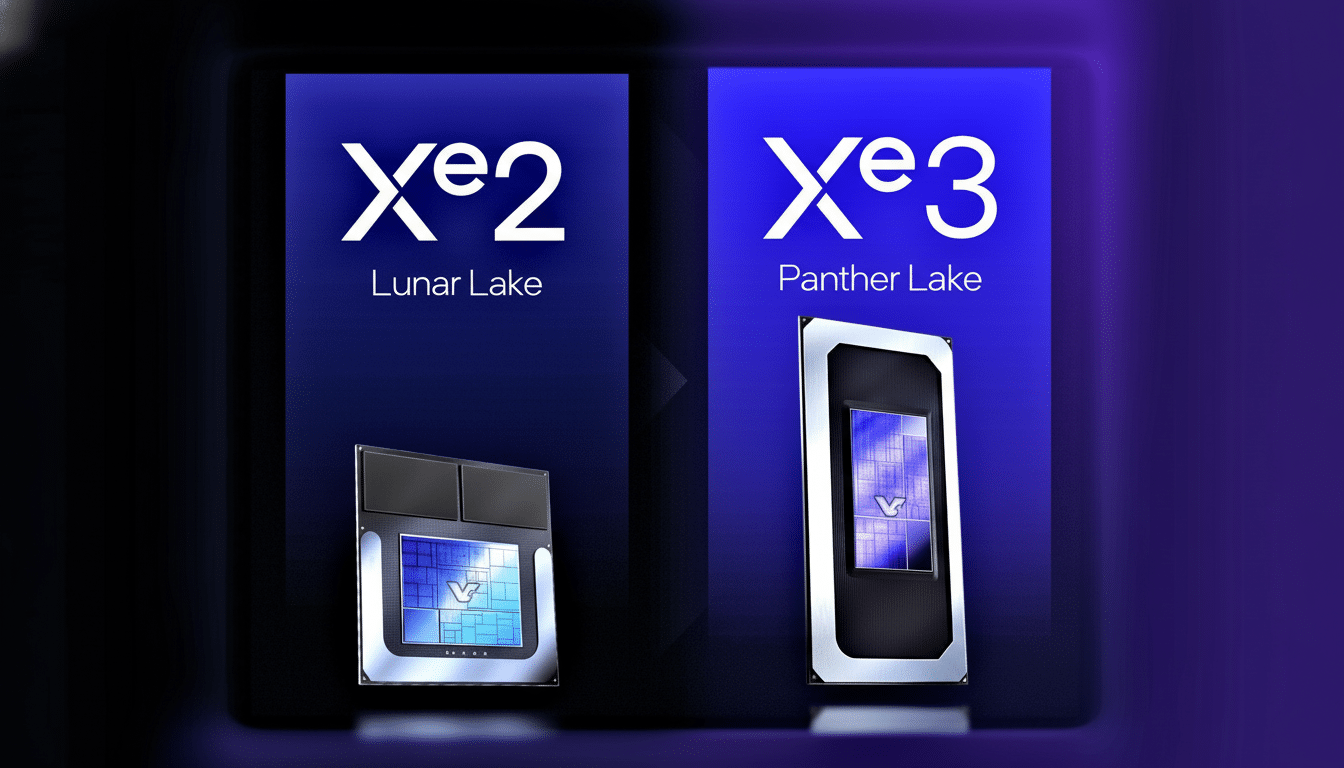
Panther Lake introduces Xe3 graphics (based on the Arc Battlemage architecture). At the top of its iGPU tiering, Intel steps up the design to 12 Xe cores — a 50% increase over the prior generation — and is providing the company’s most credible claim yet for playable 1080p on integrated graphics in thin-and-light notebooks.
Model names do a pretty good job decoding the graphics story for you. Arc-branded iGPUs are featured in X-class parts (the Core Ultra X9 388H and Core Ultra X7 368H being two examples), though there is a notable departure further down the stack — for example the Core Ultra 5 338H: here, users get an Arc B370 engine with only 10 Xe cores. Intel is also introducing XeSS 3, a new upscaling and frame-generation technique that’s cut from the same multi-frame cloth you see in AMD FSR and Nvidia DLSS, leveraging iGPUs’ AI blocks to help raise frame rates.
Context is important: in UL’s Procyon AI benchmark, the new Intel Arc B580 desktop GPU battles closely with Nvidia’s mainstream RTX 5060 on AI throughput — at similar price points. That track record bodes well for the larger Xe3 iGPU blocks coming to these mobile chips.
AI acceleration blazes to a combined peak of 170 TOPS
With the specialized NPU 5 in Core Ultra Series 3, it brings up to 50 TOPS for sustained, low-power, on-device AI. Combine that with up to 120 TOPS handled by the Arc Xe3 iGPU and total platform AI throughput climbs as far as 170 TOPS when both engines are running — leaving room for CPU vector units if other pathways become bottlenecked.
That means laptops can process voice assistants, live transcription, and background object removal in video — as well as generative imaging tasks such as AI-driven image creation — without needing to fall back on the cloud, which helps protect privacy and reduces latency, all while running fans quietly.
Connectivity and I/O trade-offs across Panther Lake SKUs
Wi-Fi 7 R2 readiness and Bluetooth 6.0 are among the platform features, with some Core Ultra 7 and Core Ultra 9 configurations getting Thunderbolt 5 as well. Storage and GPU options differ by SKU. Core Ultra X9 388H has the fastest Arc B390 iGPU (12 Xe3 cores) but is limited to a controller with just half PCIe lanes, four of them being 5.0 and the other eight at market-leading 4.0 — enough for fast storage and mid-tier bandwidth dGPU links.
For creators and gamers looking for a discrete GPU, there’s the Core Ultra 9 386H, which dials back the iGPU to just four Xe cores while unlocking 12 PCIe 5.0 lanes along with 8 PCIe 4.0 lanes.
That layout is a closer match for high-end dGPUs, and provides fatter pipes for sustained throughput.
Choosing the right SKU for your Panther Lake laptop
Up at the top of the stack, Core Ultra X7 368H looks quite similar to the X9 388H with a very small clock delta. Core Ultra 7 366H, on the other hand, is a copy of the Core Ultra 9 386H with almost the same core counts and NPU goal (49 TOPS vs. 50). These twins enable OEM traceability by GPU, thermals, and cost without a platform rewrite.
This pricing split is something for purchasers in the midrange to keep an eye on in the Core Ultra 5. The 338H and the 336H, both H-class, bring 12 CPU cores, with the former also including the Arc B370 iGPU (10 Xe cores). Lower-end non-H Ultra 5 parts, such as the 332 and 322, drop to just eight cores and a mere two Xe GPU cores, which are more appropriate toward budget designs or in systems that rely on an entry dGPU for graphics.
Finally, Core Ultra 7 chips with no H suffix (365, 355) feature an eight-core design tuned for mainstream ultraportables that focus on efficiency and thin-and-light thermals as opposed to straight-up parallel performance.
What early systems built on Panther Lake will look like
OEMs are queuing up designs that stretch from Arc-only thin-and-lights bankrolling XeSS 3’s uber-sampling to let you game at 1080p, creator laptops wedging the 386H against discrete GPUs over wider PCIe links, and business-class machines that lean on the NPU for always-on AI features.
Pricing will vary depending on vendor configurations around displays, storage, and if they go with an Arc-only or a dGPU configuration.
There are fewer clocks in play here than you might expect, but a lot more balance. The recipe of Panther Lake — smarter cores, a significantly larger iGPU on some SKUs, and impactful on-die AI — propels Intel’s mobile stack into a new category of “AI PC” without ignoring gamers and creatives. If Intel’s performance benchmarks ring true, Panther Lake will be the company’s most interesting mobile reset in quite some time.
