


Enterprises have raced to pilot generative AI, only to discover that proofs of concept don’t easily translate into production. IBM is stepping into that gap with Enterprise Advantage, a combined platform-and-services offering designed to connect scattered AI initiatives, orchestrate workflows, and scale “agentic” applications across existing environments—without ripping out legacy systems.
The pilot trap and why it persists in enterprises
Most organizations have multiple AI experiments running, often inside separate functions and tools. That fragmentation piles up “enterprise debt.”
- Technical debt grows when quick fixes bypass architecture.
- Skills debt emerges because there aren’t enough practitioners who can operationalize AI.
- Data debt builds as information remains siloed or poorly governed.
- Process debt appears when manual steps and exceptions drain value from otherwise smart systems.
Analyst firms have repeatedly warned about this pattern. Gartner has noted that many AI programs stall between prototype and production, while McKinsey’s State of AI research points to data quality, governance, and integration as persistent hurdles to scaling. The result: organizations have promising models and pilots, but struggle to embed them into compliant, measurable, end-to-end workflows.
What Enterprise Advantage delivers at scale
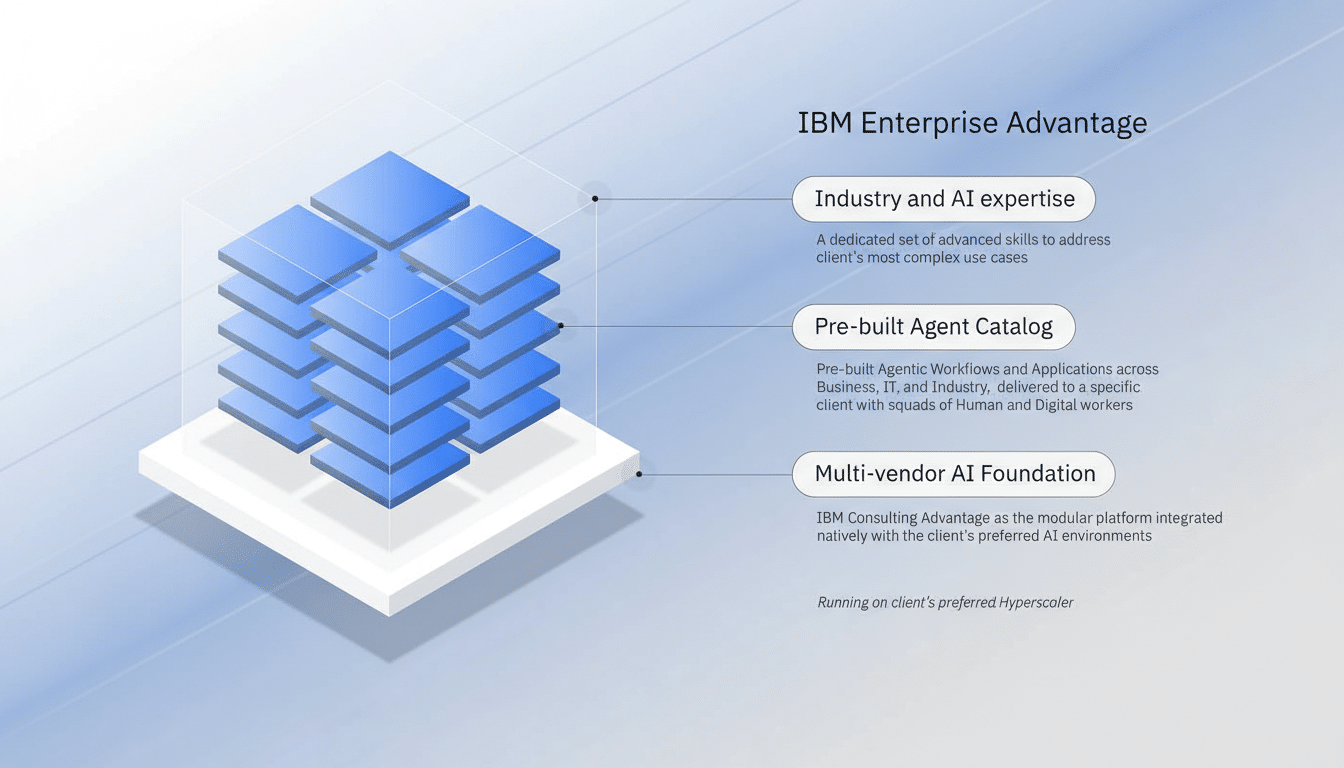
IBM Enterprise Advantage marries a governed AI delivery platform with consulting, playbooks, and pre-built components. It acts as a Services-as-Software layer that sits on top of existing cloud and data estates, connecting to AWS, Microsoft Azure, Google Cloud, and IBM watsonx, as well as both open and closed source models. The pitch is simple: keep your stack, but add an orchestration fabric that standardizes development, security, and operations for AI at scale.
The package includes a catalog of agentic applications for industry and domain workflows—think:
- Customer service automation
- Regulatory compliance
- Document-heavy processes
- Supply chain optimization
- Claims management
Beyond the software, IBM brings delivery accelerators, governance templates, and training to tackle the skills gap. In practice, that means redesigning workflows where needed, integrating with existing systems of record, and enforcing enterprise controls across data, prompts, and outputs.
Crucially, it emphasizes measurement. By tying AI agents to specific processes, data sources, and policies, leaders can track outcomes such as cycle-time reduction, cost-to-serve, and risk mitigation—moving beyond model accuracy metrics to business KPIs.
Why Services-as-Software is gaining momentum
IBM frames Enterprise Advantage as part of a broader shift toward “Services-as-Software,” where delivery is automated, composable, and governed like software rather than bespoke consulting alone. The company pegs the market opportunity at roughly $1.5 trillion over the coming decade as enterprises seek repeatable building blocks rather than one-off projects.
This aligns with a growing industry view that AI adoption must be industrialized. Instead of stitching tools together per project, organizations want curated patterns, embedded controls, and lifecycle management that cover data pipelines, model selection, monitoring, cost management, and human-in-the-loop oversight. Forrester and IDC have both highlighted the need for platforms that blend integration, governance, and reusable components to accelerate time to value.
Early results and use cases from IBM clients
IBM reports 150 client installations to date. One early adopter, a global manufacturer, used the approach to identify high-value use cases, prototype them quickly, and align leadership around a common AI roadmap. The company is now deploying AI assistants across multiple technologies in a governed environment, creating a foundation for future expansion rather than isolated wins.
Typical entry points include:
- Customer support copilots that elevate containment rates and first-contact resolution
- Compliance workflows that automate evidence collection and policy checks
- Document-centric processes such as contract review or claims triage
In each case, the focus is on stitching together data, models, and workflows with consistent controls and audit trails.
Why this matters for CIOs leading AI adoption
CIOs under pressure to “do more AI” often face a dilemma: either bolt on another tool and risk more sprawl, or pause and redesign the stack. Enterprise Advantage argues for a third path—apply a governance and orchestration layer that makes the current stack AI-ready and scalable. That can reduce time-to-value while addressing the root causes of stalled pilots: data fragmentation, process gaps, and insufficient guardrails.
There are trade-offs to weigh. Success depends on change management, data quality, and process redesign—not just model selection. Vendor lock-in is another consideration, though IBM stresses cross-cloud deployment and model choice. Still, for mid-market and large enterprises with complex estates and regulatory obligations, the blend of platform, accelerators, and expertise may be the pragmatic route from pilots to production outcomes.
The bottom line: if your AI investments are stuck in pilot mode, a Services-as-Software approach like IBM’s could provide the connective tissue—governance, reusable components, and workflow integration—to scale responsibly and measurably, without tearing up what already works.
