


Reverse rotating proxies have become a backbone tool for enterprises running bulk web automation, data scraping, and multi-account workflows. Dozens of providers now offer them, with significant differences in pool size, IP quality, and pricing. Here’s how to evaluate the market and find the provider that fits your actual use case.
What are reverse rotating proxies
Reverse rotating proxies are rotating proxies (those that distribute requests across the large IP pool) that work on server side, so the client connects not to the original server’s IP, but via the proxy IPs. They are widely used for cybersecurity, large-scale enterprise web automation, multi-account management, and data collection.

How do reverse rotating proxies work
When you send a request through a reverse rotating proxy, it passes through a single entry point (typically one host and port), while the service automatically assigns a different IP address from its pool to each request or session. The destination server sees that IP, not your server’s real one, and each successive request appears to originate from a different user.
This means high-volume workflows can run without triggering per-IP rate limits or pattern-based bot detection. Here are term definitions:
Backconnect proxy: an alternative name for a reverse rotating proxy. Both terms refer to the same architecture: one gateway, many outbound IPs.
Per-request rotation: a new IP is assigned for every individual request. Best for large-scale scraping where each interaction must appear independent.
Sticky session: the same IP is held for a defined time window, typically from a few seconds to several minutes. Best for workflows that require session continuity, such as account logins or checkout flows.
Residential IP: an address assigned by a real ISP to a real household device. Reverse rotating proxies use large residential IP pools and appear legitimate to anti-bot systems.
What are the best reverse rotating proxies
The quality gap between proxy providers is significant and shows up quickly in blocked requests, CAPTCHAs, and failed automations. The best reverse rotating proxies combine a large and diverse IP pool with smart tooling around quality, rotation control, and geographic reach.
Key features to look for:
- Large residential IP pool: at minimum tens of millions of IPs to minimize reuse and blocking
- Flexible rotation modes: support for both per-request and sticky sessions with configurable intervals
- City-level geotargeting: country-level targeting is baseline; serious workflows require city, ISP, or ASN precision
- High success rate: a provider should deliver consistent request completion, not just a large headline pool number
- Low latency: providers should offer consistent performance across regions and under high loads
- IP quality check tools: built-in fraud score and blacklist status screening reduce the risk of assigning a flagged IP to a critical session
- API access: essential for automation pipelines without manual intervention
The providers that check the most of these boxes at a reasonable price point are where the shortlist should start.
Best reverse rotating proxy providers
Let’s now focus on specific reverse rotating proxy providers and see how each of them stands out.
CyberYozh
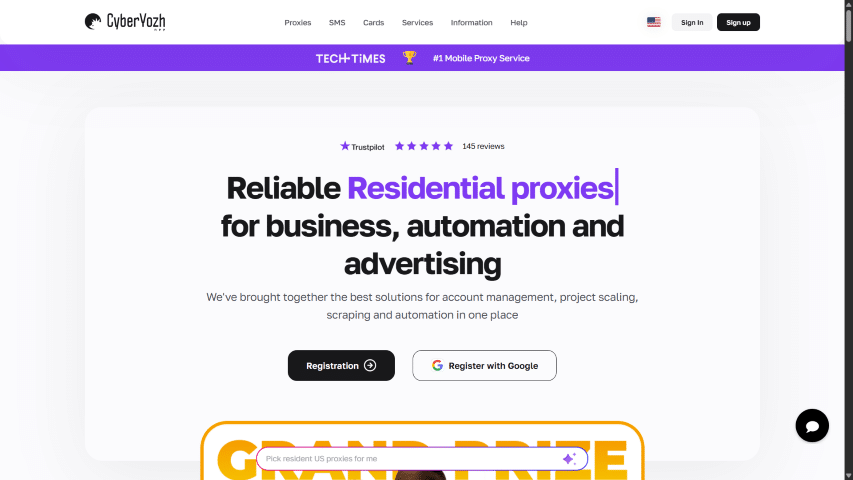
CyberYozh operates a 50M+ residential IP pool across 100+ countries, with rotating residential proxies starting from $0.9/GB.
What makes it distinctive is the broader ecosystem built around IP quality. The platform includes:
- IP Checker for fraud score, blacklist, and anonymity leak screening
- Virtual number service for local account verification (300+ supported platforms in 140+ countries)
- Virtual cards for local payment flows
- Number and card checker to verify the quality of those verification tools before use.
All of these tools can be automated via the CyberYozh API, making it a strong fit for teams running multi-step, quality-controlled automation workflows at scale.
Pool size: 50M+ residential IPs
Starting price: from $0.9/GB residential rotating
Success rate: 99.95% uptime confirmed
IPRoyal
IPRoyal offers a residential pool of 32–34 million ethically sourced IPs across 195+ countries, with rotating residential proxies starting at $7/GB pay-as-you-go, scaling down to $1.75/GB in bulk. It supports country, state, city, and ISP-level targeting in the base price and offers non-expiring traffic. Unused bandwidth rolls over rather than resetting monthly, which is a meaningful advantage for variable-volume users.
Pool size: 32M+ residential IPs
Starting price: $7/GB (PAYG)
Success rate: not publicly disclosed
NetNuts
NetNut sources its residential IPs directly from ISPs rather than end-user devices, providing a pool of 85M+ IPs across 195+ countries. This sourcing model delivers above-average stability and lower fraud scores. Rotating residential plans start at $3.53/GB on the 28 GB Starter plan.
Pool size: 85M+ residential IPs
Starting price: $3.53/GB (28 GB plan)
Success rate: fraud score 12–16 tested
SOAX
SOAX provides a pool of 155M residential IPs and adds a strong mobile proxy layer. It is particularly well-regarded for granular geotargeting and configurable rotation refresh rates for flexible session management. Residential rotating proxies start at $6.60/GB ($90/month for 25 GB).
Pool size: 155M+ residential IPs
Starting price: $6.60/GB ($90/month)
Success rate: 99.95% uptime stated
Decodo
Decodo runs a residential pool of 115M+ IPs with broad country, city, and ASN targeting options. It is consistently rated as a strong mid-market choice. Rotating residential proxies start at $3.75/GB on the 3 GB entry plan, dropping to $2.00/GB at volume.
Pool size: 115M+ residential IPs
Starting price: $3.75/GB (3 GB plan)
Success rate: not publicly disclosed
Bright Data
Bright Data operates the large residential proxy network at 200M+ IPs across 195+ countries, and is considered a strong choice for enterprise-grade scraping infrastructure. It offers deep geo and session control options, including ASN and carrier-level targeting. Residential proxies start at $2.50/GB on discounted subscription tiers or $10.50/GB pay-as-you-go.
Pool size: 200M+ residential IPs
Starting price: $2.50/GB (large-scale subscription) / $10.50/GB PAYG
Success rate: not publicly disclosed as a single figure
How to select the best reverse rotating proxy provider
The best reverse rotating proxy provider depends on your task, work specifics, and organization size. Explore the use cases below and select the provider that aligns with these
How to use reverse rotating proxies
Setting up a reverse rotating proxy is straightforward regardless of provider: you receive a host, port, username, and password, then plug those credentials into your scraping tool, proxy manager, or antidetect browser. The operational depth comes from how you configure session and rotation behavior for each specific task.
Typical use cases and what each requires:
- Cybersecurity and traffic filtering. Place a reverse proxy in front of backend servers to inspect and filter incoming requests, block volumetric attacks, and shield origin infrastructure. Services like Cloudflare operate on this same reverse-proxy principle at global scale.
- Bulk data scraping. Use per-request rotation across a large residential pool to bypass rate limits on high-volume collection runs. Pair with CAPTCHA handling tools for full pipeline automation.
- Multi-account and social media automation. Assign one sticky residential IP per account profile, matched to the account’s registered city. Combine with an antidetect browser to prevent fingerprint cross-linking.
- Ad verification and SERP monitoring. Use city-level geotargeting to confirm geo-targeted campaigns and local search rankings render correctly for specific regional audiences.
- Crypto and Web3 operations. Rotate residential IPs across wallet interactions, dApp testing, and RPC endpoint calls to avoid rate limits and bot flagging during high-competition events.
- Price and marketplace monitoring. Run continuous residential sessions from local target markets to capture geo-adjusted pricing, availability, and promotional content.
Why CyberYozh stands out: Checker and verification tools
Most reverse rotating proxy providers stop at IP delivery. CyberYozh extends the infrastructure with a suite of verification tools that directly reduce operational risk:
- IP Checker screens each address for fraud score, blacklist status, and anonymity leaks before it reaches an active session
- Virtual number service covers account registration and local verification across 300+ platforms
- Virtual card support handles local payment flows that require a trusted regional identity
All of these tools are accessible via the CyberYozh API, with full command documentation available at the API reference. This means teams can build fully automated pipelines that pull a fresh IP, check its fraud score, run a phone number through the number checker, and only proceed if both pass quality thresholds, without any manual review step.
Conclusion: Select the best reverse proxies
Reverse rotating proxies route traffic through rotating IP pools to make large-scale automation sustainable and protect server infrastructure from abuse. The right provider depends on your volume, use case, and need for quality controls. Evaluate pool size, rotation flexibility, geotargeting depth, and tooling, and then match those against your actual workflow requirements before committing.
FAQ about the best reverse rotating proxies
1. What is the difference between a reverse rotating proxy and a regular rotating proxy?
A reverse rotating proxy routes requests server-side through one gateway; a regular rotating proxy may operate client-side with a list of IPs.
2. Are backconnect proxies the same as reverse rotating proxies?
Yes — both terms describe the same architecture: one entry endpoint, many rotating outbound IPs.
3. What IP pool size do I need for large-scale scraping?
Most enterprise workflows need tens of millions of residential IPs to avoid reuse and bans at high request volumes.
4. What is a sticky session and when should I use it?
A sticky session holds the same IP for a set time window; use it when a task requires session continuity, like account logins.
5. Which proxy type has the highest trust score: residential, mobile, or datacenter?
Mobile IPs typically score highest; residential follows. Datacenter IPs carry the lowest trust and are most often flagged.
6. Can I check proxy IP quality before using it?
Yes. CyberYozh’s IP Checker evaluates fraud score, blacklist status, and anonymity leaks before any IP is assigned to a session.
7. How important is city-level geotargeting?
Essential for ad verification, local SERP monitoring, and account management where sessions must match a profile’s registered location.
8. What’s the cheapest residential rotating proxy option in 2026?
CyberYozh starts at $0.9/GB; IPRoyal reaches $1.75/GB in bulk, both competitive for variable-volume teams.
9. Do I need API access for automated proxy workflows?
Yes — API access enables programmatic IP rotation, quality checks, and session management without manual dashboard steps.
10. What is the forward vs. reverse proxy difference for web scraping?
A forward proxy handles client-side outbound traffic; a reverse/backconnect proxy routes requests server-side through a rotating IP pool — necessary for scraping at scale.

