


The Department of Health and Human Services has announced new steps intended to reduce reliance on animal testing in drug development, including FDA draft guidance on assessing products without animals and more than $150 million in reported NIH support for methods that more closely simulate human biology.
The actions, reported March 18 by STAT, could give drug companies a clearer route to propose evidence from laboratory systems and computational tools in some development programs. They do not end animal testing across the pharmaceutical industry, and the available reporting does not establish which products the new guidance covers or what evidence standards FDA will apply in individual cases.
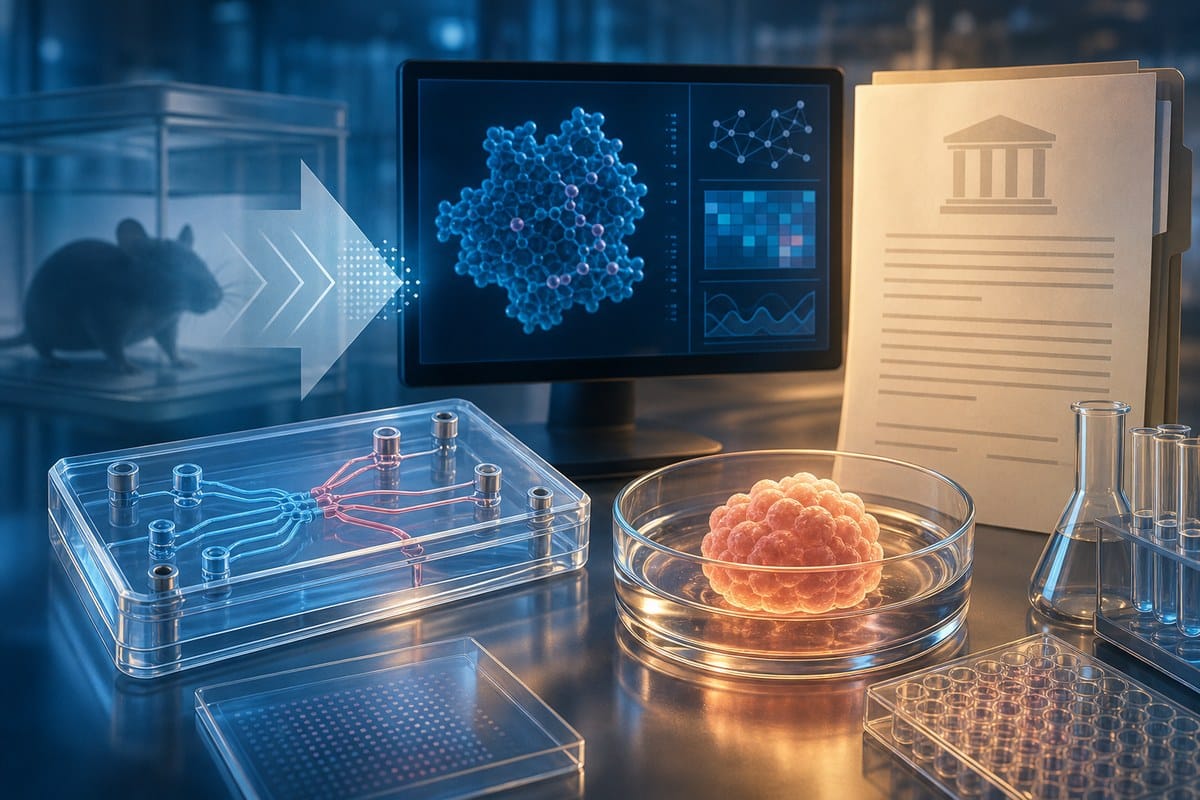
The announcement extends a gradual shift already underway at FDA. In May 2025, the agency said it would seek to reduce, refine or potentially replace some animal-testing requirements for monoclonal antibodies and other drugs. The agency’s language was more limited than a universal phaseout: it described a phased approach, with consultation and a planned pilot program for selected developers of monoclonal antibodies.
New measures build on FDA’s earlier policy
According to STAT, the newly reported FDA draft guidance is meant to help companies explore ways to assess a product’s safety and effectiveness without using animals. NIH’s reported support is directed at developing, validating and standardizing methods designed to reduce dependence on animal models.
The distinction between support for method development and completed regulatory acceptance is important. A funding opportunity can help institutions build and test new systems, while FDA guidance can clarify what sponsors should consider submitting. Neither step by itself means that a particular non-animal method will provide sufficient evidence for every drug, disease target or safety question.
No FDA or NIH document detailing the March measures was available with the announcement reported by STAT. As a result, key operational questions remain unresolved, including the types of products eligible for the approach, whether the guidance specifies particular tests, and how FDA will judge evidence generated by different methods. STAT reporter Lizzy Lawrence also described the announcement as combining FDA draft guidance with NIH funding to develop, validate and standardize alternatives in a March 18 post.
Those details will determine how far the policy reaches. Drug development involves several distinct questions, from whether a compound causes toxic effects to how it is absorbed, distributed and cleared by the body. A model that is useful for one question may not supply the needed evidence for another.
What non-animal evidence can include
In its May 28, 2025 announcement, the FDA identified several possible sources of non-animal evidence: artificial-intelligence-based computational toxicology models, laboratory-grown cell lines, organoids and organ-on-a-chip systems. It also pointed to real-world safety data from countries with comparable regulatory standards in some circumstances.
These approaches are often grouped under the term “new approach methodologies.” Organoids are small, simplified three-dimensional tissue structures grown from cells. Organ-on-a-chip devices use cells and fluid channels to mimic selected functions of an organ or the interaction between tissues. Computational models can draw on chemical structure, prior biological data and other information to estimate whether a compound may have harmful effects.
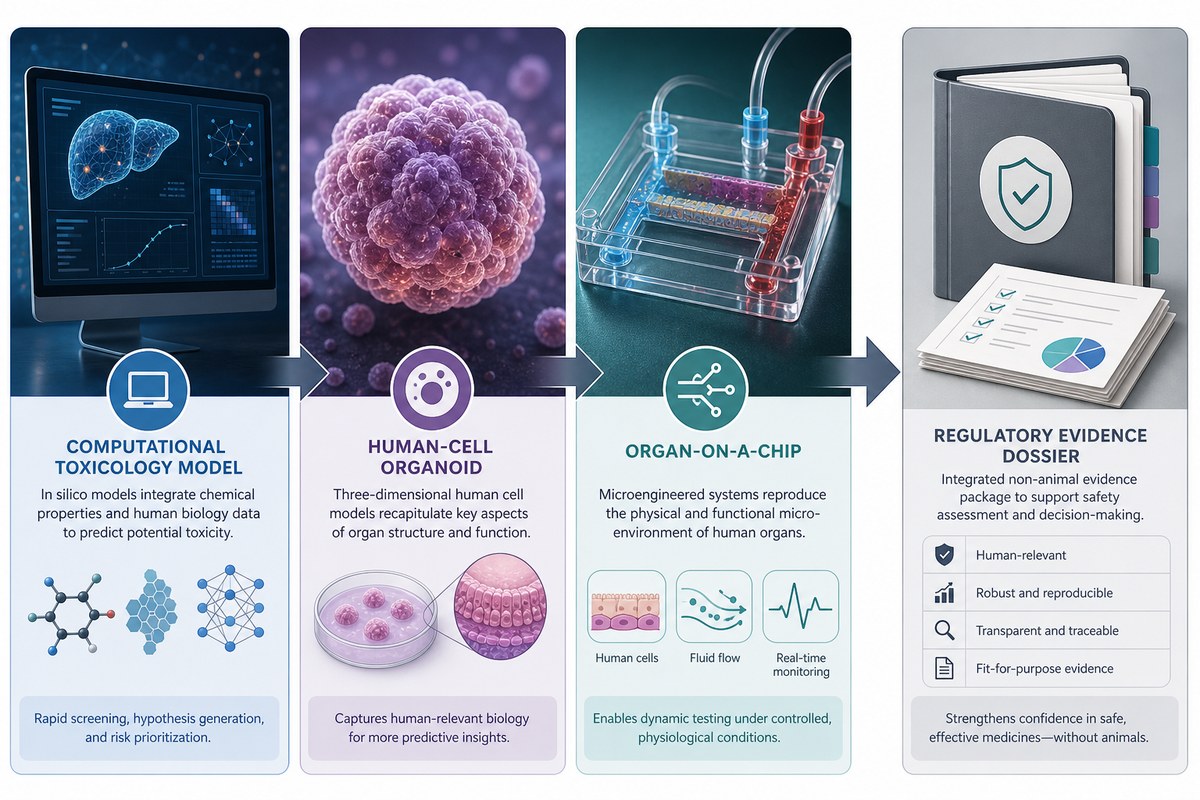
They are not interchangeable substitutes for an entire animal in every setting. Their value lies in modeling defined aspects of human biology, sometimes with human cells, rather than recreating all the interactions of a living organism. The new FDA guidance, once its text is available, should help clarify how the agency expects companies to connect results from such systems to particular regulatory decisions.
FDA’s 2025 policy focused initially on monoclonal antibodies, a class of biologic medicines engineered to bind specific targets. The agency said data from new approach methodologies would be encouraged in investigational new drug applications, the submissions companies generally make before beginning clinical trials in people. It also said it intended to launch a pilot program over the following year for selected monoclonal-antibody developers.
A phased change, not evidence of a completed replacement
The federal move responds in part to a longstanding scientific concern: animal studies do not always predict how people will respond to a medicine. FDA said in 2025 that more human-relevant methods could improve safety, speed evaluation and lower research-and-development costs. Those were prospective agency expectations, not results from a clinical trial or an assessment showing that alternatives have already outperformed animal studies across drug classes.
For developers, the practical question is likely to be whether FDA accepts a package of evidence that combines several tools: a computational prediction, cell-based testing, organoid or chip data, prior knowledge about a product and, where appropriate, human information. The answer may differ by product and by the risk being evaluated.
The timeline also helps separate the current development from the earlier one. FDA’s official announcement is dated May 28, 2025, although some accounts referenced an April 2025 policy move. The March 2026 actions reported by STAT represent a further step: draft guidance for companies and reported NIH support for the methods that may eventually be used more often in regulatory submissions.
Whether that step changes routine drug development will depend on the forthcoming guidance and on how quickly researchers can produce methods that regulators consider fit for specific uses. For now, the clearest documented federal commitment remains FDA’s 2025 formulation: to reduce, refine or potentially replace certain animal-testing expectations rather than eliminate them outright.

