
The Grok 4.7 release date is 2026-09-21, and the model shipped as xAI’s flagship text model at $2 in and $6 out per million tokens with a 500K-token context window. Grok 4.7 is carried here at list rate with no markup, so testing the model against its own release date costs the tokens it uses and nothing else.
Most pages that answer this question stop at the date. The date is correct and it is the least interesting part of the answer, because a release date does not sit alone on a calendar — it sits inside a window, and the window is what decides how much anybody knows about the model a month later.
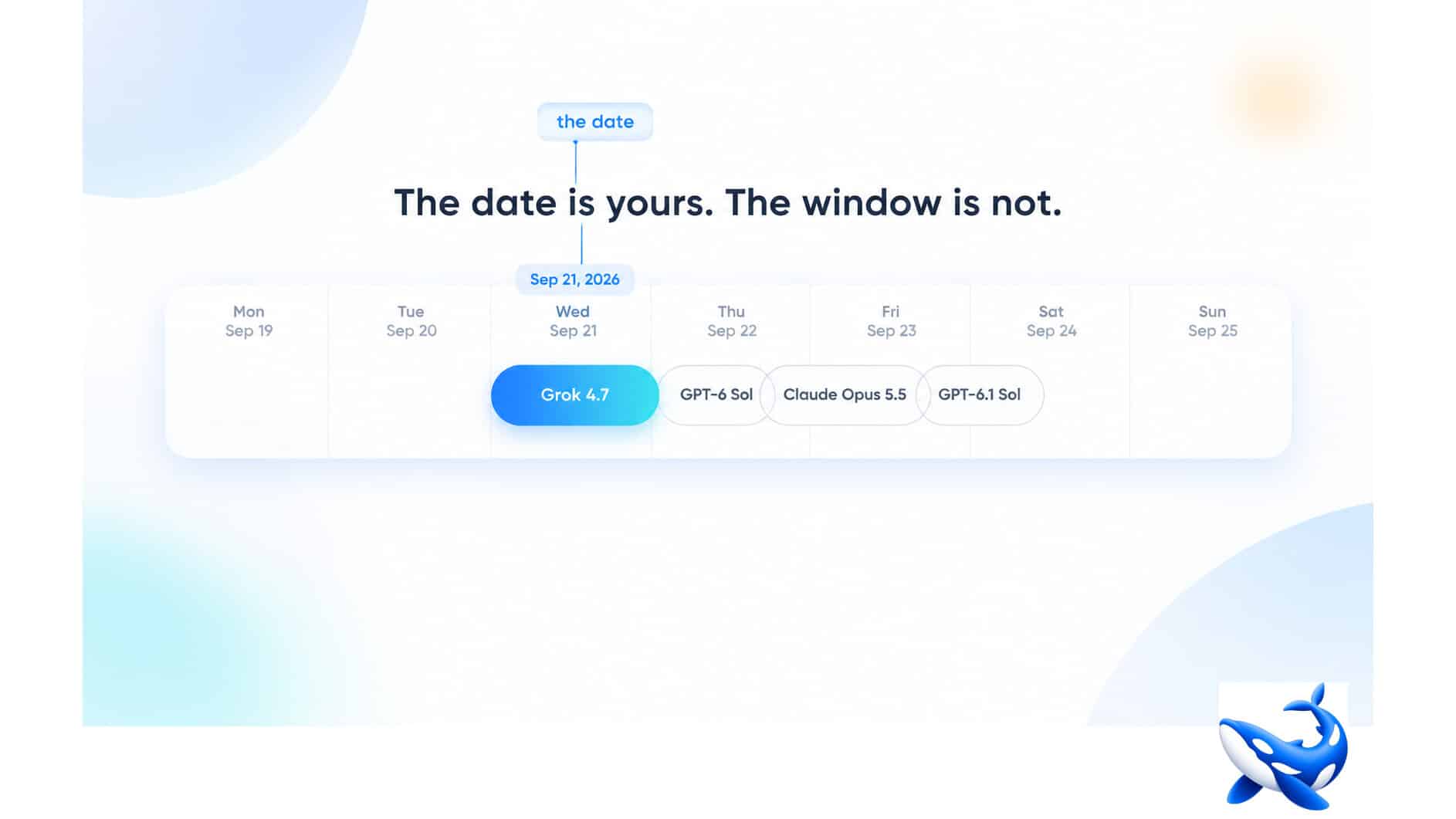
What actually shipped on September 21
A launch is rarely a single artifact. What arrived with Grok 4.7:
| what | detail |
| the model | a flagship text model, replacing Grok 4.6 in the line |
| the identifier | grok-4.7 — a version bump of an existing name, not a new name |
| the replacement chain | the older slug resolves to this one on the independent record |
| price | $2 per million input, $6 per million output |
| context | 500K tokens |
| a companion model | none named alongside it |
The identifier carries the most information in that table. A version bump means the release is a new rung on an existing ladder — integration guidance, tooling and eval harnesses mostly carry over — whereas a fresh product name usually means a repositioning and a fresh set of assumptions. Grok 4.7 is the first kind. That distinction survives every later reading of the model, unlike a price, which can change on a Tuesday.
There is one detail in the row above worth stating on its own: no companion model shipped with Grok 4.7. Some launches arrive in pairs or families — a small sibling, a vision variant, an older name being retired in the same announcement. This one did not, so everything a page dates to September 21 and attributes to a Grok model is this one model.
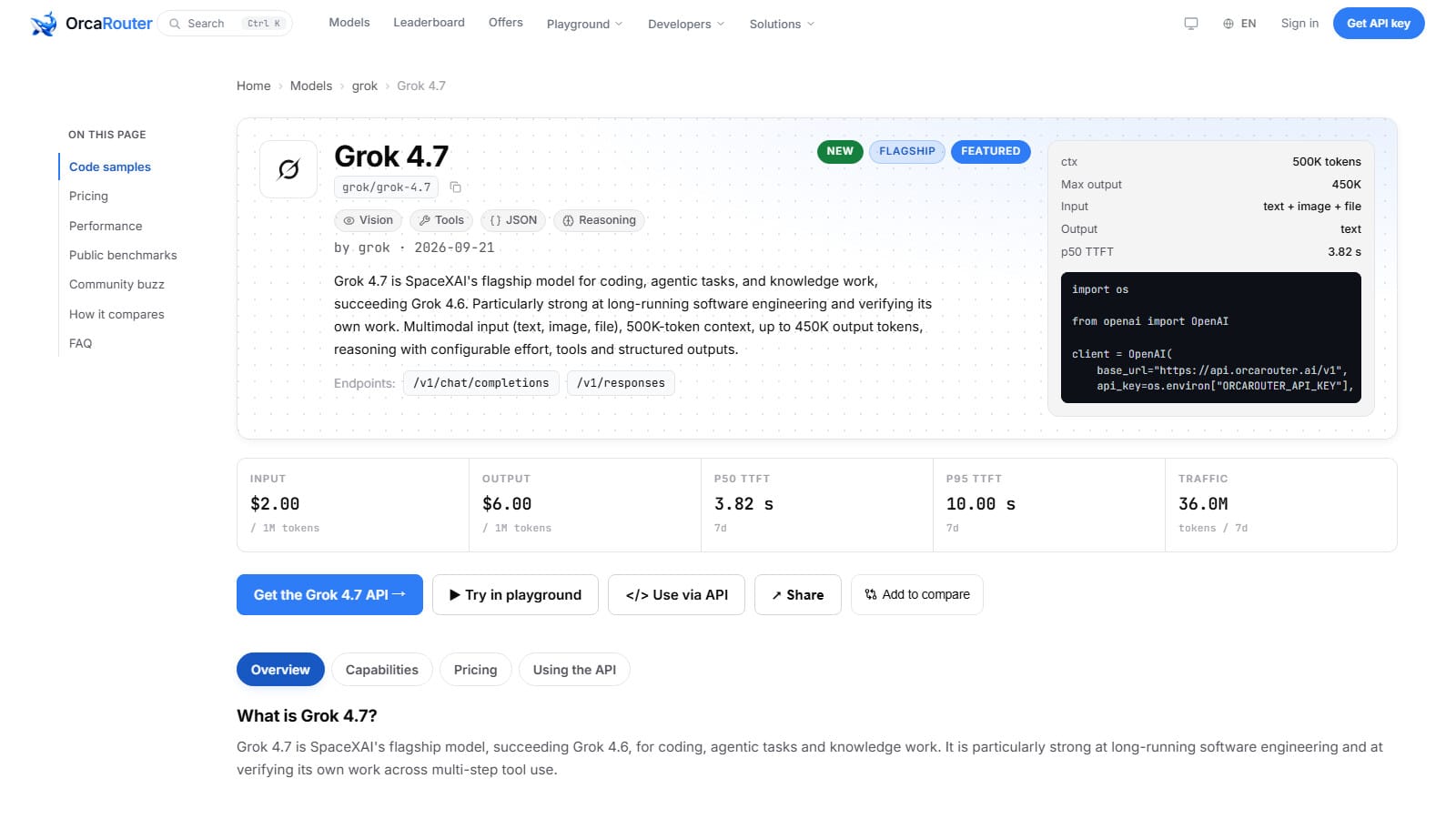
The window it landed in
Now widen the frame by two days in each direction. This is the part most pages do not show:
| date | what shipped |
| 2026-09-03 | GPT-6 Astra |
| 2026-09-21 | Grok 4.7 |
| 2026-09-22 | GPT-6 Sol, GPT-6 Luna, Claude Opus 5.5 |
| 2026-09-29 | GPT-6.1 Sol |
Grok 4.7 sits twenty-four hours ahead of a day that carried three model releases. That is not a curiosity; it is the mechanism behind the number every later comparison article has to work around.
Independent evaluators are not infinite. When three flagship models from two major labs arrive on the same day, measurement capacity and the attention that pays for it go to the day rather than to the two quiet days around it. A model released on a crowded date gets a thinner public record not because it is worse but because the week was full.
What a sixteen-day-old record contains
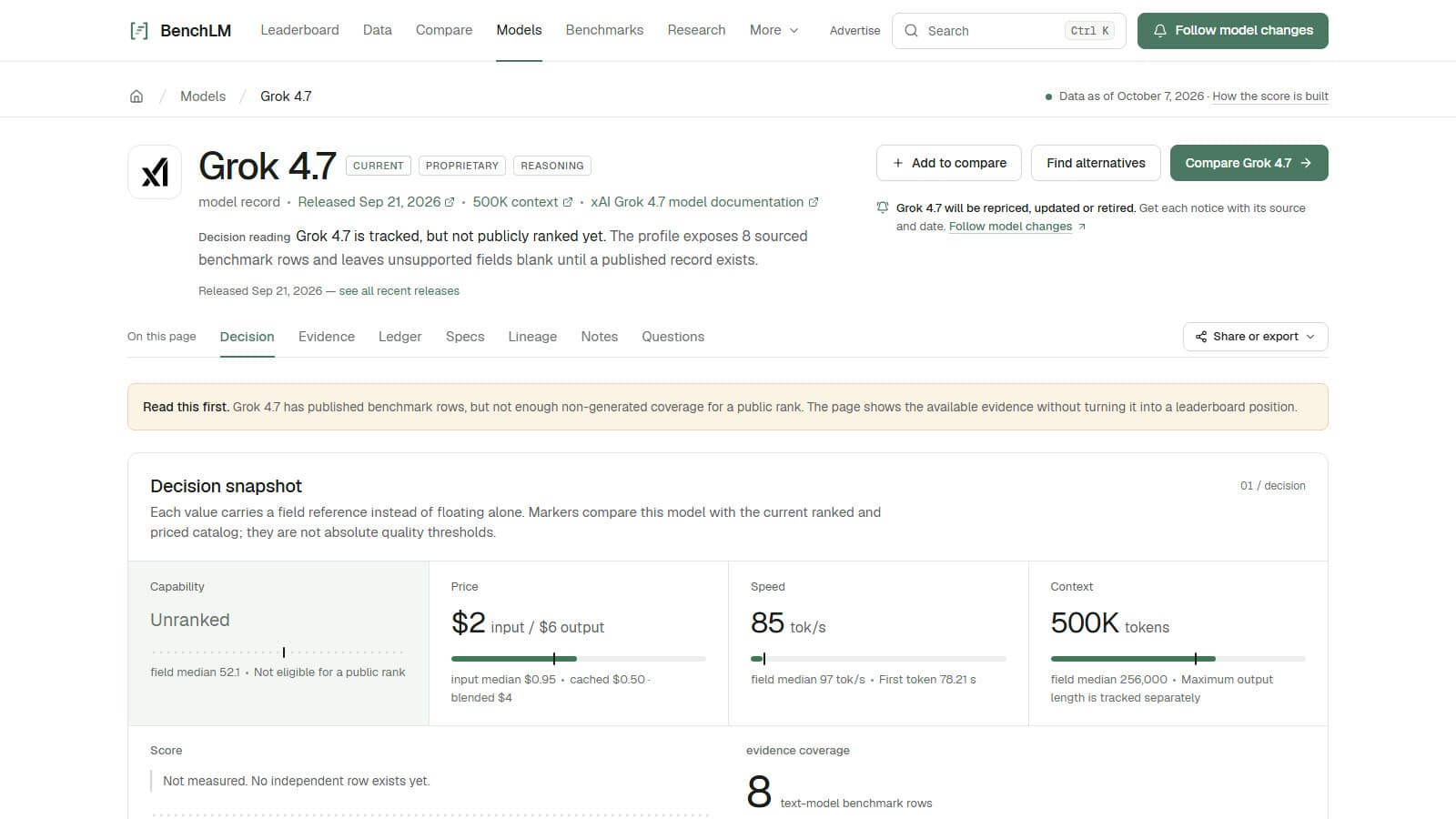
At the read date of 2026-10-07, Grok 4.7 was sixteen days old. Here is what had accumulated in that time, from benchlm.ai and Artificial Analysis, read 2026-10-07:
| measure | Grok 4.7 |
| individual result rows | 8 of 26 |
| categories covered | 3 of 8 |
| display score | none published |
| ranking eligibility | not eligible |
| Intelligence Index | 46.45 |
| reasoning effort measured at | Xhigh |
Two readings of that table, and they point the same way.
The first is that the record is small, and it is small in an uneven way. Eight rows across three categories is not a lightly-sampled version of a full record; it is a record that stops before most of the categories start. If the three categories it does cover are not the ones your workload lives in, the board’s numbers tell you very little about your decision.
The second is that no score is published at all. The page carries a result set and no display score, and marks the model ineligible for ranking. A model that has not been ranked is not a model that ranked badly — those are different facts, and the difference matters most when a comparison table needs a cell filled.
A note on the third row: Grok 4.7 is measured at the Xhigh reasoning setting on the independent harness, while the OpenAI and Anthropic models in this comparison are measured at Max, read 2026-10-07. Any table that puts those numbers side by side without the settings attached is comparing configurations rather than models.
The date the vendor’s page carries, and the date to trust
Two dates matter here and they are not the same one.
The ship date — 2026-09-21 — is the vendor’s own and it is fixed. It will read the same in a year.
The reading date — 2026-10-07 for every figure in this article — moves, because harnesses re-run and their numbers move with them. A benchmark figure has a shelf life shorter than the interval on which most pages get refreshed, and an undated score quoted from a September article is a September measurement wearing a current tense.
The retirement date does not exist yet, and its absence is itself a fact with a shelf life. Grok 4.7 is the current top of the line; a successor slug will appear on the record one day without an announcement, and when it does, every integration note written this month starts aging.
Three dates, then, and only one of them is permanent. That asymmetry is the whole reason this cluster attaches a read date to every figure it quotes.
How to date a Grok 4.7 claim
Four checks, ordered by how much time they save.
Read the identifier before the prose. grok-4.7 with a version dot means a successor rung. A page describing a launch as a new line when the identifier says otherwise has a positioning problem, not a factual one, and it will mislead you about how much of your integration carries over.
Check whether the claim is about the model or about the window. “Shipped the same week as three flagship releases” is a fact about the calendar, and it explains a thin record without saying anything about quality. Do not let the two get compressed into one sentence.
Attach the read date to every score. This is the habit that catches the most, because a model sixteen days old can have figures read on four different days, and the spread between them can exceed the difference between two models.
Ask which category the row is in. Eight rows across three of eight categories is a map of what has been measured, not a summary of the model. Before quoting one, find out whether the category is one your workload is in.
The takeaway
Grok 4.7 shipped on 2026-09-21 as xAI’s flagship text model — grok-4.7, a version bump on the existing line rather than a new name — at $2 in and $6 out per million tokens with a 500K-token context window, and with no companion model beside it on the same day.
The date matters less than the window around it. Grok 4.7 landed twenty-four hours before a day carrying three flagship releases, and on 2026-10-07, sixteen days later, its public record held 8 of 26 result rows across 3 of 8 categories, with no display score and no ranking eligibility. That is a schedule outcome as much as an evaluation one, and it is the reason this model’s figures come with a read date attached everywhere in this series — every score in this article is a reading from 2026-10-07, taken at the Xhigh setting the harness used.
Treat the ship date as the one fixed fact, the reading dates as moving ones, and the row count as a map rather than a verdict.
OrcaRouter carries Grok 4.7 at list rate on the same key as the rest of the xAI line, so dating a claim against the live model is a model-string change rather than a procurement cycle.
Sourcing note: the release date 2026-09-21, the replacement chain from grok-4-6 to grok-4-7 and the release dates for the other models in the window (GPT-6 Astra 2026-09-03, GPT-6 Sol and GPT-6 Luna and Claude Opus 5.5 on 2026-09-22, GPT-6.1 Sol 2026-09-29) are from the vendor’s own announcement and from Artificial Analysis’ live pages, read 2026-10-07. The 8-of-26 row count, 3-of-8 category coverage, the absence of a display score and the ranking-ineligible flag are benchlm.ai’s live values, read the same day; the Intelligence Index of 46.45 and the Xhigh reasoning setting recorded for Grok 4.7, against Max for the OpenAI and Anthropic models in this comparison, are from Artificial Analysis’ live pages, read the same day. Grok 4.7’s flagship position and the $2 / $6 rates are xAI’s own published claims and have not been independently reproduced. The reading that a crowded release window rather than model quality explains the thin public record is this article’s own analysis of those published counts, not a published claim. All checked 2026-10-07; re-check before 2026-11-01.