


Google is weaving deeper conversational AI into Search by placing AI Mode directly inside AI Overviews and making Gemini 3 the default model that powers those summaries globally. The move pushes Search beyond one-off answers toward sustained, context-aware dialogue, while signaling Google’s confidence that its newest large model can handle high-volume, real-world queries at speed.
What Changes for Searchers as AI Mode Comes to Overviews
Mobile users now see a “See More” option at the bottom of an AI Overview. Tapping it opens a text bar that shifts the session into AI Mode, letting you ask follow-ups without losing the context of the original query. In practice, this collapses what used to be several separate searches into a single flowing conversation.
- What Changes for Searchers as AI Mode Comes to Overviews
- Gemini 3 Becomes the Engine Behind AI Overviews
- Why It Matters for Users, Businesses, and Publishers
- What Using It Looks Like in Real Search Scenarios
- Safety and Quality Controls for AI Overviews and Mode
- Competitive Context as Rivals Race to Define AI Search
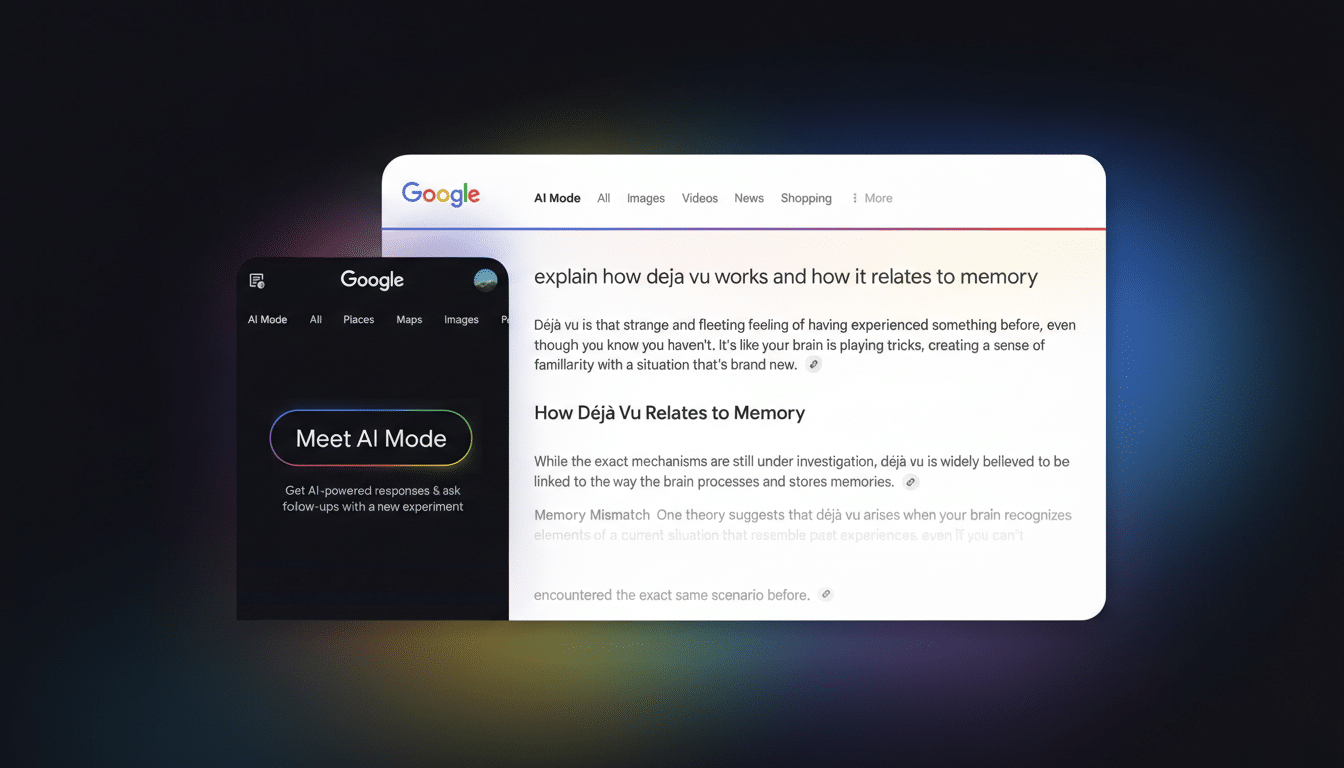
The design is less about flashy chat and more about reducing friction. If you start with “best mirrorless cameras for beginners,” you can follow with “only full-frame options,” then “under $1,200,” and “compare stabilization and battery life,” all within the same thread, with sources and web results still attached.
Gemini 3 Becomes the Engine Behind AI Overviews
Google says Gemini 3 is now the default model for AI Overviews worldwide. While the company hasn’t published a full scorecard yet, the positioning is clear: faster, more grounded responses with improved multi-step reasoning and safer behavior. Expect better performance on tasks like planning, multi-source synthesis, and nuanced comparisons, especially across messy real-world constraints.
Grounding remains the critical piece. Google ties AI Overviews to its established ranking and quality systems, which are designed to prioritize authoritative sources and reduce hallucinations. The company has emphasized techniques like retrieval-augmented generation and citation display to keep answers anchored to the open web.
Why It Matters for Users, Businesses, and Publishers
Search behavior is steadily shifting from “query and click” to “ask and iterate.” By moving AI Mode into AI Overviews, Google closes the gap between quick facts and deep exploration. For users, that means fewer dead ends and faster decision-making. For businesses and publishers, it raises new questions about visibility, since the assistant can satisfy intent earlier in the journey—though links and source attributions remain a core part of the experience.
Independent tracking firms have documented how AI summaries are appearing across a subset of queries and vary by category. BrightEdge research found that AI Overviews showed up far more frequently in complex informational searches like health and finance than in simple navigational queries, underscoring Google’s intent to use AI where it adds the most value. Meanwhile, StatCounter continues to peg Google’s share of global search above 90%, making even small interface changes consequential at web scale.

What Using It Looks Like in Real Search Scenarios
Consider a trip plan: Start with “four-day Kyoto itinerary in spring.” The AI Overview might propose a day-by-day plan with transit notes. Tap “See More,” then refine: “avoid crowded attractions,” “keep lodging under $180 per night,” and “add two vegetarian lunch spots near Arashiyama.” Because AI Mode keeps context, it updates the plan, cites sources for venues, and can export lists you can compare later.
For a product decision, begin with “hybrid SUVs with strong towing capacity.” Follow with “2024 or newer,” “exclude luxury brands,” and “rank by reliability and warranty.” Gemini 3 is designed to juggle those constraints, summarize trade-offs, and point to testing from organizations like Consumer Reports and automaker spec sheets it used to formulate the answer.
Safety and Quality Controls for AI Overviews and Mode
Google says AI Overviews and AI Mode continue to use guardrails that filter sensitive topics, backstop medical or financial content with conservative phrasing, and elevate authoritative sources. Users can still expand citations, report issues, and view how the system assembled an answer. These controls are critical as conversational prompts can drift into ambiguous or risky territory across multi-turn chats.
Competitive Context as Rivals Race to Define AI Search
The update lands amid intensified competition to define “AI search.” Microsoft’s Bing with Copilot, OpenAI’s chat-driven answers, and startups like Perplexity are pushing conversational retrieval into mainstream discovery. Gartner has projected that a material share of information queries will shift to AI assistants, and Google’s move places its own chat experience where users already begin: the Search results page.
For now, the takeaway is straightforward: AI Overviews aren’t just summaries anymore—they’re a launchpad. With AI Mode embedded and Gemini 3 under the hood, Google is betting that the most intuitive way to search is to keep asking until you get exactly what you need.
