


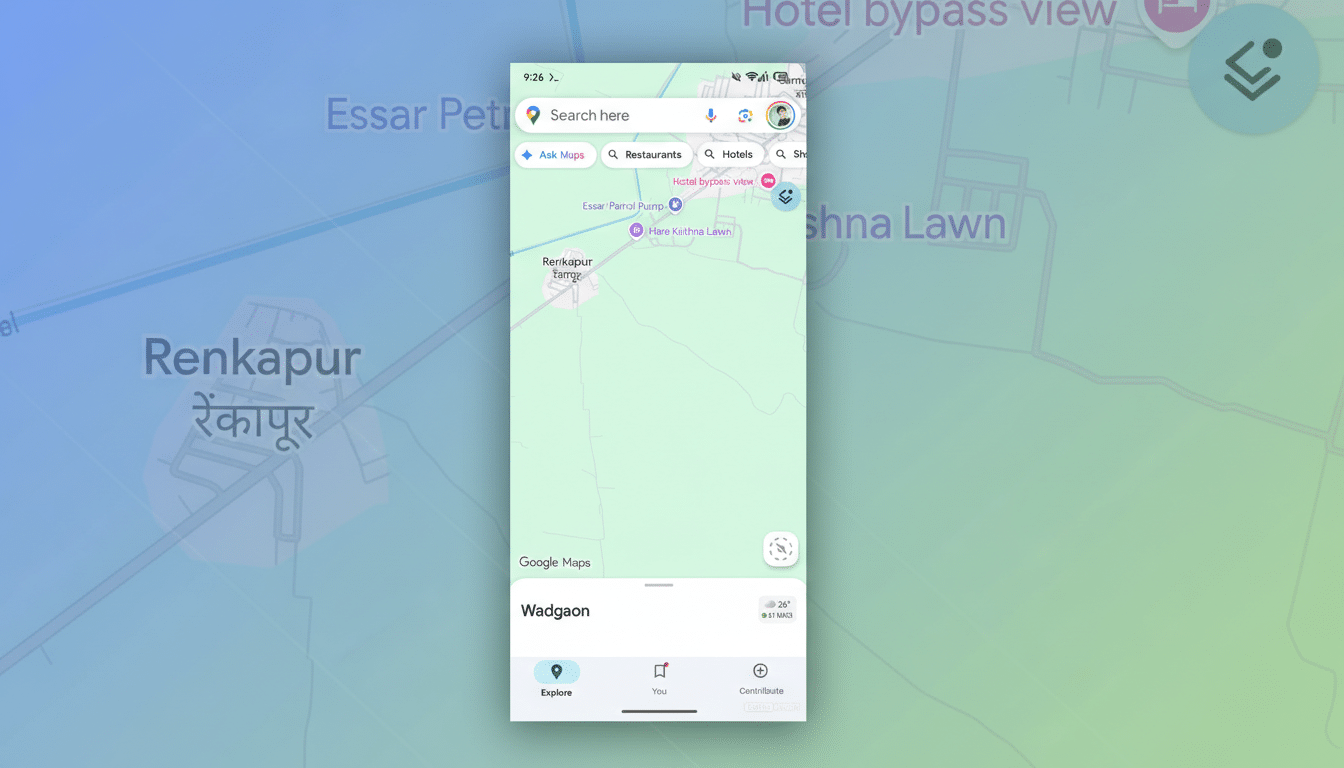
Google Maps is gearing up to talk back. Evidence in a recent app build points to Ask Maps, a Gemini-powered conversational tool that lives directly on the main map screen, signaling the most significant interface shift in Maps since Explore and Live View.
The feature appears as a tappable chip overlaying the map. Tap it and a chat-style panel opens, inviting natural-language prompts—think trip ideas, place discovery, and follow-up questions that refine results. A new Try New Features section in settings will let users opt in, with language suggesting limited early access and capacity-controlled slots.
- What Ask Maps Is Aiming to Solve for Google Maps Users
- How It Works Inside the App and Settings Experience
- Why Google Is Going Conversational with Maps Planning
- Rollout And Availability: Versions, Regions, And Access
- Implications For Businesses And Creators
- Privacy And Reliability Considerations For Ask Maps
- The Bottom Line: What Ask Maps Means For Users
What Ask Maps Is Aiming to Solve for Google Maps Users
Maps is great at point-to-point navigation; it’s less fluid at turning vague ideas into concrete plans. Ask Maps attempts to bridge that gap. Instead of typing a series of filters, users can say, “Plan a coffee crawl near me with quiet spots to work, all open past 6,” and get a curated path with business hours, ratings, and travel time baked in. Follow-ups like “make it walkable” or “add a pastry stop” keep the context without starting over.
Under the hood, Gemini models can synthesize place attributes, live traffic, opening hours, reviews, and photos into multi-step suggestions. This is the kind of task that traditionally required bouncing between Search, Maps, and notes. By collapsing it into a single, conversational surface, Google is betting users will spend more time planning inside Maps rather than elsewhere.
How It Works Inside the App and Settings Experience
Ask Maps shows up as a chip on the primary map canvas. Tapping the chip opens a Gemini-like conversation view with starter prompts. The settings screen includes an opt-in under Try New Features, describing Ask Maps as a way to “turn ideas into adventures with help from Gemini models.” Strings in the app also reference capacity limits, hinting at a rolling, small-batch admission while Google collects feedback.
In practical terms, expect results pages that blend lists, mini-itineraries, and visual previews. A weekend plan might show clusters of attractions, estimated time between stops, and optional detours. For drivers, EV-compatible routes could include charging stops that align with meal breaks. For walkers, routes might bias toward safer or more scenic corridors when data supports it.
Why Google Is Going Conversational with Maps Planning
Google has been threading Gemini through core products, but Maps is uniquely suited for conversational discovery. More than a billion people use Maps every month, and local intent often starts with open-ended needs—“somewhere kid-friendly,” “a quick hike before sunset,” “a good first-date bar.” LLMs excel at turning ambiguous goals into workable plans, especially when they can fuse structured datasets (POIs, hours, transit) with unstructured signals (reviews, photos).
The move also positions Maps against rivals experimenting with AI trip planning. While third-party apps can stitch itineraries, few own the live data and navigation stack end to end. If Ask Maps sticks the landing, it tightens the loop from discovery to directions, and it may boost engagement with features like Immersive View, Lens in Maps, and curated lists.

Rollout And Availability: Versions, Regions, And Access
The feature surfaced in Maps version 26.07.01.867227976 during testing, with an opt-in entry point and a banner noting limited space. That language suggests a staged playground: small cohorts first, iterative tuning, then broader release. Google typically scales such experiments regionally and by account, so two devices on the same version may not see the same options.
Early testers should expect hiccups. In some builds the chat panel appears but doesn’t return results—a sign that server-side flags and capacity gates are still in flux. Feedback loops during this period will likely shape defaults, prompt suggestions, and safety constraints.
Implications For Businesses And Creators
If conversational planning becomes a primary discovery path, business profiles and review quality matter even more. Attributes like outdoor seating, kid-friendliness, noise levels, and dietary options could influence itinerary assembly. Owners who keep hours, photos, and attributes current may surface more often in generated plans, while creators’ lists could be pulled as starting points for Ask Maps prompts.
Privacy And Reliability Considerations For Ask Maps
Conversational layers raise predictable questions. Will the model ever improvise details? Google has said its AI systems are bounded by real-time data and guardrails, but hallucinations remain a risk in generative systems. Expect careful scoping at launch—Ask Maps should handle discovery and planning, while trusted routing engines continue to provide turn-by-turn directions.
Location privacy is another pressure point. Google typically applies aggregation and anonymization to location signals and provides granular controls, but a chat interface that blends preferences with real-world movement must reassure users about data handling and retention. Clear disclosures and easy opt-outs will be essential to trust.
The Bottom Line: What Ask Maps Means For Users
Ask Maps hints at a future where you tell Maps what you want, not just where you’re going. The pieces—Gemini reasoning, rich place data, and real-time conditions—are finally aligned. With a limited opt-in rolling out and capacity gates in place, the talkative version of Maps looks close to prime time.
