


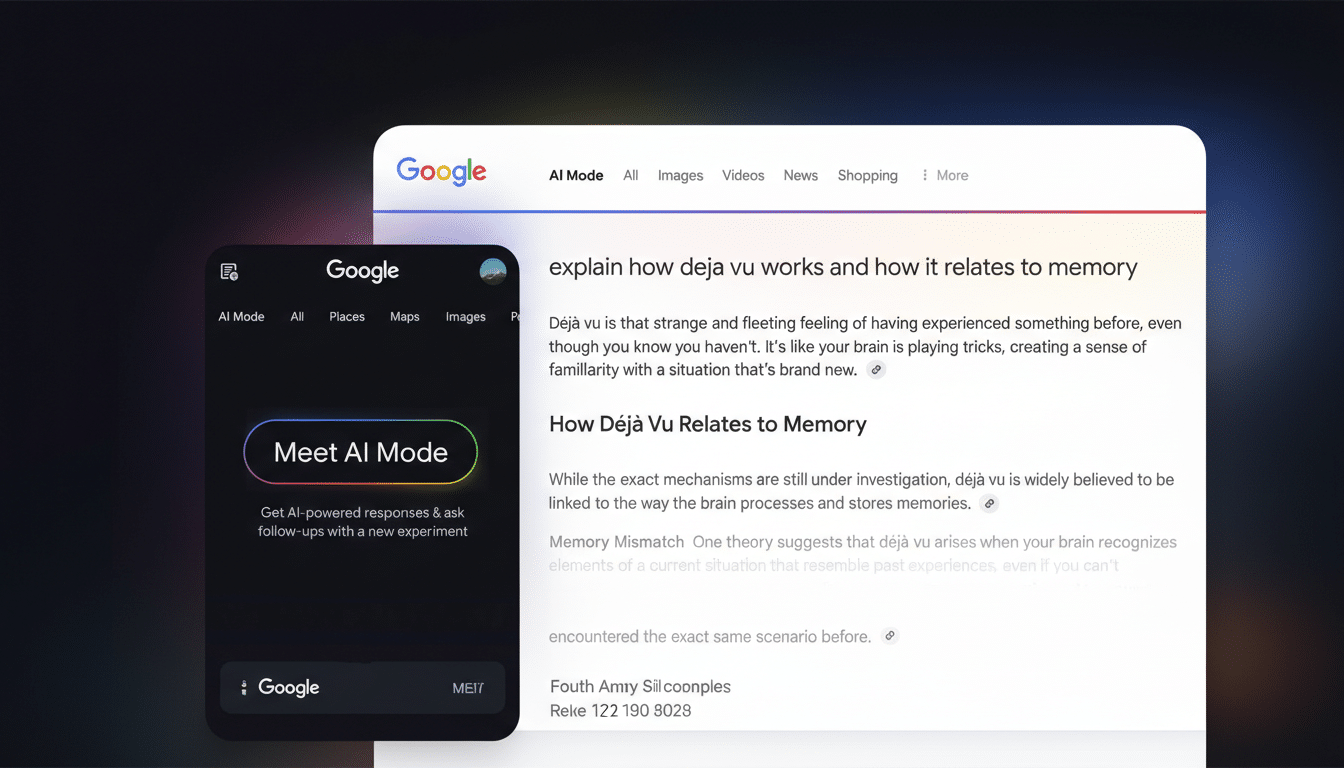
Google is weaving more of your own content into Search. The company is rolling out Personal Intelligence inside AI Mode, letting people securely connect Gmail and Google Photos so results can reflect their actual purchases, plans, and preferences. Powered by the Gemini 3 model, the upgrade pushes Search beyond generic answers toward context-aware guidance drawn from the information you already keep in Google’s apps.
What Personal Intelligence Does in AI Mode Search
With Personal Intelligence enabled, AI Mode can reference recent emails or photos to tailor its responses. Shopping for running shoes, for example, it can notice a recent order confirmation in Gmail and suggest the latest model from the same brand—an example Google’s VP of Product for Search, Robby Stein, highlighted to illustrate how it reduces friction in everyday decisions.
Travel planning is another early use case. Ask for a trip itinerary and AI Mode can scan your Google Photos library to identify where you’ve been, when you went, and which activities you seemed to enjoy, then propose a plan that mirrors your own habits—say, museum-heavy afternoons if your albums skew that way, or sunrise hikes if your camera roll is full of trail views.
This is not a generic personalization layer. It is dynamic, prompt-scoped context, similar to retrieval-augmented generation but applied to your private data vaults. The effect is a search result that feels like advice from someone who knows you, rather than a one-size-fits-all page of links.
How It Works and Privacy Controls for AI Mode Search
Google says Personal Intelligence is strictly opt-in and limited to the services you connect. Access is scoped to answer the specific prompt, and the company emphasizes that personal data from Gmail and Photos is not used to train models. Users can disconnect at any time, returning AI Mode to a more traditional, non-personalized experience.
The architecture matters. By confining retrieval to defined sources and prompt windows, Google is aiming for relevance without the creep factor. That approach echoes a broader industry shift toward privacy-preserving personalization: on-device or tightly controlled cloud queries that help the model “know enough” without hoovering up everything.
It also raises a familiar question: how much convenience is worth the intimacy of letting a model read your receipts and scan your photos? Research from independent privacy watchdogs and consumer surveys has consistently shown that people value personalization but want clear control and transparency over what’s used and when. Google will be judged on how well those controls hold up in everyday use.
Why It Matters for Search and Everyday Decisions
Search is shifting from “find me information” to “help me decide.” Personal Intelligence accelerates that shift by anchoring generative answers in your lived context. Rather than asking you to sift through reviews for “best noise-canceling headphones,” AI Mode could factor in your past purchases, travel frequency, and budget cues from emails to surface a short list that fits your profile.
For merchants, this sets the stage for higher-intent recommendations, but it may also intensify scrutiny over preferential nudges. Regulators have warned that opaque ranking systems can distort competition. If AI Mode appears to favor brands you’ve bought from, that might be helpful—or it could look like a closed loop. Disclosure and user choice will be key.
Technically, Gemini 3’s longer context window and improved multimodal reasoning are central here. Parsing an email thread and cross-referencing it with visual cues from photos in a single session demands robust grounding and memory management. If successful, the payoff is fewer follow-up prompts and more first-try answers that feel tailored and trustworthy.
Availability and Eligibility for Personal Intelligence
Personal Intelligence for AI Mode is rolling out in the U.S. through Google Labs, the company’s testbed for experimental features. Access is limited at launch to paid AI Pro and AI Ultra subscribers, mirroring the tiered approach used for the Personal Intelligence features in the Gemini assistant.
The feature supports personal Google accounts only, with Workspace accounts for business, enterprise, or education excluded at this stage. That boundary likely reflects more complex compliance and data-governance requirements in organizational environments.
Competitive Context Among Big Tech and Search Rivals
The move slots Google alongside a broader trend: assistants that learn from your own archives. Apple has emphasized private compute for personalized actions in its ecosystem, while Microsoft has explored memory-like features in Windows for context-aware help. The difference is Google’s decision to put that capability directly inside Search, where intent already lives.
If adoption is strong, expect rapid iteration—additional app connectors, finer-grained controls, and clearer audit trails. If users hesitate, it will likely be over trust, not utility. For now, Personal Intelligence signals what the next chapter of Search could look like: less about pages, more about personal context, and a tighter loop between what you ask and what your life actually needs.
