


Group of Seven leaders agreed Friday to coordinate the release of up to 100 million barrels of strategic crude-oil and refined-product reserves over the next four months, putting diesel at the center of an emergency response to elevated fuel prices. The agreement, announced after a videoconference convened by French President Emmanuel Macron, also commits G7 members not to impose energy-export bans or restrictions on one another.
The decision matters because it combines an effort to place more physical fuel into a tight market with a pledge to keep supplies moving among major industrial economies. But important operational details remain unknown, including each country’s contribution, the share that will be diesel rather than crude and whether the 100 million barrels represent new supply beyond an earlier International Energy Agency action.

Official terms focus on diesel, crude and trade flows
In its official account of the meeting, the French presidency said the leaders unanimously backed a release of strategic reserves of refined products, particularly diesel, and crude oil, up to the 100 million-barrel ceiling. The International Energy Agency will coordinate the effort.
The four-month period does not mean barrels will be released at a uniform pace. If the full volume were distributed evenly across roughly 120 days, it would equate to about 830,000 barrels a day. The announced ceiling is therefore an upper bound, not a disclosed delivery schedule or a guarantee that every barrel will reach consumers in the same market.
The French statement adds a potentially consequential restriction on national policy: the G7 agreed not to impose bans or restrictions on energy exports to other members. That commitment addresses the risk that a country could release domestic stockpiles while limiting cross-border sales, undermining the coordinated response. It is especially relevant for diesel, a product traded among regions with different refinery configurations and seasonal demand patterns.
Leaders also agreed to continue efforts to restore full freedom of navigation in the Strait of Hormuz and to optimize energy production so refineries operate at maximum capacity, according to the presidency. The measures point to a two-part strategy: draw from emergency inventories while seeking to preserve commercial fuel flows and raise refinery output.
Reported diesel timetable goes beyond the official statement
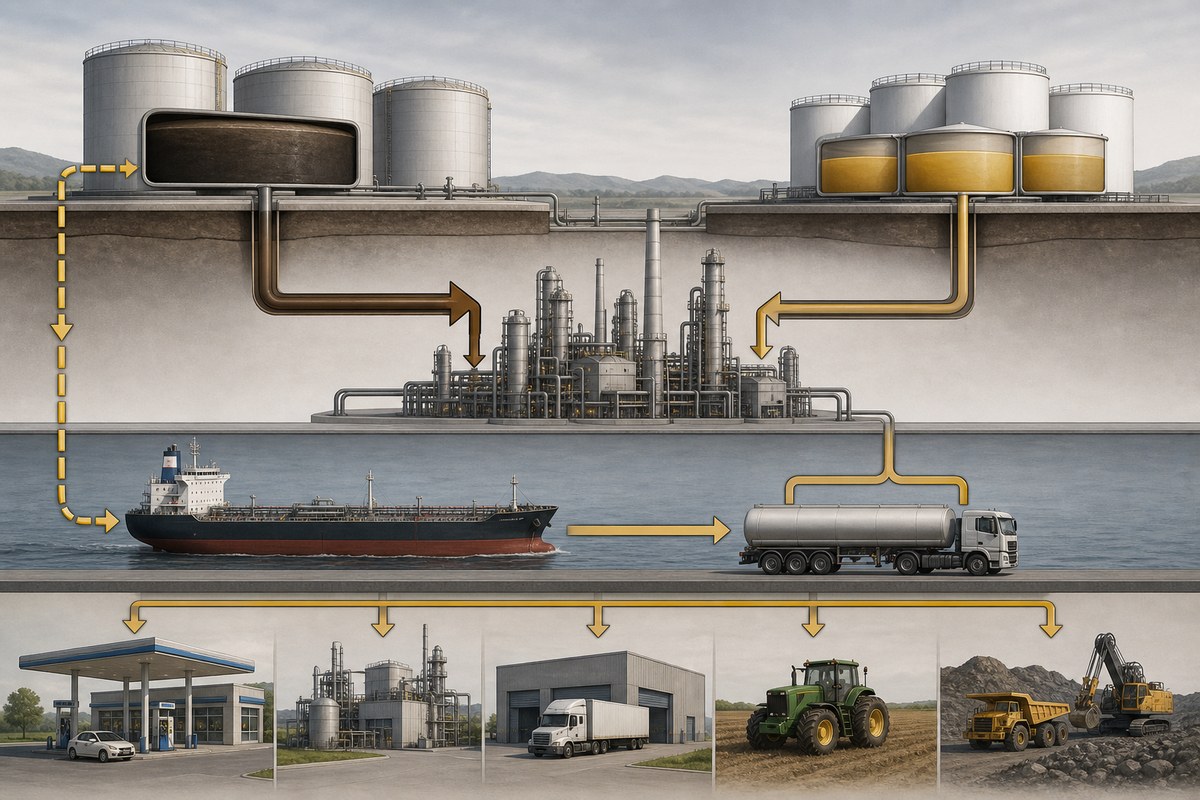
Associated Press reporting, carried by the Toronto Star, said the program would begin with a substantial, front-loaded release of diesel within 20 days. That detail would be significant because refined products can address immediate transport and industrial fuel needs more directly than crude, which still must be processed by a refinery before becoming diesel, gasoline or jet fuel.
Still, the 20-day element should be treated as reported implementation detail rather than as a term confirmed in the French announcement. The official statement identifies diesel as a priority and sets a four-month window, but it does not specify a 20-day deadline, country allocations, release mechanisms or the quantity of diesel within the overall ceiling.
Macron said the coordinated measure and volumes should bring down prices and add liquidity, according to the AP report. Markets registered an immediate response: U.S. oil prices fell 2% after the G7 statement, AP reported. A one-day market move, however, does not establish the eventual effect on wholesale products or retail fuel costs, which will depend on the volume released, its destination, refinery operations and the durability of transport routes.
Diesel prices show the pressure, but not the eventual consumer outcome
U.S. average diesel prices stood at $6.37 a gallon on Oct. 2, according to AAA data cited by AP. That was 15 cents below the $6.52 a gallon reported for Sept. 22, a decline of about 2.3% in 10 days, but it remained a historically elevated cost for trucking, freight-dependent businesses and diesel vehicle operators.
Michael Lynch of the Energy Policy Research Foundation told AP that a European diesel release could reduce the need for U.S. diesel exports and potentially cut U.S. diesel prices by 25 cents to 50 cents a gallon after several weeks. That is an analyst estimate, not an announced policy result. The official G7 statement does not promise a retail-price target, and no national release volumes have been published.
The design of the announcement also illustrates the trade-off in using strategic inventories. Releasing stocks can add supply when commercial markets are strained, but it leaves countries with less emergency cover until inventories are replenished. Jim Krane of Rice University’s Baker Institute told AP that governments could later need to refill those reserves, creating a future purchasing requirement.
The unresolved question is whether the barrels are incremental
The largest accounting issue concerns a previously reported 426 million-barrel International Energy Agency release announced in March. AP reported that the new G7 move follows that earlier action, but the French presidency’s Oct. 2 statement does not say whether the up-to-100-million-barrel commitment is additional to the 426 million barrels, part of it, or a remaining tranche of a broader plan.
Pavel Molchanov of Raymond James identified the ambiguity in comments to AP. Until the IEA or participating governments specify the relationship between the two figures, treating the new announcement as 100 million barrels of incremental supply would overstate what has been confirmed.
For oil and product markets, the next disclosures will be more important than the headline ceiling: which reserves are tapped, how much is refined diesel, when cargoes become available and whether the pledge against intra-G7 export restrictions holds as supplies move through the system. The G7 has set a coordinated framework; it has not yet published the operational ledger needed to measure its full market effect.

