


After decades tuning Linux machines from laptops to racks of servers, I finally found myself reaching for a different tool. FreeBSD, the quiet workhorse of the Unix world, gave me a clear reason to switch: a coherent, integrated operating system that rewards precision with stability, performance, and surprisingly low maintenance once it’s dialed in.
Why FreeBSD Finally Stood Out in Daily Use
Linux is a kernel surrounded by a constellation of vendor decisions and userland choices. FreeBSD ships as a complete operating system: kernel, userland, documentation, and a release engineering discipline that treats the whole as one tested artifact. That architectural choice has consequences. Upgrades are predictable. Interfaces don’t churn without warning. You know who built what and why.
Storage sealed the deal. ZFS is not an add-on here; it’s a first-class citizen with end-to-end checksumming, copy-on-write snapshots, and painless send/receive replication. On multi-terabyte pools, scrubs quietly fix bit rot before I even get a monitoring alert. Rolling back a bad change takes seconds and never risks a half-written filesystem.
Then there are jails. Long before containers went mainstream, FreeBSD jails offered lightweight isolation with a small attack surface and near-zero overhead. For service segregation and test environments, they’re refreshingly straightforward. Pair jails with the pf firewall and Capsicum capability framework, and you get compartmentalization that feels purpose-built rather than bolted on.
From ISO to Desktop: What It Really Takes
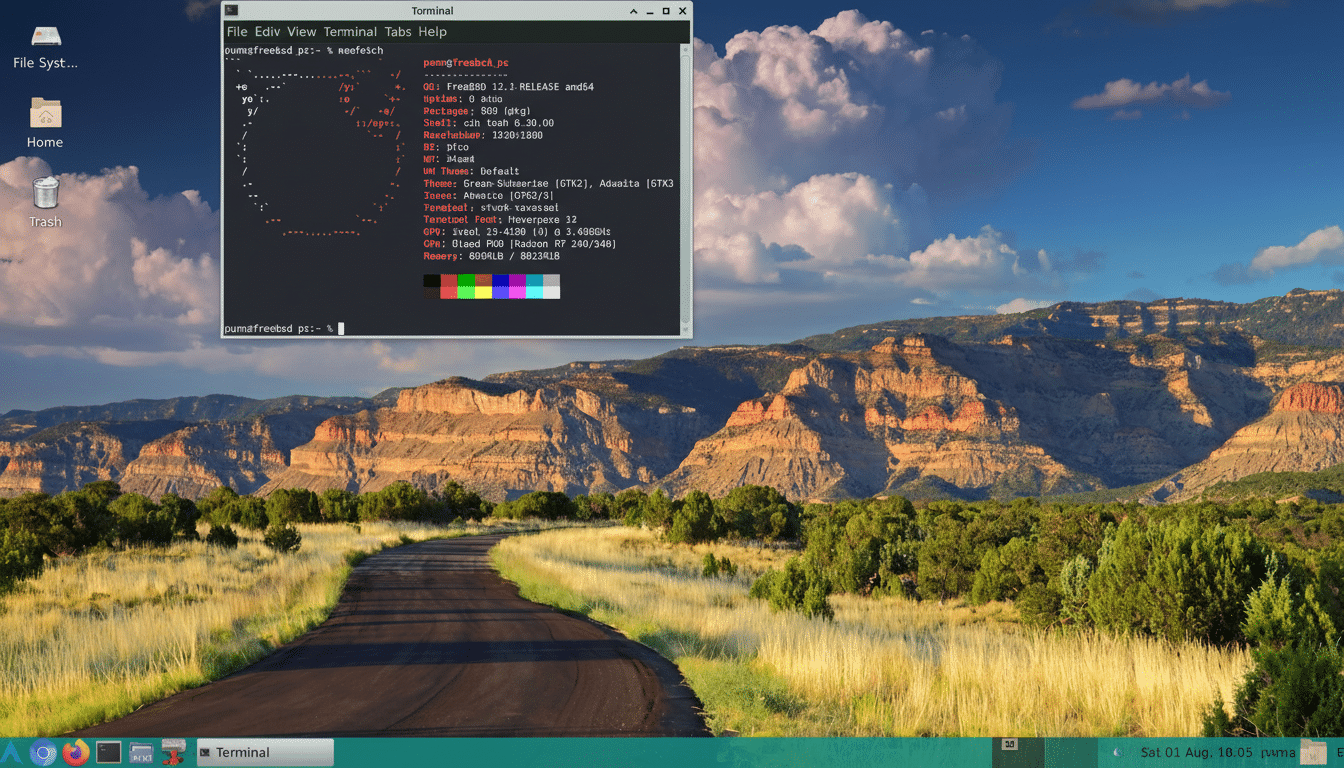
The installer is text-based and fast. Accept sane defaults, set a root password, create a user, and you’re on a clean, headless system in minutes. The “hands-on” part starts when you decide to build a workstation. You enable services like dbus, install your desktop of choice through pkg (the binary package manager), and optionally compile custom builds from the Ports Collection if you want fine-grained control.
It’s not a one-click experience, and that’s intentional. Some graphical app centers rely on PackageKit, which is less mature on FreeBSD, so the command line remains the most reliable way to manage software. The tradeoff is clarity: every service you enable is one you chose, and the system stays lean and understandable. The FreeBSD Handbook and man pages are exceptionally good, which keeps the learning curve honest rather than frustrating.
The Case Built on Real Workloads in the Field
FreeBSD’s network stack is the reason many of the internet’s heavy lifters run it in production. Netflix engineers have repeatedly presented how their Open Connect appliances, based on FreeBSD with sendfile, kqueue, and kernel TLS optimizations, serve massive volumes of video traffic from a single box. Sandvine’s Global Internet Phenomena reports consistently place Netflix among the leaders in downstream traffic, and Netflix has credited FreeBSD for helping it achieve that efficiency in the field.
Look around and you see the same pattern: Juniper’s Junos is FreeBSD-derived, Sony’s PlayStation system software builds on FreeBSD, and Microsoft maintains FreeBSD images and drivers for Azure appliances. These aren’t hobby deployments; they’re long-running validations of the platform’s stability, driver model, and predictable performance.
Day-to-day, that reliability shows up as calm operations. The base system and third-party packages are cleanly separated. Security updates via freebsd-update don’t pull in surprises from half a dozen vendors. When you do need to tune, sysctl exposes clear, well-documented switches. And when you don’t, the machine disappears into the background and simply keeps working.
Trade-offs and Who Should Consider the Move
This is not a blanket recommendation. Desktop Linux remains unmatched for out-of-the-box hardware breadth, gaming via Proton, and vendor support. If you live on the bleeding edge of new GPUs or proprietary apps, Linux will get you there first. FreeBSD’s strength is measured, repeatable operations over long horizons, not chasing every shiny feature the moment it ships.
If you run storage, networking, homelab services, or developer workloads that favor clean isolation and reproducible environments, FreeBSD is an easy win. If you value a coherent base more than an ocean of choices, it’s liberating. In my case, the equation changed: fewer moving parts, ZFS everywhere, jails for isolation, and a release process I trust were enough to retire muscle memory built on Linux.
That is the reason, finally, to switch. Not because FreeBSD feels familiar—it often doesn’t—but because it rewards time invested with a quieter, more dependable system. After years of tuning around the edges, I’d rather start from a platform that needs less tuning in the first place.
