


The European Commission has opened formal proceedings under the Digital Markets Act to test whether Google is giving its Gemini AI privileged treatment inside Android and withholding critical search data from rivals. Regulators want third-party AI assistants and chatbots to gain equal and effective access to the same system-level features Google uses for Gemini, and they expect competing search and AI services to receive anonymized ranking, query, click, and view data needed to build credible alternatives.
Officials plan to share preliminary findings and proposed measures within three months and conclude the case within six months. Potential penalties are substantial: the DMA enables fines of up to 10% of a company’s worldwide turnover for non-compliance, rising to 20% for repeat infringements, plus periodic penalty payments of up to 5% of daily turnover to enforce obligations.
What Equal Access Means on Android for AI Assistants
At the heart of the case is “deep integration” — the privileged hooks that let an assistant feel truly native. On Android, that can include default assistant roles, on-screen context capture, system overlays, lock screen and notification access, voice activation pathways, and manufacturer-level placements. Gemini already benefits from multiple such touchpoints, including system gestures and context-aware features that make it more immediate and useful than a regular app.
The Commission’s point is not to block Google from integrating Gemini, but to make sure others can compete on the same terms. That implies parity of functionality and performance, not merely nominal APIs. If the only way to access a powerful feature is to be Google, choice is an illusion. In practice, this could translate into clearer, documented APIs for assistant triggers, richer context-sharing mechanisms with user consent, and equal access to surfaces like the lock screen or quick actions.
Why Search and AI Need Data to Compete Effectively
The second pillar of the Commission’s probe focuses on data. Rival search engines and AI services argue they cannot meaningfully improve ranking and answers without aggregated, anonymized signals such as queries, clicks, views, and relative position data. These signals feed models that learn what users find relevant. Without them, rivals are flying blind, especially as generative AI reshapes expectations for answer quality and speed.
Regulators are emphasizing anonymization and appropriate safeguards to align with privacy rules, while insisting that data essential for competition be shared. This mirrors prior European cases where access to datasets and interfaces — under fair, reasonable, and non-discriminatory terms — proved decisive for fostering real competition.
Why It Matters for Users and Developers Across Europe
Android powers roughly 70% of smartphones in Europe, according to StatCounter, so small shifts in platform rules cascade across the market. If third-party AI assistants such as Microsoft Copilot, Amazon Alexa, or emerging chatbots can plug into Android at the same depth as Gemini, users would see genuine choice: pick your default assistant, trigger it from the same gestures, access screen context with comparable fidelity, and get consistent performance on the lock screen and notifications.
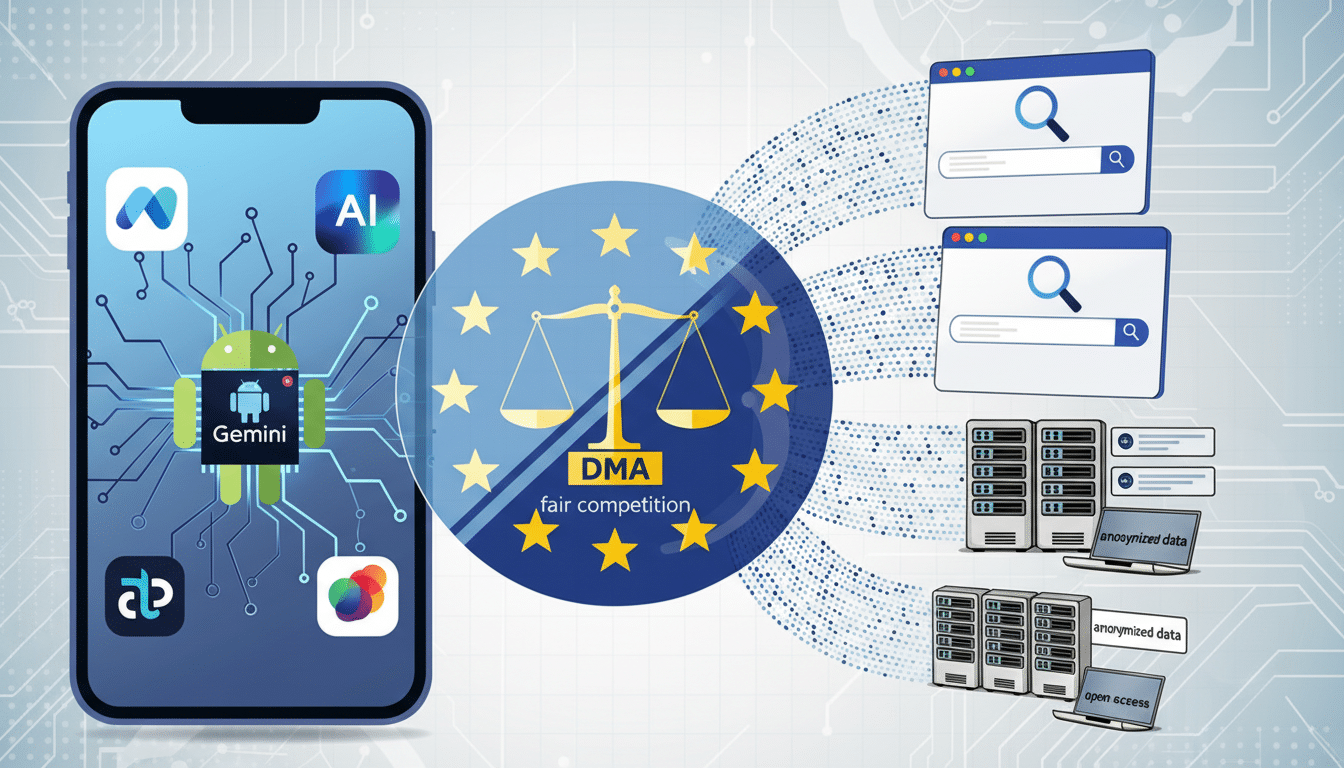
For developers, equal access means they can design features with confidence that system-level capabilities won’t be off-limits. For device makers, it broadens partnership options — an OEM could preinstall a non-Google assistant without sacrificing the seamlessness consumers expect. The result is a more contestable market where innovation, not access privileges, decides winners.
What Compliance Could Look Like Under the DMA
If the Commission finds shortcomings, remedies may include a standardized choice flow for default assistants, documented APIs for context capture and overlays, interoperability commitments for voice activation, and a governed portal for sharing anonymized search interaction data with eligible rivals. Expect granular safeguards around user consent, security boundaries, and rate limits to prevent abuse.
Google is likely to argue that some integrations require tight coupling for safety, privacy, and device performance. The Commission has signaled it will weigh those concerns but will expect proportionate, non-discriminatory access. Europe has taken similar positions with other gatekeepers, requiring Apple to open parts of iOS to alternative distribution and browser engines under the DMA.
Google’s EU Antitrust History and the High Stakes Now
Google’s previous EU antitrust cases — from Android tying to shopping and AdSense — underscore how platform defaults and privileged placement can shape markets. The DMA flips the script from years-long litigation to ex-ante obligations with rapid timelines. In practical terms, the company now faces a near-term decision: proactively implement equal access for AI on Android and open up anonymized search interaction data, or risk corrective measures and escalating fines.
The broader signal is clear. In Europe, vertically integrated AI assistants cannot rely on exclusive platform advantages. If Gemini is to define the future of mobile AI, it will have to do so in a field where competitors can reach users with the same depth and immediacy — and where data needed to train better answers is not locked behind one gatekeeper.
