


Karl Deisseroth, Peter Hegemann and Georg Nagel have been awarded the 2026 Nobel Prize in Physiology or Medicine for discoveries that led to optogenetics, a method that lets researchers use light to control selected cells. The Nobel Assembly at Karolinska Institutet announced the prize on Oct. 5, recognizing their work on light-gated ion channels and optogenetics.
The technique transformed experiments on the brain by allowing scientists to do more than observe which cells are active during a behavior, memory or sensation. When light-sensitive proteins are placed in targeted cells, light can be used to manipulate those cells in experimental systems and test whether a circuit contributes to a measured outcome. That ability to examine cause and effect has made optogenetics a widely used experimental method, even as its medical uses remain limited and under investigation.
From a single-celled alga to a neural switch
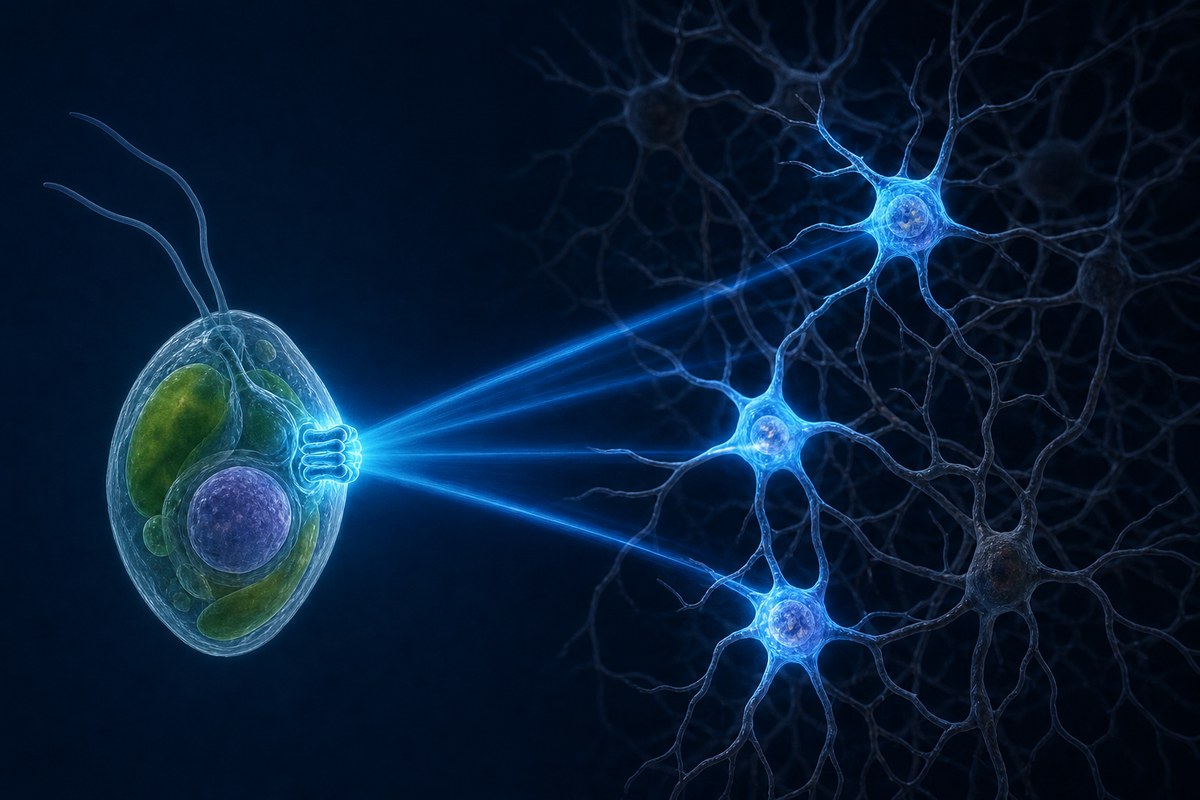
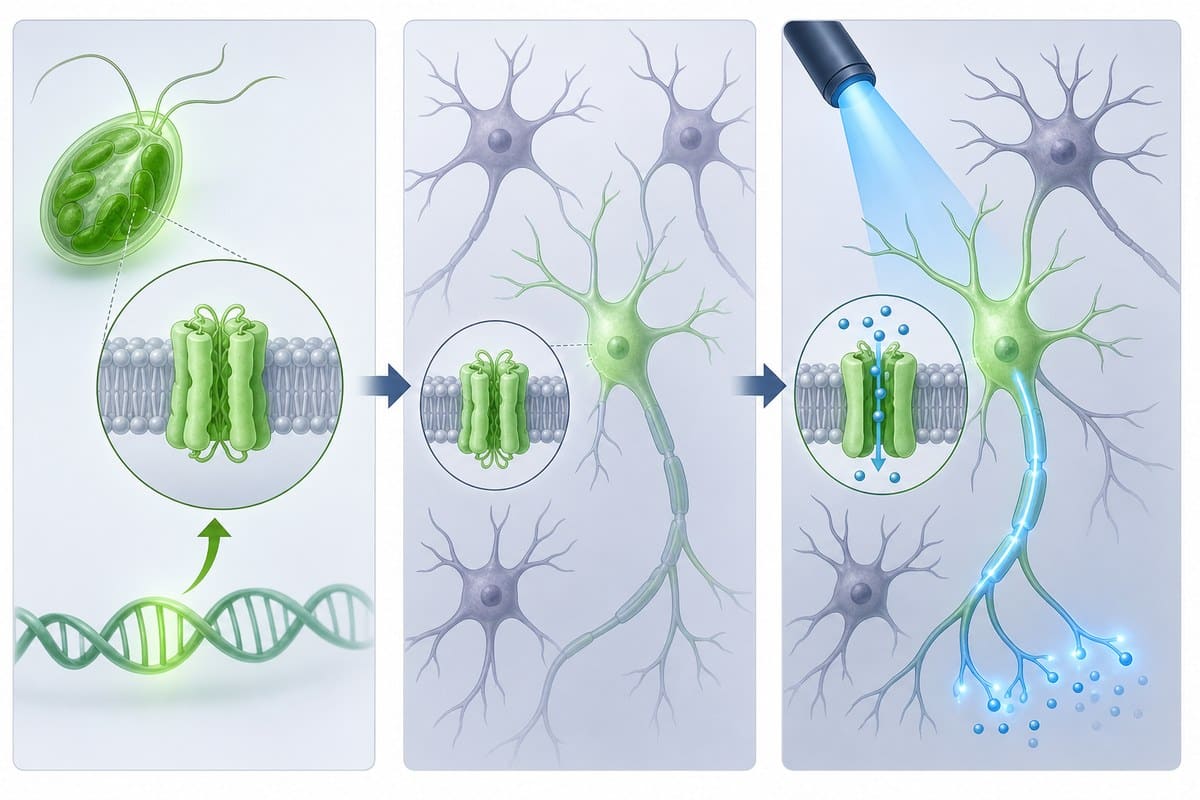
The work honored by the prize began with an organism far removed from the mammalian brain: Chlamydomonas, a single-celled alga that moves toward light. Hegemann and Nagel identified channelrhodopsin, a protein that detects light and functions as an ion channel. According to the Nobel Assembly, blue light opens that channel, allowing ions to flow into the cell and producing an electrical impulse.
That molecular mechanism supplied a potentially useful switch. Deisseroth showed in 2005 that introducing the gene for channelrhodopsin into rat nerve cells could make the cells generate nerve signals when exposed to blue light, the Nobel Assembly said. By 2007, the approach had been made to work in living mouse brains.
The prize recognizes a chain of basic discoveries and experiments: identifying a light-responsive channel in algae, establishing its cellular action and adapting it so particular neurons could be controlled in intact animals. The 12 million Swedish kronor prize will be divided equally among the three laureates. Deisseroth is affiliated with the Howard Hughes Medical Institute and Stanford University; Hegemann is at Humboldt University of Berlin, and Nagel is at the University of Würzburg.
Optogenetics combines genetic targeting with optical control. Researchers can arrange for a light-sensitive protein to be present in a chosen population of cells, rather than throughout the brain, then assess what changes when those cells are manipulated. A scientific review hosted by the National Institutes of Health describes the field as combining genetic and optical methods to control defined cellular events with cell-type specificity and timing on the scale of milliseconds.
Why causal control changed brain research
Brain studies often find correlations: a group of neurons may become active while an animal makes a choice, recalls a learned association or responds to a stimulus. Such observations can identify promising circuits, but activity alone does not prove that the cells produced the behavior. The same neural signal could be a downstream effect or simply occur alongside the process under study.
By selectively manipulating a defined cell population and measuring what follows, optogenetics gives researchers a way to test causal hypotheses about circuitry. The Nobel Assembly said the method has helped reveal circuits linked to particular memories, feelings and behaviors. BBC coverage of the award similarly described optogenetics as a tool that has altered research into the brain’s inner workings.
Its experimental precision should not be confused with an ability to read thoughts, recover an entire memory or explain complex illnesses on its own. Results from a controlled circuit experiment can establish what a manipulated pathway does under the conditions studied. They do not automatically establish how a human disease develops, whether the same circuit has the same role across species, or whether changing it would safely help patients.
Clinical research remains limited
The Nobel Assembly noted that researchers are attempting to use optogenetics to restore sight in people with visual impairment. But the award material does not provide sample sizes, comparative outcomes or evidence that the approach has established clinical efficacy.
More broadly, turning an optogenetic result into a therapy poses practical and biological challenges. A peer-reviewed review of human therapeutic applications identified questions about safe and effective gene delivery, targeting the appropriate cells, immune responses and ways to deliver sufficient light. Optogenetics remains primarily an experimental research tool, not an established general treatment for neurological or psychiatric disorders.

