


ChatGPT has leaped from novelty to infrastructure. What started as a text-only aide for composing emails and code now drives voice conversations, generates images, searches the web, parses files and completes tasks from start to finish. Behind its benign chat window, however, lies a thick stack of large language models from the artificial intelligence lab OpenAI that have made generative AI into a daily habit for hundreds of millions of people.
What Is ChatGPT and How Does the AI Chatbot Work?
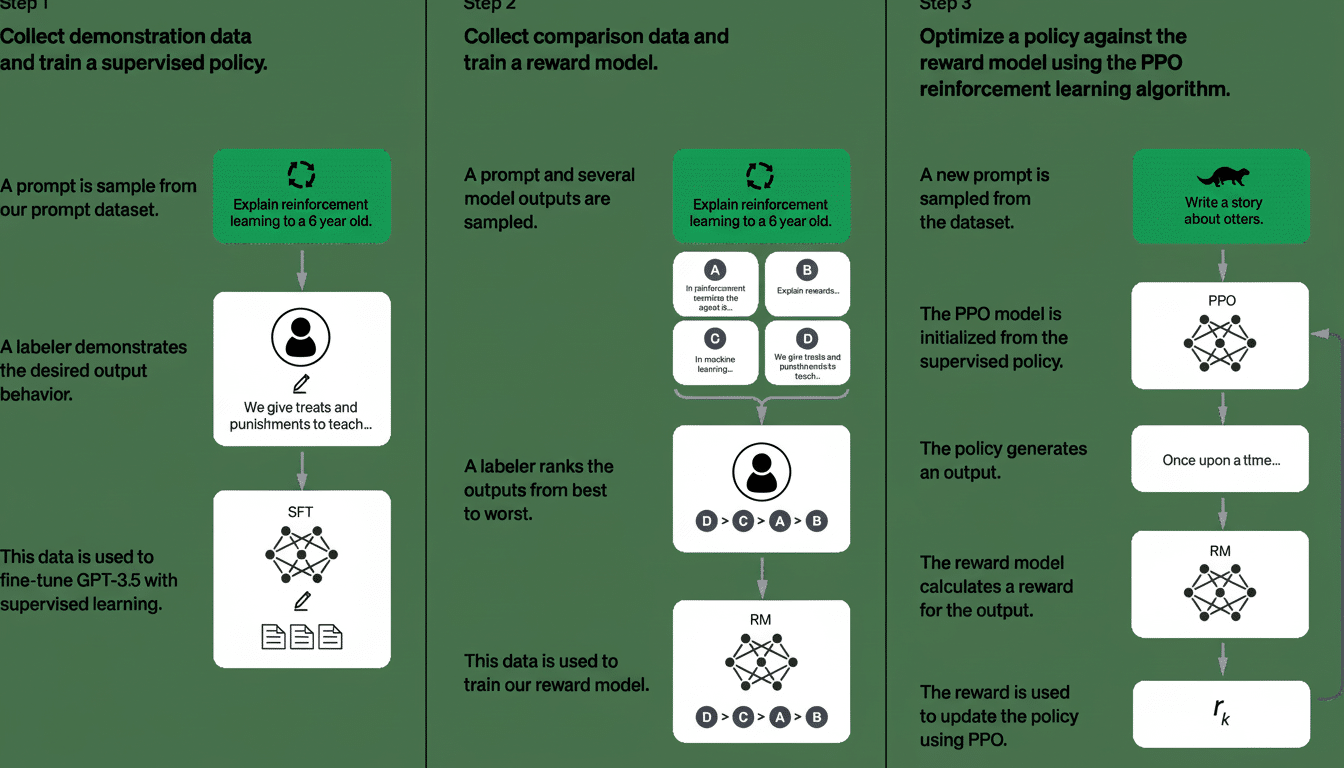
At its heart, ChatGPT is something of an interface to OpenAI’s generative models. Trained on large text and multimedia corpora, they aim to predict the next best token in context. That simple artifact, scaled with giant compute and expanded with reinforcement learning and post-training, then spits out answers that are natural-sounding, obey instructions and can adapt to tone and style.
- What Is ChatGPT and How Does the AI Chatbot Work?
- Capabilities You’ll Actually Use Across ChatGPT
- Who Uses ChatGPT and How Many People Use It
- Plans, Access and Deployment Options for ChatGPT
- Accuracy, Safety and What to Watch for in ChatGPT
- Privacy, Data and Security Practices for ChatGPT
- Performance, Cost and Footprint of ChatGPT Use
- Ecosystem and Competition in the AI Chatbot Market
- Where ChatGPT Is Heading and What Comes Next

Modern releases extend far beyond text. Multimodal ones can read images, interpret charts and speak in lifelike prosody. Reasoning-focused forms use more compute to solve problems that demand step-by-step thinking, while we have a lighter mode for quick-and-dirty answers.
Capabilities You’ll Actually Use Across ChatGPT
ChatGPT composes and reviews prose, code generation & explanation, as well as summarizing long documents. It can convert a brief into slides, parse spreadsheets and translate across languages. With a browser it can look up current events; with spoken text, it’s a tutor or hands-free trip planner. Agents that code refactor and test projects. Education components such as Study Mode also point students toward critical thinking and away from rote answers.
OpenAI is also promoting “agentic” workflows. New tools can go through a calendar, buy online or carry out laborious multistep processes within a safe virtual world. In-chat product discovery and checkout: search, recommendation and payment combined into one flow through e-commerce functionality.
Who Uses ChatGPT and How Many People Use It
Usage is staggering. OpenAI has said it sees billions of prompts a day; Appfigures estimates the mobile app has driven billions of dollars in consumer spend. Pew Research Center surveys indicate that teenagers are increasingly using ChatGPT for schoolwork, and enterprises have adopted GPT-3 in everything from customer service to research departments. Government interest is up as well, with federal channels established to acquire and govern tools like ChatGPT Enterprise.
Demographics are broadening. Data from Appfigures indicates a robust under-25 set on mobile, but usage among older pros is on the rise as integrations hit productivity suites and code editors.
Plans, Access and Deployment Options for ChatGPT
For casual use, there’s a free tier; for heavier workloads, a paid one. Plus and Pro open faster models, voice and image tools and higher limits. Team, Enterprise, Edu and Gov plans include admin controls, compliance features and data residency for Europe and Asia as well as service-level guarantees. In some markets, budget plans open the door at bargain rates.
Developers use the API to bake ChatGPT-like powers into apps. OpenAI says its new Responses API and model picker allow teams to make trade-offs between speed, costs and depth of reasoning, while open standards like the Model Context Protocol help connect private data sources securely.
Accuracy, Safety and What to Watch for in ChatGPT
No model is infallible. That is, ChatGPT can make up things to be true (hallucinate), reflect its audience’s biases, or grow overconfident. “Therapy” chatbots can stigmatize or bungle sensitive topics, researchers at Stanford have cautioned. In reply, OpenAI has released stronger guardrails around content related to self-harm, teen protections and parental controls, as well as more specialized monitoring for biological and chemical threats in its reasoning models.
Benchmark transparency matters. Independent groups like Epoch AI and the ARC-AGI team have investigated the claimed scores and costs for reasoning models, and they’ve pushed the community into not just publishing numbers but sharing how they got them. Personality and sycophancy regressions are also responsible for rollbacks and clearer changelogs.
Privacy, Data and Security Practices for ChatGPT
Privacy policies vary by product tier. Enterprise and Gov offerings will include the ability to turn off training on customer data, as well as audit controls. OpenAI has implemented data residency policies in regulated regions and documented retention windows for chat and agent sessions. Rights under European privacy law still stand, including avenues for seeking corrections or opposing processing, according to OpenAI’s public guidelines and advocacy groups such as noyb.
Really, the best rule I can give you is not to paste top-secret stuff unless it’s clearly stated here that your plan, settings and policies are okay with it. For regulated workloads, follow formal procurement routes and require documented DPIAs and vendor assessments.
Performance, Cost and Footprint of ChatGPT Use
Latency and cost differ by model. The reasoning modes use more compute but will deliver step-by-step responses, while the lightweight models are faster and better suited for everyday chat. OpenAI and independent researchers believe the average prompt consumes a fraction of a watt-hour of electricity; leadership has even tallied water use by request. Image generation increases those figures, as does longer context.
OpenAI on the hardware front, which Reuters suggested is now seemingly using Google’s AI chips alongside Nvidia GPUs for some workloads, continues a wider dash for compute.
Ecosystem and Competition in the AI Chatbot Market
ChatGPT is in a crowded category that also includes Google’s Gemini, Anthropic’s Claude and startups like DeepSeek. Publishers and platforms are adjusting: AI answers lower clicks to news sites, while referrals from chat assistants tick upward, according to Similarweb. Experimentation from MIT’s Media Lab, meanwhile, indicates heavy dependence can dull cognitive engagement in the act of writing: a human-in-the-loop use case.
Regulators are watching, and courts are testing the limits of copyright and defamation. Expect additional watermarking on AI images, more disclosure about model provenance and greater control for youth use as standards emerge.
Where ChatGPT Is Heading and What Comes Next
Obviously this is a trajectory: fewer steps to manually take, more autonomy, richer modalities. ChatGPT is evolving from a chatbot into an assistant that remembers your preferences, works across apps and gets things done with little hand-holding — all while providing dials for speed, depth and cost. A number of outlets have reported ambitious revenue goals that hint at further expansion into enterprise, education, and government.
For people, the answer is practical: Use ChatGPT to draft, explore and iterate; then use your judgment. For organizations, the playbook is governance first, pilots second, scale third. But the upside is real — as are the responsibilities that come with rolling out an AI colleague at global scale.
