


One little accessory at CES is helping to bring back the feel of a real button.
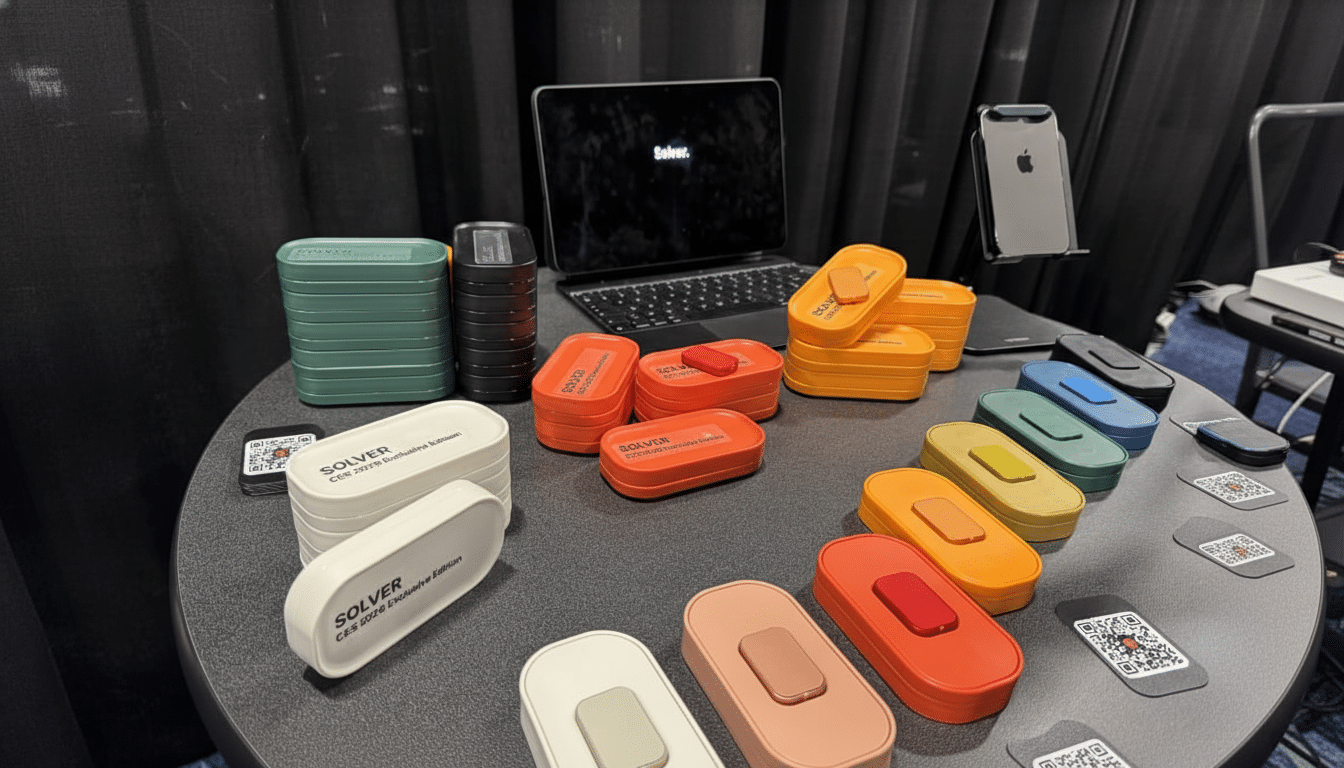
Solver, a thin magnetic add-on, snaps to the back of your smartphone (iPhone or Android) and provides you with two tactile, programmable haptic buttons that can trigger apps, shortcuts, or slightly more complex routines with an easy tap.
While most phones have either whittled away hardware buttons, Solver doubles down on tactile feedback. The pitch is simple: Grab your most-used actions without waking your screen, digging through menus, or deploying voice assistants.
How Solver’s NFC-Based Haptic Buttons Work on Phones
Solver uses Near Field Communication (NFC), which also powers contactless payments, to communicate.
There’s no battery to charge, no pairing, and no cable: each press of the button offers a new NFC trigger that your phone can map to an action. The usual read distance for NFC is a couple of centimeters, making this the perfect combination with the magnetic mount to ensure a reliable and consistent scan.
- On iPhone, the buttons can trigger Shortcuts automations.
- On Android, they can integrate with native NFC actions or third-party tools like Tasker.
In demos, taps opened apps, triggered smart home scenes, and initiated various multi-step workflows. The accessory delivers the physical click itself; haptic feedback and vibration are provided by your phone, leading to a light yet immediate feel.
There are platform-specific considerations to take into account. Recent versions of iOS and Android support background NFC scans, though some actions will still require confirmation or an unlock in accordance with Apple’s and Google’s respective security policies. The germ of the idea holds true: A physical tap can start complex routines without digging deep into a menu system.
Real-World Uses and Safety Situations for Solver
The simplest use is speed. One button might open Notes to a blank page, begin a voice memo, or switch the camera into video mode. The other could activate a commute routine — Do Not Disturb, open Maps, and then play your favorite playlist — without ever touching the screen.
Where Solver gets exciting, though, is in chained automations. With one press, a user can share their live location with preselected trusted contacts, start recording audio or video, and send that file once they’re finished. The booth demonstrated safety-focused workflows that layered an alarm sound, a location share, and a call to emergency services into one tap. NFC is passive, and it doesn’t continuously broadcast, so the device is not tracking you; it’s just starting up what your phone can already do.
Accessibility is another angle. Some users may find on-screen gestures unreliable or small touch targets a bit elusive to hit — something that physical buttons can be much more reliable for. Haptic affordances work better — you can more easily find their locations by hand, even when traveling or in low light.
Why Physical Controls Are Back on Modern Smartphones
Smartphones have gone through phases of buttons, from side keys and dedicated camera shutters to all-screen minimalism. The pendulum has recently nudged back: Apple’s Action Button brought a programmable control back to the high-end iPhone, and gaming phones have made capacitive shoulder triggers mainstream. Solver takes this a step further, adding two reprogrammable buttons to virtually any modern phone.
There’s a broader context, too. Meanwhile, in recent years IDC has noted shipments of more than one billion smartphone units worldwide, and at the high end this convenience and user experience feature set has been cited as a purchasing driver. And, as apps multiply, trimming seconds off the time taken by repetitive tasks can end up making the difference that people can actually feel every single day.
There had been earlier stabs at add-on inputs, but with trade-offs: the Pressy plug took over your headphone jack; Bluetooth “smart buttons” like Flic demanded charging and an always-on app. Using passive NFC and a trim-tab mechanical interface, Solver sidesteps the hassle of pairing and battery woes.
Compatibility, Price, and Availability for Solver
Solver is compatible with both iOS and Android handsets that have NFC, and attaches magnetically to the back of the device (or a compatible case). NFC reliability might depend on the case thickness and the materials used; just like when using contactless payments, we had no issue here: thinner cases and non-metallic ones seem the most suitable.
The accessory is available in a variety of colors for $140. That’s not impulse territory, but it targets the market of power users, creators, and commuters who appreciate fast, consistent control. For people who miss the surety of a physical press, two extra buttons that launch anything from a Spotify scene to an emergency macro could find their way onto the back of the phone permanently.
Small ideas with outsized impact often break through at CES. Solver makes no claim to reinvent the smartphone; it simply makes that other one you carry faster, safer, and sexier in your hand. In a screen-dominated world, that click may be exactly what people want to feel again.
