


A drug sometimes used to suppress milk production after childbirth was associated with substantially lower subsequent breast-cancer incidence in health records from Spain and Norway, according to researchers led by the University of British Columbia. The finding, reported Oct. 15 by UBC News, has prompted plans to test a post-weaning treatment strategy for some people at high genetic risk.
But the human result does not show that cabergoline prevents cancer. The analysis was retrospective, comparing women who did and did not receive the drug rather than randomly assigning treatment. A planned placebo-controlled trial in women with BRCA1 mutations is intended to test biological changes associated with future cancer risk after weaning; it has not yet established that the drug reduces cancer diagnoses or deaths.
Large records analysis, but incomplete clinical answers
The research team said it examined health records for more than 150,000 women in Spain and Norway with information on cabergoline use after delivery. Women who received the drug to stop lactation were about 70% less likely to develop breast cancer in the ensuing years than women who did not receive it, UBC’s account of the work, published in Cancer Discovery, said.
That is a relative comparison, not a demonstrated 70% preventive effect. The available account does not provide absolute breast-cancer risks, the number of cancer cases, follow-up time, participant characteristics, confidence intervals or details of statistical adjustment. Without those data, it is not possible to judge the size or precision of the association, or how readily it might apply to different populations.
More importantly, women given cabergoline may have differed from those who were not in ways that affect later cancer risk. The available account does not identify all such differences; possible unmeasured differences could include pregnancy or breastfeeding circumstances, access to medical care, health history or other factors. Observational data can identify a pattern worth testing, but cannot by themselves rule out those explanations.
The reported finding is nevertheless notable because cabergoline is an existing medication with a known use in suppressing lactation, and because the proposed intervention would occur after a person has finished breastfeeding. The report does not support using cabergoline to change breastfeeding duration or making postpartum treatment decisions outside a clinical study.
Why researchers are studying the period after weaning
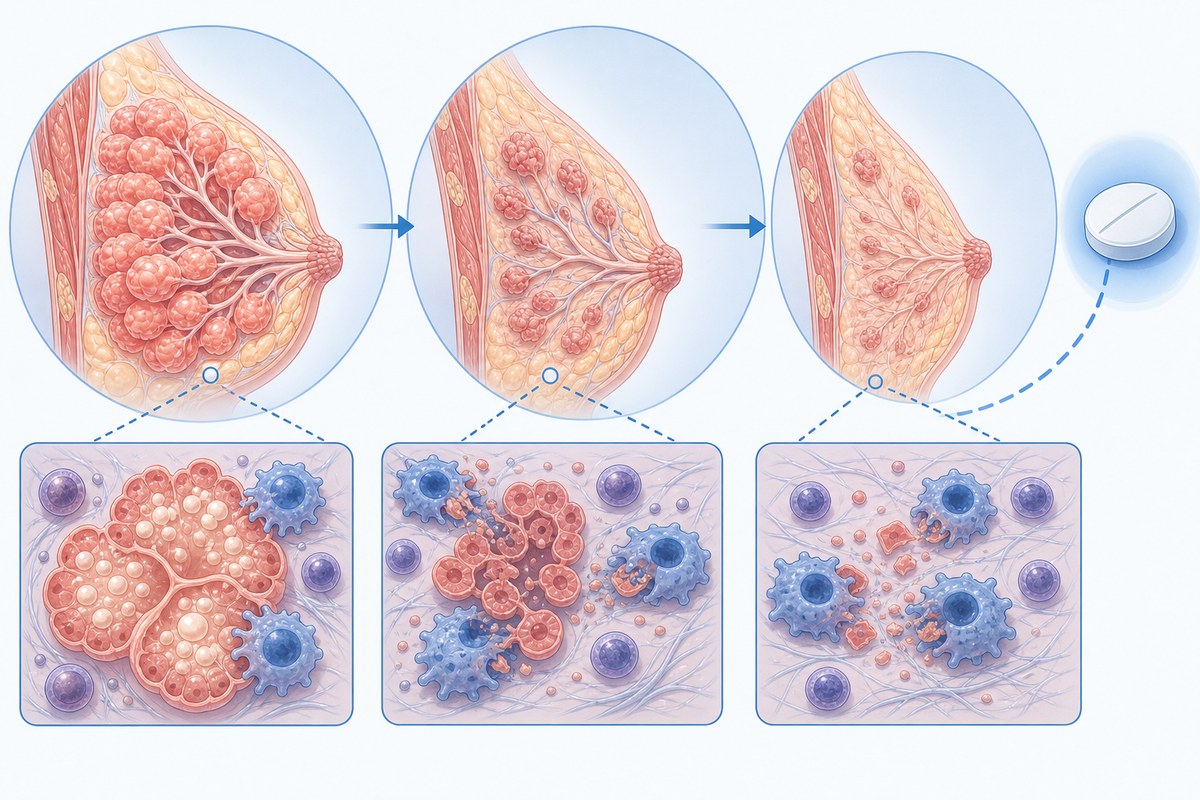
After lactation ends, breast tissue undergoes involution, a remodeling process in which milk-producing structures regress. The researchers propose that cabergoline may accelerate aspects of that process, reducing potentially abnormal tissue and increasing immune-cell clearance. This remains a biological hypothesis in people, rather than a proven explanation for the health-record association.
In experiments involving mice carrying BRCA1 and TP53 mutations, the team administered a single dose of cabergoline and reported tumor incidence about half that of comparison animals. Animal experiments can directly test an intervention in a way health-record analyses cannot. Yet genetically engineered mouse models represent particular forms of high-risk biology, and a result in those animals cannot establish effectiveness or safety as cancer prevention in people.
The focus on weaning is also distinct from the broader question of breastfeeding and long-term breast-cancer risk. It does not mean breastfeeding itself is harmful or that shortening breastfeeding would lower risk. The proposed treatment is specifically after breastfeeding has ended, and the available findings do not show whether cabergoline changes any long-term association between breastfeeding and breast cancer.
There is reason researchers have paid close attention to the postpartum interval. A 2022 Oregon Health & Science University report on a Utah database study found that, among 2,970 people diagnosed with breast cancer at age 45 or younger, cancers diagnosed within five years of childbirth were associated with 50% higher risks of metastasis and breast-cancer-specific death than cancers in people who had not given birth. That study addressed outcomes after a diagnosis, not whether cabergoline can prevent cancer, but it underscores why the biology of the period after pregnancy has drawn scientific interest.
A BRCA1 trial is planned, not completed
The UBC team has received Gray Foundation funding for a multinational trial in women with BRCA1 mutations. Participants are expected to receive cabergoline or placebo after weaning. Random assignment should make the groups more comparable and therefore offer a more reliable test of whether any observed changes are due to the drug rather than differences between patients.
As described by UBC, the planned trial will assess biological markers linked to future breast-cancer risk. Such markers can provide an important early signal, but they are not equivalent to evidence that fewer women develop invasive breast cancer or die from it. Demonstrating a reduction in cancer incidence would generally require longer follow-up and enough participants to observe a meaningful number of diagnoses.
For now, cabergoline is not an established breast-cancer prevention medicine. The National Cancer Institute describes risk-reducing surgery, enhanced surveillance and selected medicines as options that can lower risk for some people at very high risk; tamoxifen and raloxifene are FDA-approved for risk reduction in women at increased risk.
Cabergoline remains investigational for breast-cancer prevention. The planned BRCA1 trial will test whether treatment after weaning affects risk-related biomarkers; further research on cancer incidence would be needed to show preventive benefit.

