


A study published in Science has found that, among Polynesian populations included in its analysis, Native Hawaiians shared the greatest amount of Polynesian ancestry with people from Rapa Nui, also known as Easter Island. The result adds genetic evidence to long-running efforts to reconstruct the settlement of the Pacific, but it does not establish that people made a direct voyage from Rapa Nui to Hawaii.
The research, described Oct. 15 by Stanford Medicine, analyzed genomes from more than 1,000 people across Polynesia. The researchers reported that Mangareva, in the Gambier Islands of French Polynesia, showed the next-closest Polynesian ancestry relationship to Native Hawaiians. Their interpretation is that Hawaii’s settlement history involved an ancestral voyaging population connected with those islands, rather than that the study has recovered a literal map of a single journey.
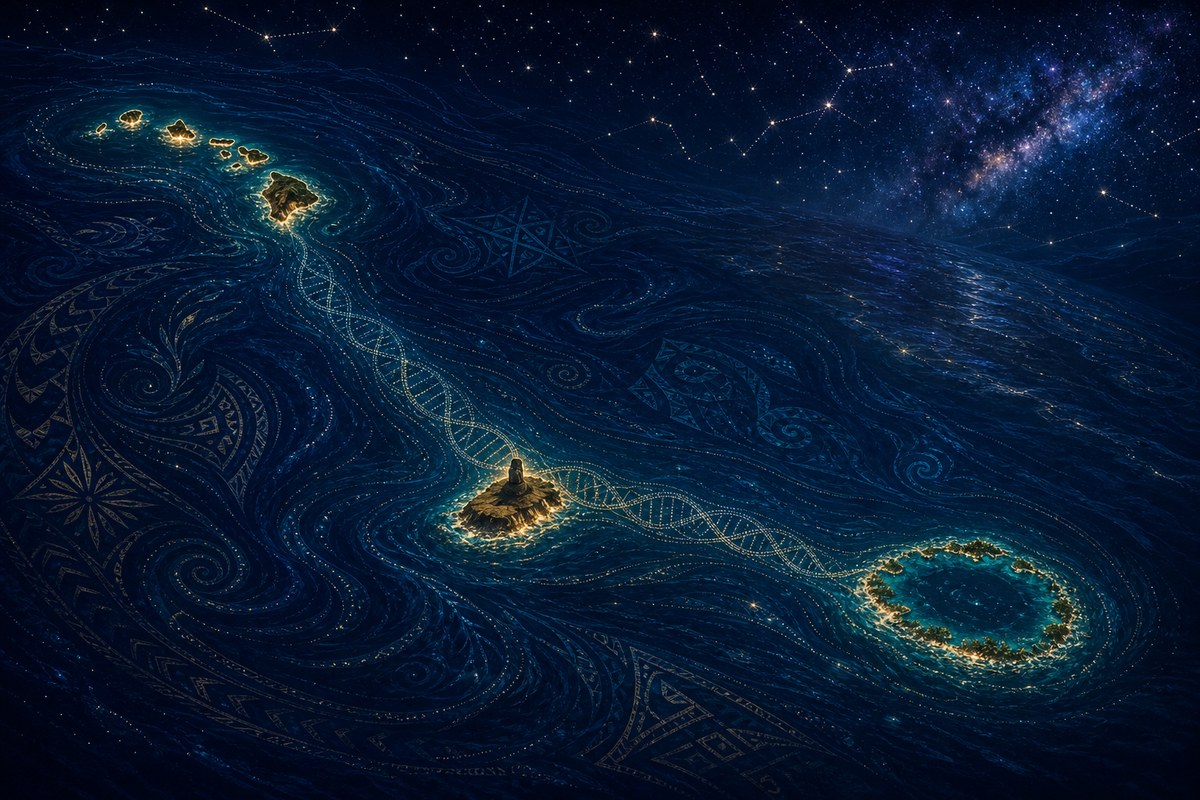
What the genome comparisons found
The team focused on portions of participants’ DNA assigned to Polynesian ancestry, then compared identity-by-descent segments: long stretches of chromosomes inherited from a shared ancestor. In general, more or longer such shared segments can point to a more recent common ancestral population. This approach can reveal patterns of population relatedness even when no written records exist from the period being studied.
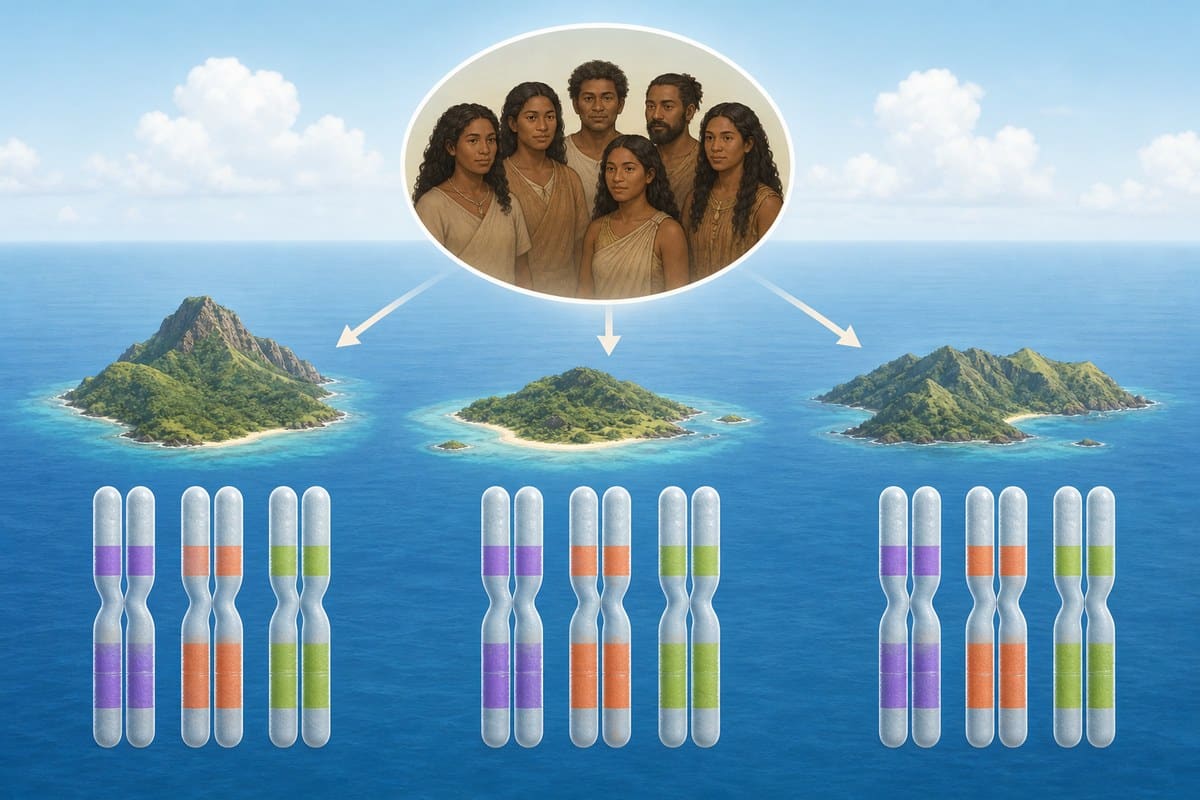
In the comparison, the strongest reported Polynesian-ancestry sharing for Native Hawaiians was with Rapa Nui, followed by Mangareva. Stanford’s account said the investigators viewed the pattern as consistent with an ancestral pathway involving Mangareva and Rapa Nui before Hawaii was settled. Alexander Ioannidis, a Stanford geneticist and co-senior author, and Keolu Fox, an anthropologist at the University of California, San Diego, were co-senior authors of the work.
The finding is significant because the islands are separated by vast distances and because Pacific settlement has been investigated through archaeology, linguistics, oral traditions and navigation knowledge as well as genetics. Genome-wide evidence can add one line of evidence to that work; it does not replace those other records or Indigenous knowledge systems.
Shared ancestry is not proof of a direct voyage
The analysis used genomes from contemporary people, not DNA recovered from ancient settlers in Hawaii or Rapa Nui. As a result, it can infer historical population relationships but cannot independently identify the direction, timing or exact route of an individual expedition. Multiple population histories can sometimes produce related patterns of genetic sharing.
An independent account by ZME Science similarly noted that the genetic result does not prove direct travel between Rapa Nui and Hawaii. A shared ancestral population, movement through intermediary islands, or other connections within the wider Eastern Polynesian network could help explain related genetic patterns. The available reporting does not settle among those possibilities.
That caution is especially important because phrases such as “origin” can suggest a single, simple answer to the history of Native Hawaiian people. The reported result is narrower: a comparison of Polynesian-ancestry segments in sampled present-day populations found the closest relationship, within this dataset, between Native Hawaiians and Rapa Nui people. Stanford said that more genomic data would be needed for similarly detailed reconstructions of Hawaii and Rapa Nui themselves.
The study also used patterns of DNA shared within the Tahitian population to model earlier demographic events. Stanford reported an estimate that a founding generation of about 800 reproductive-age people arrived in Tahiti around 34 generations ago, or roughly 1070. Such figures are model-based estimates derived from genetic patterns, not a census-like count of historical arrivals. Stanford also said earlier work by the researchers dated settlement of Rapa Nui to about 1210.
Evidence of repeated population bottlenecks
Beyond the Hawaii-Rapa Nui comparison, the study reported pronounced serial founder effects in Eastern Polynesia. A founder effect occurs when a new population is established by relatively few people, carrying only part of the genetic diversity of the larger population from which they came. Repeated settlement of distant islands by relatively small groups can compound that effect over generations.
According to Stanford’s report, the cumulative founder effects detected in Eastern Polynesian populations were more than 10 times larger than those documented in several extensively studied populations of European descent that also underwent founder events. That demographic history can increase the frequency of some otherwise uncommon genetic variants, while reducing overall genetic diversity in particular regions of the genome.
Founder effects do not mean that any population is genetically uniform, nor do they determine an individual’s health. They are population-level descriptions of how migration, isolation and chance can shape the distribution of genetic variation. The magnitude and implications of such effects can also vary between islands and communities.
Why the work may matter for health research
The researchers examined three variants in the genes ADAMTSL4, PDE6B and FAN1, which have previously been linked to autosomal recessive eye and kidney conditions among Eastern Polynesians. Stanford reported that each variant was carried by 2% to 3% of the Eastern Polynesian participants studied, while being rare in global population datasets.
A carrier frequency is not the same as disease prevalence. For a recessive condition, a person generally must inherit relevant variants from both parents to be affected, and clinical risk depends on the specific variant, inheritance pattern and other medical evidence. The reported percentages therefore do not mean that 2% to 3% of Eastern Polynesians have the associated conditions.
Still, the findings illustrate a persistent problem in genomic medicine: databases have disproportionately drawn on people of European ancestry, making it harder to interpret variants found more often in other populations. Better representation could help researchers distinguish harmless variation from variants that warrant further clinical study. It would not by itself justify a population screening program, which would require validation, clinical planning and community-engaged decision-making.
The study received National Institutes of Health funding, according to Stanford Medicine. Its authors called for additional sequencing and characterization of inherited conditions among Native Hawaiians and other Polynesian communities—work that could refine both the historical inferences and the medical relevance of variants that global databases have often overlooked.

