


Introduction: Why “Edge” matters now
Clear definition of edge computing
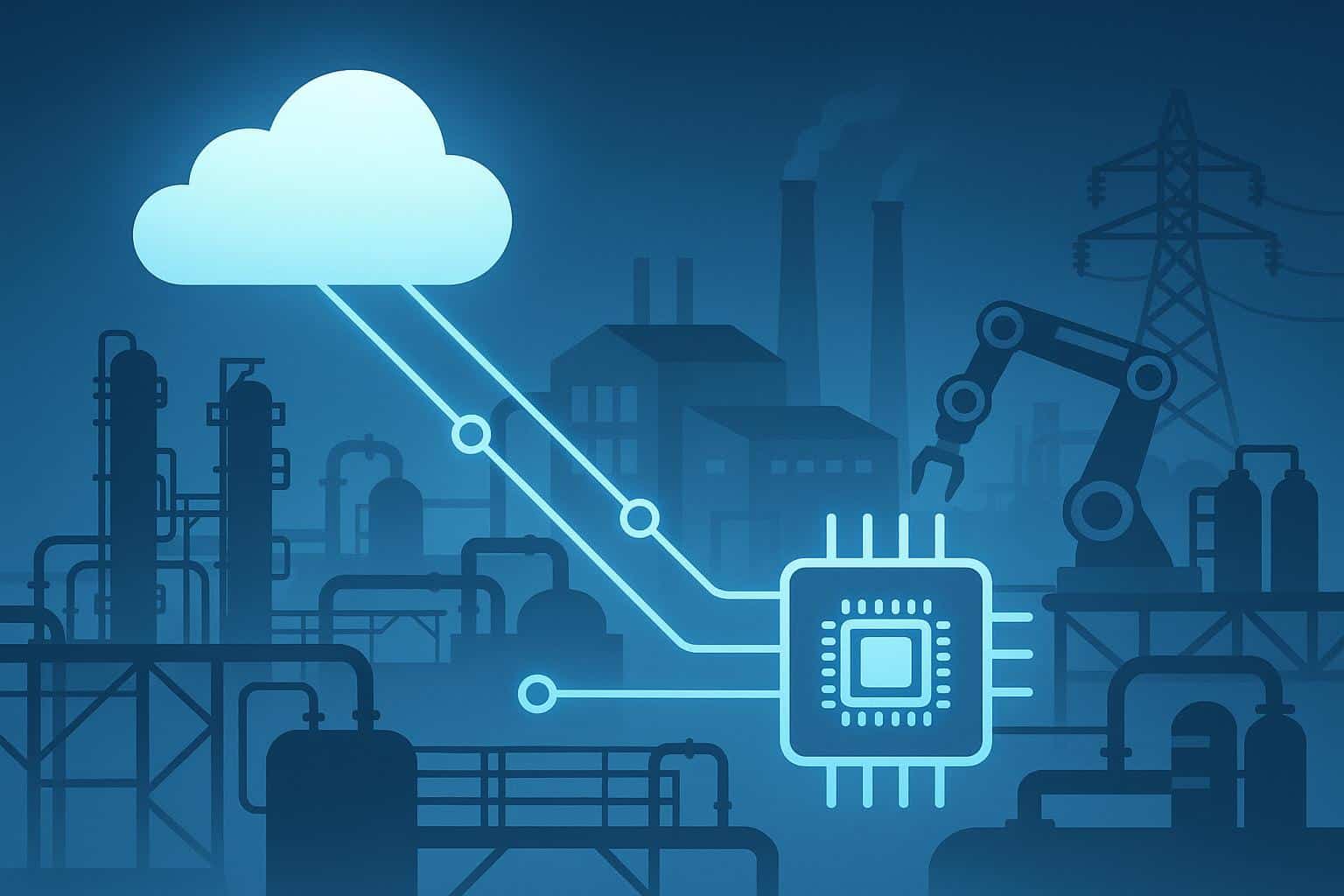
Edge computing moves data processing closer to the devices that generate it, performing analysis and control at or near the network edge rather than immediately forwarding raw telemetry to a central cloud. Unlike a cloud-only model, edge architectures reduce round-trip latency and limit bandwidth use by sending only processed results upstream. Manufacturing and critical infrastructure commonly require deterministic responses and local autonomy, which make them natural candidates for edge deployments. This local processing shifts some responsibilities traditionally held by the cloud—real-time control, short-term storage, and immediate decision making—into on-site hardware.
The operational problem it solves
Plant floors and remote sites face several recurring problems: stringent latency requirements for control loops, high costs for transporting and storing raw telemetry in the cloud, and unreliable WAN connectivity in industrial environments. These limitations cause slower detection of faults, inefficient control actions, and lost optimization opportunities that translate to downtime and higher operating costs. Edge computing addresses those problems by enabling immediate local decisions, selectively uploading data, and maintaining operation during connectivity disruptions. The practical question for many teams is therefore not whether to use cloud or edge, but how to balance them.
- Introduction: Why “Edge” matters now
- Clear definition of edge computing
- The operational problem it solves
- Quick preview of article structure
- Technical foundations: what an industrial edge looks like
- Basic architecture: edge, fog, cloud
- Hardware and devices that comprise the edge
- Protocols and data flow
- Enterprise benefits & measurable ROI
- Deployment patterns & integration strategies
- Hybrid edge-cloud pattern
- Orchestration, updates, and lifecycle management
- Sourcing and procurement considerations
- Security, standards, and interoperability
- Challenges, pitfalls, and best practices
- Conclusion & practical next steps
Quick preview of article structure
This article outlines the technical foundations of industrial edge deployments, describes measurable enterprise benefits and KPIs, and explains common deployment and procurement strategies. It also covers security, standards, and interoperability checks that support reliable production use, plus a compact set of best practices to avoid common pitfalls. The aim is vendor-neutral guidance that helps OT and IT teams plan a practical pilot and scale responsibly.
Technical foundations: what an industrial edge looks like
Basic architecture: edge, fog, cloud
Industrial architectures are typically layered: sensors and actuators at the field level feed edge devices (PLCs, gateways, and IIoT modules), which in turn may connect to a local aggregation or “fog” tier before data is forwarded to cloud platforms. Each layer has responsibilities: the edge handles deterministic control and event filtering, the fog performs near-real-time aggregation and local analytics, and the cloud provides model training, long-term analytics, and archival storage. Understanding which functions belong at each layer is critical to answering search queries such as “edge vs fog vs cloud architecture.”
Hardware and devices that comprise the edge
Typical edge hardware includes industrial controllers (PLCs/RTUs), protocol gateways, IIoT modules, compact edge servers, and rugged I/O units designed for harsh environments. These devices vary by compute capability, I/O density, environmental rating (temperature, vibration, ingress), and lifecycle support—factors that determine suitability for particular floor or field tasks. Procurement teams often compare MTTF, warranty terms, and protocol support when selecting components. For neutral supplier listings of industrial edge controllers and I/O modules consult vendor catalogues that focus on industrial specifications rather than consumer features.
Protocols and data flow
Field and messaging standards govern reliable data exchange at the edge: Modbus and EtherNet/IP for legacy connectivity, OPC UA for semantic interoperability, and MQTT for lightweight telemetry to cloud systems. Protocol choice impacts latency, payload size, and interoperability with existing SCADA/IT stacks, so teams should prioritize standards that support compact, secure telemetry and can bridge to cloud APIs when needed. Designing data flows around event-driven uploads and schema-based payloads reduces complexity and bandwidth consumption.
Enterprise benefits & measurable ROI
Latency, closed-loop control, and safety
On-device processing provides deterministic responses required for motion control, safety interlocks, and time-critical protection schemes. Millisecond-level improvements in control response can prevent equipment trips or product defects that otherwise cause extended downtime. By handling time-sensitive logic locally, systems maintain safe and predictable behavior even when central services are temporarily unreachable. This capability is often the primary business driver for edge adoption in manufacturing.
Bandwidth and cost savings
Pre-processing at the edge—filtering, aggregation, and event-driven uploads—reduces the volume of data sent to the cloud and lowers egress and storage costs. A simple pilot calculation compares raw telemetry throughput to aggregated event summaries to project monthly GB savings and cost reduction. Teams should track actual payload volumes during a short pilot to validate assumptions and refine data retention policies before scaling.
Resilience and local autonomy
Edge systems can continue critical functions during WAN outages by running local ML inference, buffering historian data, and executing safe shutdown routines when necessary. That local autonomy preserves production continuity and reduces the operational impact of network incidents. Key KPIs to measure ROI include:
- Reduction in data transmitted to cloud (GB/day)
- Improvements in mean time to detect/resolve (MTTD/MTTR)
- Reduction in unplanned downtime (hours/month)
Deployment patterns & integration strategies
Hybrid edge-cloud pattern
Most industrial deployments use a hybrid model: on-prem inference and short-term analytics at the edge, with model training, historical analytics, and fleet-level monitoring in the cloud. Clear handoff rules determine what stays local (safety, control) and what is aggregated upstream (trend data, training sets). This approach enables cloud resources to focus on non-real-time workloads while preserving deterministic edge behavior and answers typical integration questions for Azure/AWS/GCP hybrid setups.
Orchestration, updates, and lifecycle management
Successful rollouts require device provisioning, secure over-the-air (OTA) updates, and configuration drift detection to maintain fleet consistency. Centralized orchestration platforms support staged rollouts, health monitoring, and rollback mechanisms to limit operational risk. Include telemetry for device health, firmware version, and network performance as part of routine operational dashboards.
Sourcing and procurement considerations
When buying edge hardware verify intellectual property protection, environmental ratings, MTTF figures, warranty terms, and native support for industrial protocols. Ensure supplier transparency on firmware signing and update procedures to reduce lifecycle risk. For a vendor catalogue oriented to industrial automation buyers, consider Iainventory as a reference entry point for compatible components and documentation.
Security, standards, and interoperability
Threat model and mitigations
Edge devices face threats such as exposed management ports, insecure local services, and supply-chain firmware risks. Mitigations include strong device identity, mutual TLS for connections, signed firmware updates, and network segmentation that enforces least privilege between OT and IT zones. Regular vulnerability scanning and patch management are essential controls for production deployments.
Standards and compliance to mention
Referencing recognized standards increases trust: OPC UA’s security model for secure data exchange and IEC 62443 for OT security practices are particularly important. These frameworks provide prescriptive controls and architectures teams can adopt to demonstrate compliance and improve governance. Aligning pilots to these standards simplifies audits and vendor evaluation.
Interoperability checklist
Validate that devices support common data models, protocol bridges, and vendor-neutral APIs before large-scale procurement. A short validation sequence for pilots:
- Confirm protocol compatibility (OPC UA/MQTT) with existing SCADA/IT systems.
- Test semantic mapping and schema translation for key variables.
- Verify OTA update process and rollback on representative hardware.
Challenges, pitfalls, and best practices
Common pitfalls
Frequent causes of edge project failure include scope creep (trying to solve too many use cases at once), underestimating lifecycle and support costs, and poor OT/IT coordination. Ignoring governance and change control leads to configuration drift that undermines reliability. Address these risks early with clear pilot objectives and cross-functional ownership.
Best-practice checklist
Implement a compact set of practices to increase success probability:
- Start with a high-value pilot tied to measurable KPIs.
- Use standards (OPC UA, MQTT) to reduce vendor lock-in.
- Plan OTA updates, monitoring, and a rollback strategy.
- Integrate OT and IT teams from project inception.
Conclusion & practical next steps
Key takeaways
Edge computing complements the cloud by delivering low-latency control, reduced bandwidth costs, and greater resilience for industrial systems. Realizing these benefits requires disciplined lifecycle management, adherence to security standards, and an interoperability-first procurement approach. Properly scoped pilots validate assumptions before scale-up.
Actionable next steps for teams
Identify a single, measurable pilot use case, select compatible devices and protocols, and run a 3-month validation focused on the KPIs above. Use centralized orchestration and staged OTA processes when scaling, and document compliance to OPC UA and IEC 62443 to support governance. Measure results objectively and iterate—edge success is operational discipline as much as technology choice.
