


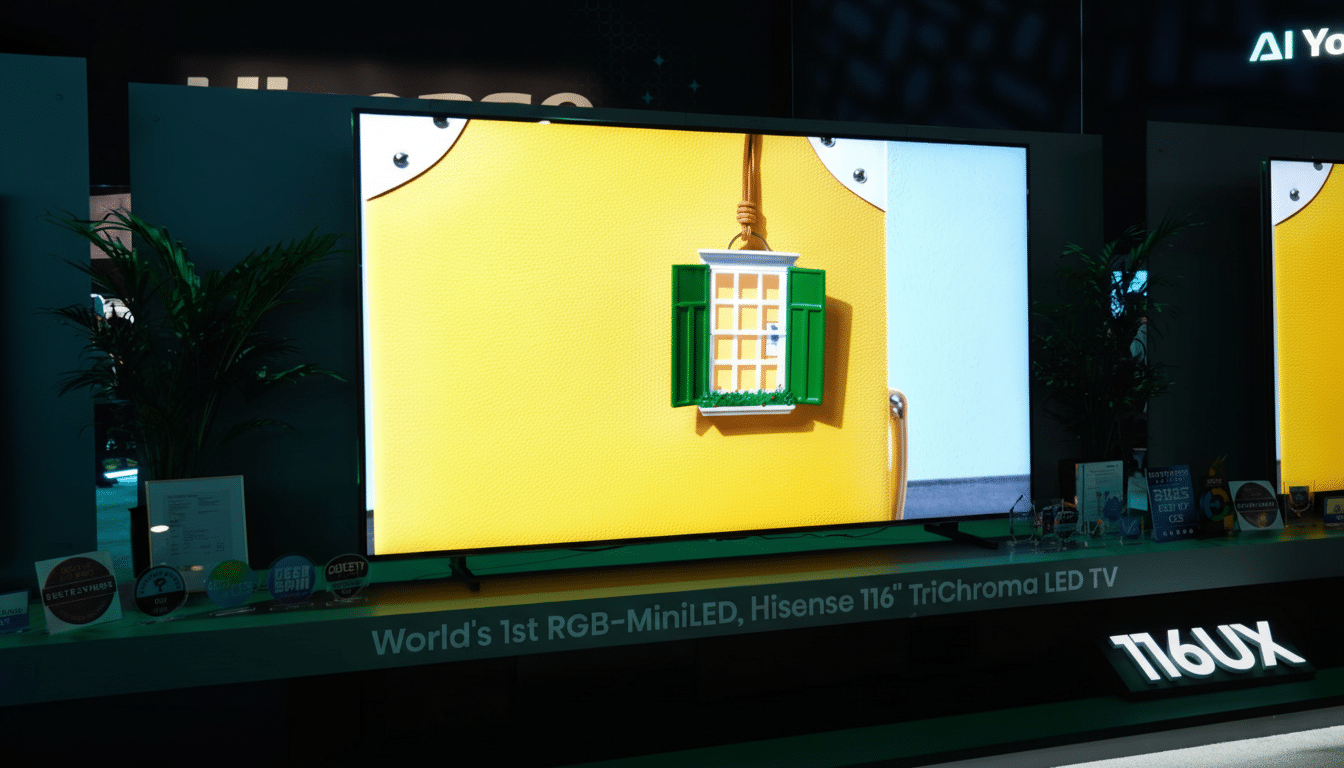
Hisense made a point of showcasing color science at CES, with the fourth-primary approach on its halo sets and taking self-emissive displays in a new direction. A cyan-enriched RGB MiniLED evo backlight debuts with the 116UXS, while a new 163-inch MicroLED called the 163MX introduces a yellow subpixel to deliver what the company says is the industry’s first RGBY MicroLED. Hisense promises smoother gradients, more realistic transitions, and wide-gamut results that stretch up to 110% of BT.2020 on the 116UXS and up to 100% on the 163MX, alongside a wider spread of its 2025 RGB MiniLED tech across more affordable UR9 and UR8 models from 55 to 100 inches.
What Hisense Altered Around Color Science and Primaries
Red, green, and blue primaries are what most color TVs use to create images. Hisense also adds a cyan subpixel (dubbed “sky blue”) because our visual system happens to be particularly sensitive to changes around the blue-green range. That fits the CIE color-matching functions, which show increased discrimination in the 490–510 nm range. In practice, it should help preserve subtle tonality in ocean scenes, skylines, and skin highlights that may band or clip on a traditional RGB set.
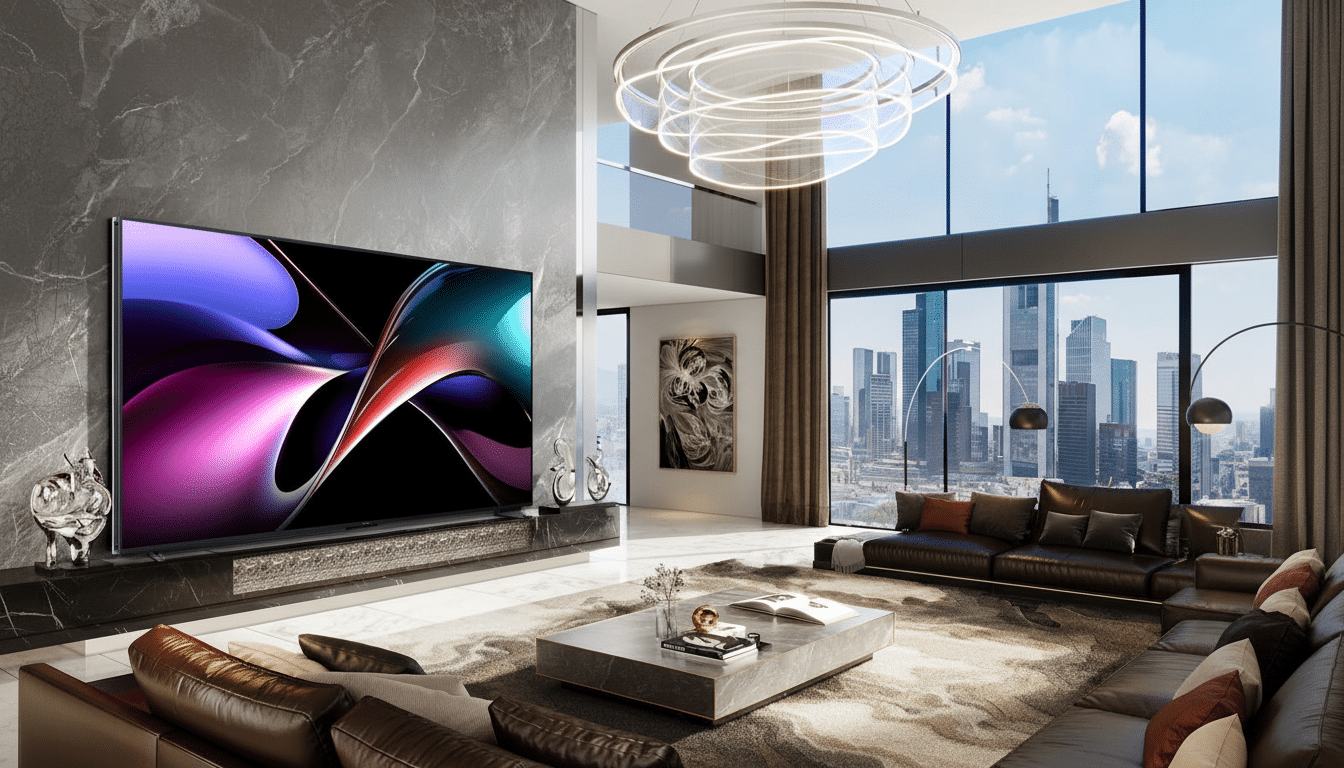
Adding a fourth primary is not straightforward. It requires tighter color management and more careful mapping so that additional saturation doesn’t push hues out of whack. Hisense says its processing emphasizes luminance balance and hue accuracy, with the goal of improving shadow blending and detail in brighter scenes without introducing posterization that often accompanies heavy-handed gamut expansion.
RGB MiniLED Evo Debuts on Stage in the 116UXS
RGB MiniLED evo with cyan gets its debut in the 116UXS, which combines a densely packed MiniLED backlight with an additional subpixel to improve color accuracy. Hisense is promising richer midtones, cleaner specular highlights, and more consistent color in SDR and HDR, not only on demo reels but with everyday content like sports, games, and streaming TV.
That “up to 110% BT.2020” figure requires context. ITU-R BT.2020 defines a very wide color container. When vendors speak of more than 100% gamut, they are describing coverage on an x–y chromaticity graph under particular measurement conditions—not measurable primaries beyond the spectral locus. The tangible benefit here is more headroom for saturated teals, cyans, and greens. Most movies and TV shows are still mastered to P3 within the BT.2020 container. Expect the benefit to appear in animation, game HUDs, and nature docs with challenging water and sky gradients.
Real-life example: under stadium lights, grass can go from emerald to fluorescent on lesser sets. With a cyan subpixel and improved tone mapping, uniforms, turf, and skin tones should retain separation without appearing oversharpened or overly vibrant.
MicroLED Lets Yellow Into the Mix for RGBY Color
At the absolute high end, Hisense’s 163MX adds a yellow subpixel to MicroLED to create an RGBY stack designed to close the 500–600 nm “spectral gap” between green and red. That in turn should make for more convincing golds, ambers, and warm skin undertones—tones that conventional RGB can skew or dim when pushed hard.
The idea of adding yellow is not new to the industry—Sharp experimented with RGBY in its Quattron LCDs—but in the case of self-emissive MicroLED, it is an interesting exercise. The technology’s per-pixel control enables very high peak brightness and low-level precision, but adding a fourth primary color puts additional strain on calibration to achieve chromatic parity across panels. Hisense announced that its color management balances luminance with hue in order to achieve up to 100% of BT.2020. For years, analysts at organizations such as DSCC have observed that MicroLED emission wavelengths are tunable via material science and conversion layers. Nevertheless, the problem remains how to maintain consistency at scale. If Hisense’s RGBY experiment is commercially sustainable, it may increase color volume without sacrificing accuracy. Also, RGB MiniLED technology for 2025 is being passed down to its flagship UR9 and UR8 collection. MiniLED technology has been hailed as a solution for bright living rooms, with Hisense claiming that it will keep stable, natural color in fast-moving content like sports and video games, a scenario where other implementations can look isolating or exhibit haloing. An Omdia market study has reported MiniLED’s explosive growth in recent years as more brands aim to increase brightness while gaining more granular local dimming on LCD. In contrast, the wider array of sizes hints at Hisense aggressively targeting a broader number of price points with broad-gamut, high-APL performance, although pricing and fully specified models are still under review.
Color advancements are again most important in the real world, where ambient light can interfere and HDR needs both oomph and fidelity. A properly formulated 4th color—(four-color process: cyan, magenta, yellow, and black)—can minimize banding, maximize highlight saturation, and do away with obnoxious “showy” colors.
Competition is getting hotter. LG is promising big gains in OLED brightness this year, and Samsung continues to refine its MicroLED and quantum dot offerings. Hisense’s bet is an unorthodox one: add more primaries and rely on processing to provide nuance that survives the light in a living room and fast motion.
The proof will be in calibrated results—D65 white, EOTF tracking, and color volume across luminance. That suggests cleaner cyan skies, more believable yellows and ambers, and smoother tonal ramps in shadows, among other things. If wide-gamut accuracy and high-brightness-room HDR are your bag, then the 116UXS and 163MX chart a bold course, with UR9 and UR8 presumably looking to bring pieces of that color story at more mainstream sizes.
