


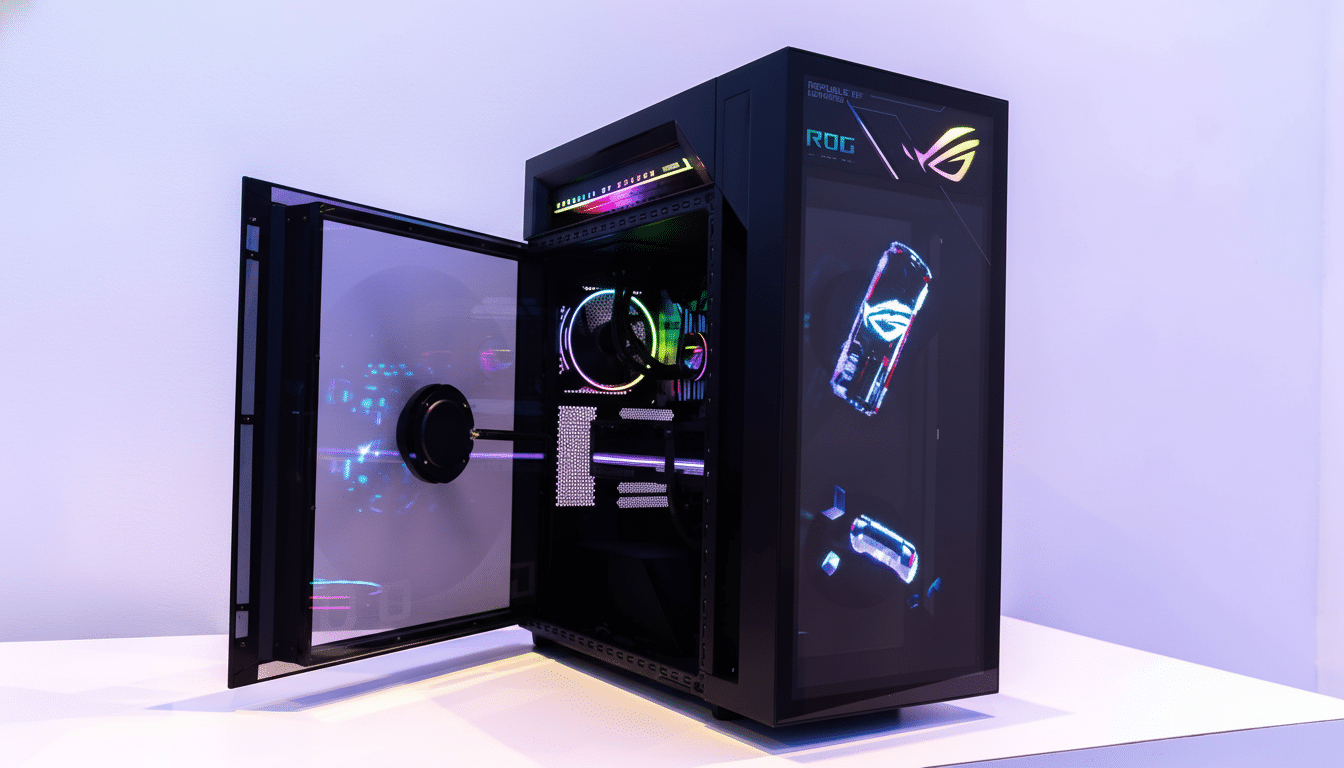
Asus is transforming the desktop into an animated canvas. The towering gaming PC ROG G1000, displayed pre-CES, incorporates spinning LED “holo” bars within its side and front glass to project rotating animated imagery that seemingly floats in the air. It’s not just yet another RGB strip: it’s a persistence-of-vision display named ROG AniMe Holo, which turns the system into what looks like an interactive showpiece without compromising airflow or serviceability.
Beneath the showmanship, there’s real hardware here, with setups that max out at an AMD Ryzen 9 9950X3D and Nvidia GeForce RTX 5090, powered by an X870 motherboard nonetheless and DDR5. But here the story isn’t just speeds and feeds, it’s a new way of melding showcase design with thermals and practicality.
Holograms in Glass Are No More Than RGB Effects
The G1000’s panels deploy high-speed spinning LED bars placed behind tempered glass to project images that linger in your vision, just like the same physics at work in retail “holo fans,” which display rotating logos floating around in midair.
In real life, the effect is motion-true and bright and has only a hint of strobing even on off angles. In demos, the side panel displayed a swirling ROG logo that moved around while the front showed a spinning Coke can — an in-case ad thrown in for good measure.
Since the display is physically within the case, Asus can sync them up with system telemetry. Picture this: GPU temperatures pulsing into a warning graphic mid-render; or game-integrated callouts when you heal, reload, or pull off a round-clinching play. That sort of contextual feedback is where POV displays go beyond fun novelty — useful status at a glance, without needing to ever add another discrete screen to your desk.
And on a mechanical level, the shifting bars raise questions about longevity and noise. The demo units were quiet up close, and the motors were kept away from the chassis to prevent vibration being transmitted into the glass. Reliability will be in the bearing design and dust management — you look at retail POV units, some run for thousands of hours, but over time enclosure sealing and filter quality is what counts!
Cooling Architecture Designed for Real Work
It chunks up its interior into three airflow zones, a configuration that several other boutique builders (and mainstream brands) have proved effective on individual dual- and tri-chamber cases. At the top, a dedicated CPU bay is accompanied by a 420mm liquid cooling support that faces straight upwards. A 420mm exchanger has approximately 30% more fin and fan sweep area than a 360mm, which is just enough headroom for the densest of the 3D V-Cache CPUs at sustained all-core loads.
The middle section takes care of the motherboard, memory, and GPU along a front-to-back route uncorrupted by PSU heat. Down below, the power supply breathes on its own and vents out the rear. This separation alleviates thermal cross-talk; third-party testing from the likes of GamersNexus has shown configurations like this can drop GPU temps a few degrees Celsius under load when properly airflow-balanced.
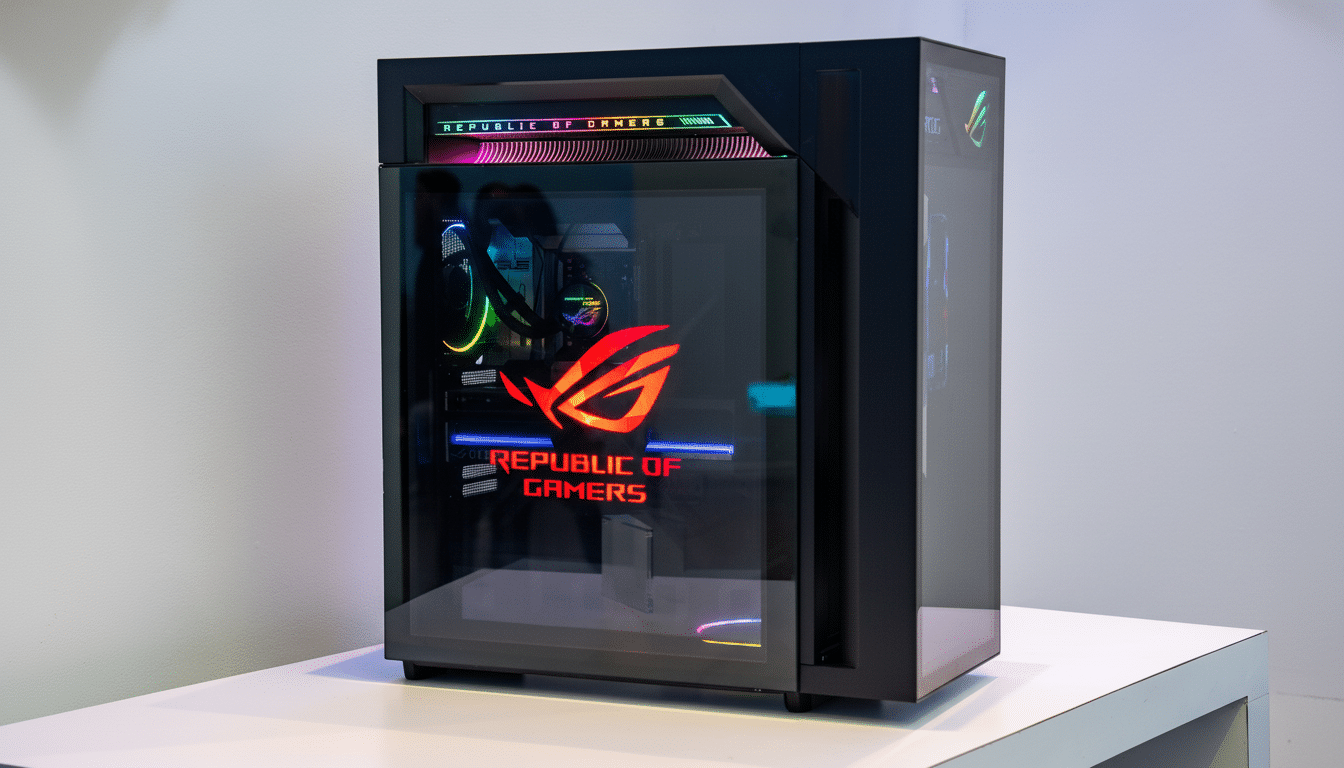
Over the course of our tests, even early paper demonstrations made it clear: there is intake all around as much as there can be while exhausting aggressively out the top, with a steadily drawing PSU shroud.
What matters is surface area: the case has generous mesh and venting, allowing fans to move air at lower RPMs with a resulting reduction in tonal spikes that people are more likely to perceive as annoying and discordant than they would raw volume.
High-End Specs and a Clear Upgrade Path for Users
Asus has its sights on the sky with a G1000 that can be configured up to a Ryzen 9 9950X3D chip, GeForce RTX 5090 graphics, DDR5 memory and an X951 platform featuring Asus’ AEMP II memory optimization. Although detailed SKU lists weren’t provided, the chassis is tool-free and accepts standard components, which matters if you are thinking about swapping GPUs or adding storage as needs evolve.
One of the unseen heroes in builds like this is power delivery. Expect ATX 3.x readiness and native 12V-2×6 cabling for next-gen GPUs under transient spikes. That, plus the 420mm top radiator and independent PSU thermals, will keep the usual cascade in check where CPU radiators hate the GPU zone and vice versa.
Why This Design Push Matters for Future Desktops
Desktop gaming is a visual pastime and people like the option to personalize. Jon Peddie Research has consistently underlined that top-tier GPUs are the lifeblood of the enthusiast market, and high-wattage flagships need smarter airflow, not just larger fans. The G1000 plays to both truths, employing compartmentalized cooling as a means of taming heat even while transforming the case into an ambient display.
Crucially, the “holo” conception is no dead-end flourish. Should Asus reveal an open tool or profile library, content creators could share animations, studios could brand event rigs and streamers could toss live alerts onto the glass. It’s the same flywheel that made RGB useful when it became software-addressable as opposed to a fixed color wheel.
Lab testing will be required to confirm the acoustics and thermals with shipping configs, particularly under heavy GPU loads, like those 350W systems or even 450W gaming cards are pulling these days. But on ambition alone, the ROG G1000 points us down a path for premium towers: surfaces that talk back, cooling that tells folks what it’s off to do in no uncertain terms, and hardware that requires you don’t pick between showpiece and workhorse.
