


NASA’s first crewed Artemis mission is closing in on the pad, and with it comes the practical info people actually need: how to watch and when liftoff can happen. The agency has outlined multiple launch opportunities for Artemis II and detailed where every major step — from fueling test to liftoff — will stream live.
The mission will send Commander Reid Wiseman, pilot Victor Glover, mission specialist Christina Hammock Koch, and Canadian Space Agency astronaut Jeremy Hansen on a 10-day lunar flyby to prove Orion’s life support, navigation, and comms in deep space. While no landing occurs, this is the shakedown cruise that will set the tone for the first lunar surface attempt that follows.
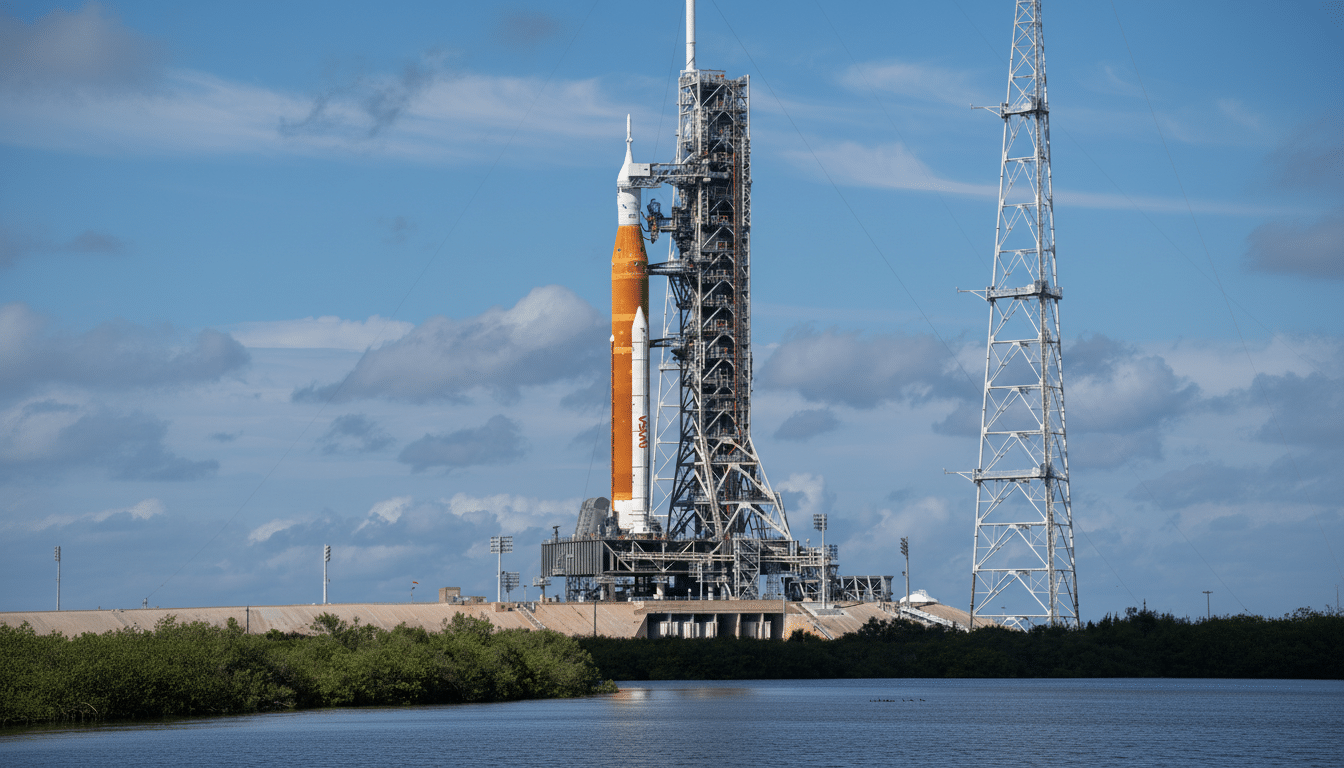
Before managers pick a specific date, teams will conduct a full “wet dress rehearsal” at Kennedy Space Center’s Launch CompleX 39B, chilling down lines and loading the Space Launch System with liquid oxygen and liquid hydrogen. If the rocket, ground systems, and countdown flow perform to expectations, mission leadership can move to the earliest available opportunity; if not, they’ll pivot to later windows.
How To Watch The Artemis II Livestream Across NASA Channels
NASA will carry comprehensive live coverage across its official channels, including NASA TV, NASA’s YouTube channel, NASA+, Facebook, and its account on X. Expect wall-to-wall programming on tanking operations, the crew walkout and suit-up, launch and ascent, and translunar injection. NASA typically offers additional behind-the-scenes segments and commentary in the hours leading up to liftoff.
NASA+ is the agency’s free, ad-free streaming service available on major platforms and mobile apps. Many local broadcasters and third-party OTT services often simulcast NASA’s feed; check provider listings as launch day approaches. Spanish-language coverage is commonly offered via NASA en Español channels.
For enthusiasts who like a long lead-up, NASA also maintains a persistent pad camera view of the 322-foot SLS at the pad following rollout from the Vehicle Assembly Building. That feed typically goes live well ahead of the countdown and provides an unfiltered view of weather and pad activity.
Understanding The Launch Window For Artemis II
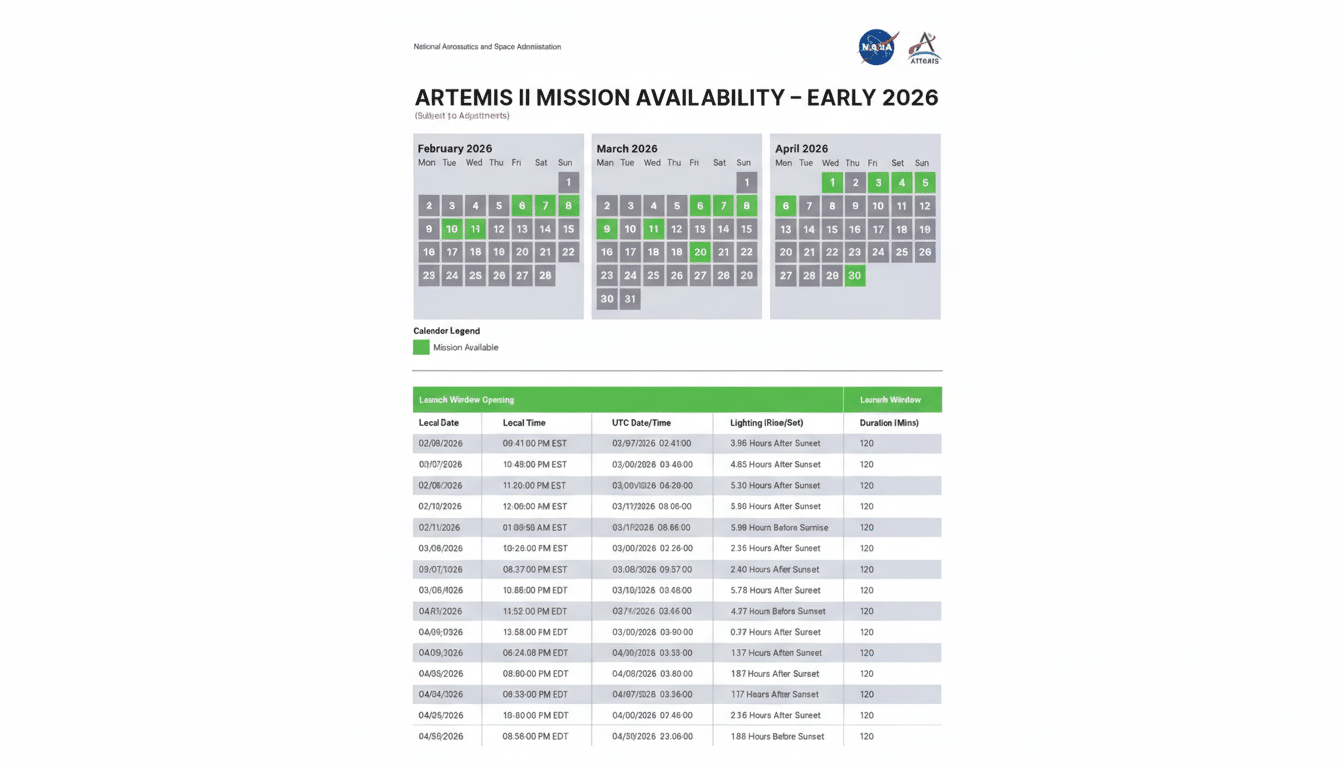
Artemis II can only launch when orbital mechanics and mission rules align. The pad must rotate into the correct plane for the parking orbit; the moon’s position must enable a precisely timed translunar injection; the trajectory must satisfy lighting constraints for tracking and optics; and the Eastern Range must clear air and sea traffic. The result: a handful of tightly defined opportunities, many in evening and overnight hours, each roughly two hours long.
Weather also matters. Cryogenic fueling is sensitive to winds, lightning, and upper-level conditions, and range safety is overseen by Space Launch Delta 45. If any constraint trips during the countdown, teams can pause, recycle within the window, or stand down to the next opportunity.
February Launch Opportunities For Artemis II
- Feb. 6: Window opens 9:41 p.m. ET (two hours).
- Feb. 7: Window opens 10:46 p.m. ET (two hours).
- Feb. 8: Window opens 11:20 p.m. ET (two hours).
- Feb. 10: Window opens 12:06 a.m. ET (two hours).
- Feb. 11: Window opens 1:05 a.m. ET (two hours).
March Launch Opportunities For Artemis II
- March 6: Window opens 8:29 p.m. ET (two hours).
- March 7: Window opens 8:57 p.m. ET (two hours).
- March 8: Window opens 10:56 p.m. ET (two hours).
- March 9: Window opens 11:52 p.m. ET (two hours).
- March 11: Window opens 12:48 a.m. ET (1 hour 55 minutes).
April Launch Opportunities For Artemis II
- April 1: Window opens 6:24 p.m. ET (two hours).
- April 3: Window opens 8:00 p.m. ET (two hours).
- April 4: Window opens 8:53 p.m. ET (two hours).
- April 5: Window opens 9:40 p.m. ET (two hours).
- April 6: Window opens 10:36 p.m. ET (two hours).
- April 30: Window opens 6:06 p.m. ET (two hours).
What To Expect On Artemis II Launch Day Events
The countdown is a disciplined ballet. After fueling, SLS’s four RS-25 engines and twin boosters ignite to produce roughly 8.8 million pounds of thrust, placing Orion into orbit for systems checks before the upper stage performs the translunar burn. From there, the crew will loop past the moon and return for a high-energy reentry and splashdown designed to validate heat shield performance under crewed conditions.
If the wet dress reveals issues or weather or range constraints intervene, managers can scrub and move to the next available date. Recycle times vary depending on how far the countdown progressed and how much cryogenic propellant must be detanked, but one- or two-day turnarounds are common for a vehicle of this scale.
NASA, Johnson Space Center, and Kennedy Space Center public affairs offices will issue updated advisories as the team narrows on a target. For the most reliable schedule and live coverage, stick to the agency’s official channels listed above.
