


Apple is working on the most ambitious update to its Siri voice assistant yet, with a new system that could more directly challenge Google’s market-leading search engine. It will be among the first major overhauls of Siri since its release, as Apple attempts to catch up with counterparts from rivals like Amazon and Google. According to several reports from Bloomberg and 9to5Mac, the plan is to ship the revamp of iOS (called Snow) with a future point release. The bigger question remains: Will this be the moment that Siri finally catches up after years of false starts?
What the New Siri Is Supposed to Do Across Apple Devices
Apple is developing an LLM-based Siri — a conversational model. Anticipate more seamless back-and-forth, the ability to hang on to context between turns, and even to follow several steps of multi-part instructions without the need to phrase them so stiltedly.
- What the New Siri Is Supposed to Do Across Apple Devices
- Why It Matters for Apple’s Ecosystem and Users
- The Technical Bet: On Privacy and Latency
- The Bar for Competition Has Been Raised in Voice and AI Assistants
- What Will Decide Whether That’s Enough for a Successful Siri Overhaul
- What to Watch Next as Apple Rolls Out New Siri
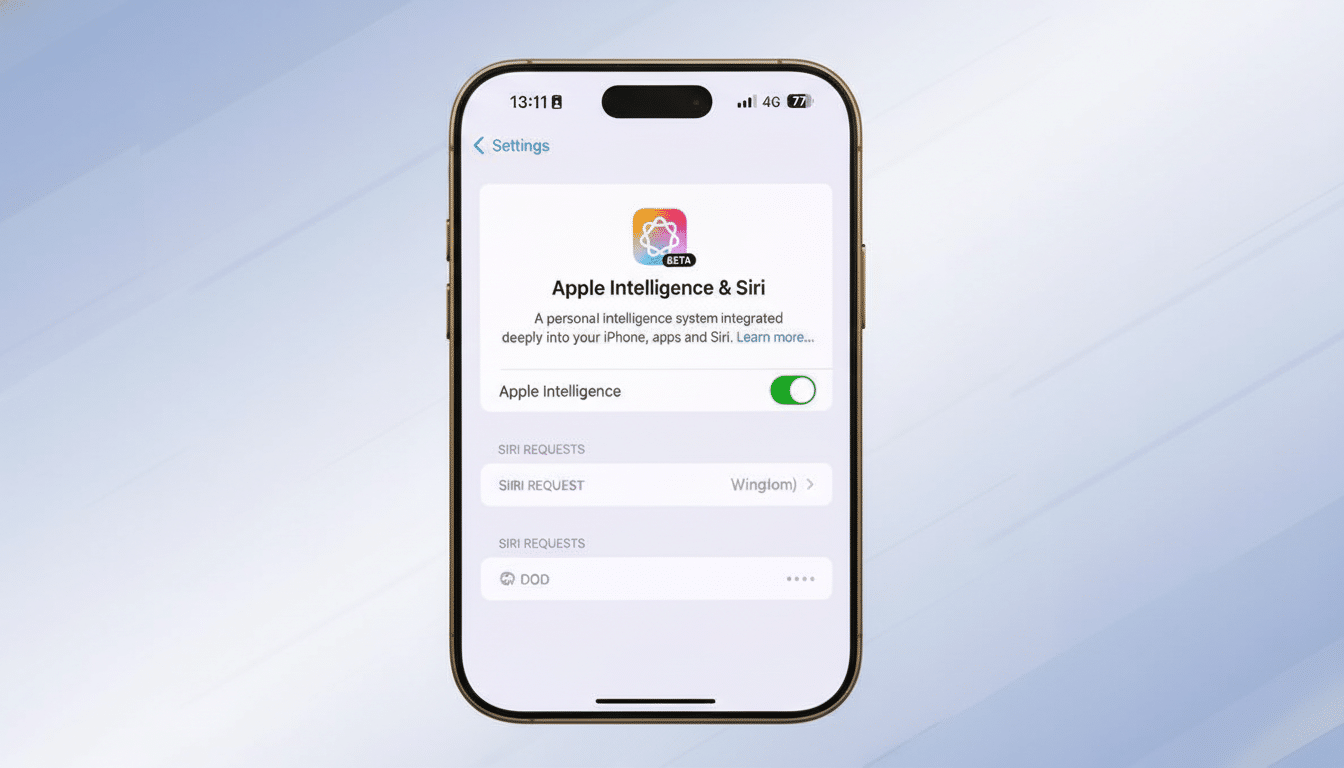
On-device processing will take care of routine requests for speed and privacy, with more intensive tasks offloaded to cloud models. Reuters and The Information have reported that Apple has considered deals with OpenAI and Google for cloud inference, while keeping private data on infrastructure it controls.
Here are three capabilities that will anchor the experience:
- App Intents would enable Siri to open and run features within Apple apps and third-party apps. Think “edit the last portrait in Photos,” “check my boarding pass in the American Airlines app,” or “reorder the jasmine tea I bought on Amazon.”
- Personal context knowledge that understands what’s on your device and helps you fulfill a complete intended answer, like finding a specific message thread or surfacing an ID number you stored in Notes.
- Onscreen awareness will allow Siri to act on what you’re looking at: things like adding a visible address to Contacts or summarizing an article you’re reading.
Apple is also experimenting with more generalized “world knowledge answers,” guaranteeing direct responses to fact-based questions instead of just passing off links. If done well, that would soften one of the assistant’s most long-standing weaknesses.
Why It Matters for Apple’s Ecosystem and Users
Incremental uplift at Apple scale makes a difference even for Apple.
Apple announced that its active installed base exceeded 2.2 billion, and Siri is included on iPhone, iPad, Mac, Apple Watch, HomePod, and in cars with CarPlay. Improvement in accuracy or utility is multiplied across the installed base in a manner that rivals struggle to match.
It’s also something of a credibility test after Apple Intelligence launched with some promise and patchy follow-through. It gave users useful tools, but conversational breadth was still trailing rivals like ChatGPT, Google’s Gemini, and Microsoft Copilot. A half-decent LLM Siri could simply weave those device strengths together with current AI trends to ultimately give the impression that, for once, this is one UI component not so much a bauble but an actual piece worth its while.

The Technical Bet: On Privacy and Latency
Apple’s approach relies on a hybrid stack. On-device smaller models can be fast, private, and even work in an offline environment, but they might lose nuance or breadth. Cloud-oriented models are becoming stronger generalists, but with added cost, latency, and privacy concerns. Apple has promoted its “Private Cloud Compute” scheme, claiming that server-side processing takes place on hardware controlled by Apple with provable protections. Those allegations are likely to be tested by security researchers soon.
The acid test will be how well it actually works in the moments Apple’s customers care about most: dictating while driving, or making a change mid-timer in the kitchen, or sending an exquisitely worded request to a third-party app. It will be here where on-device speed and stout fallback logic could differentiate Siri — or expose annoying gaps.
The Bar for Competition Has Been Raised in Voice and AI Assistants
Generative AI assistants changed the landscape on that one. OpenAI claimed that ChatGPT was being used by 100M weekly active users, and Gemini and Copilot had been woven into Google and Microsoft environments. These are the tools that string together tasks, refer back to prior context, and work with vast plugin or tool ecosystems. Google is weaving Gemini more tightly into Android, while Microsoft is baking Copilot into workflows in Windows and Office.
The way to differentiate one voice assistant from another here is not to be smarter in a simple back-and-forth of questions and answers, but to master multi-step, hands-free flows and tool use. CarPlay and HomePod will be especially informative: Will Siri finally be able to query the text of an address, play the correct playlist, or navigate a detour without embarrassing itself? Can it operate your household devices and calendars in a system you find yourself trusting day in and day out?
What Will Decide Whether That’s Enough for a Successful Siri Overhaul
The verdict will hinge on three issues.
- Accuracy: They will measure the assistant by how often it gets it right on the first or second try — particularly for navigation, messaging, reminders, and dictation. One confident answer that’s wrong is worse than a polite “I can’t do that yet.”
- Developer uptake: App Intents will only rock if other developers assign meaningful actions to Siri. Apple will have to provide clear tooling, low-friction approvals, and visible promotion in order to spark adoption.
- Coverage: Our perception will also depend on language support (when posted), regional availability, and supported devices. Even a phased rollout that leaves some languages or older devices out in the cold risks providing an impression that the upgrade feels more like a demo than something you should use daily.
What to Watch Next as Apple Rolls Out New Siri
Keep an eye out for hints in the upcoming point release of iOS, where Apple frequently buries marquee features behind feature flags and slowly rolls them out to more users. Look for any mention of cloud partners, how deep on-screen awareness extends, and demonstrations in CarPlay and HomePod scenarios.
If Apple can produce a quieter but more competent assistant that respects context and works across apps, does the basics well, maybe Siri’s slow march toward redemption will gain some momentum. If not, the market won’t wait — contemporary assistants have raised expectations and users know what good looks like.
