


Apple is preparing to customize Google’s Gemini model for Siri on its own infrastructure, retaining control over tuning, safety, and branding, according to people familiar with the work cited by The Information. The arrangement lets Apple shape Gemini into a Siri-optimized brain while keeping Google at arm’s length, signaling a pragmatic but fiercely independent approach to large language model partnerships.
Why Apple Is Customizing Gemini For Siri
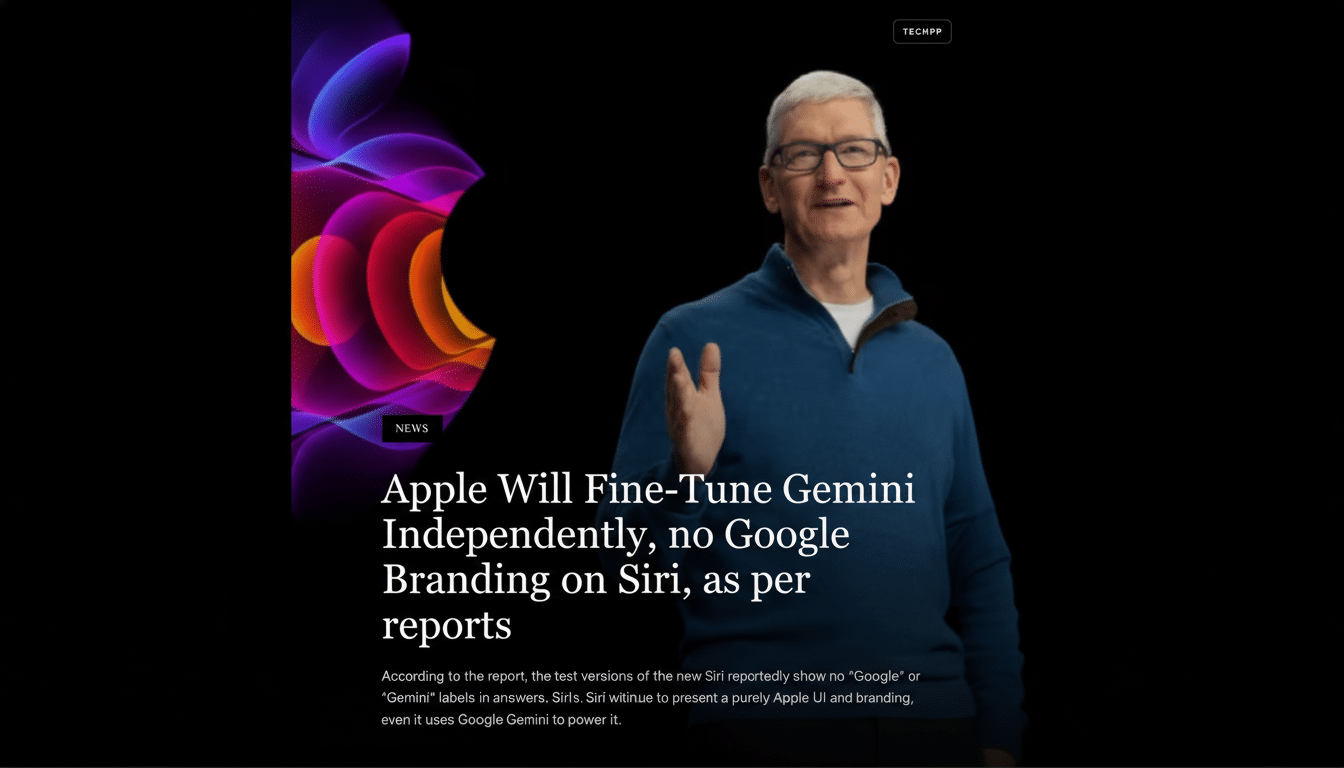
Rather than drop a third-party chatbot into iOS, Apple is treating Gemini as a foundation to be tailored for Siri’s specific jobs: reliable general knowledge, contextual understanding across on-device data, and a calmer, more emotionally attuned conversation style. Insiders told The Information that Apple will fine-tune the model independently and avoid Google or Gemini branding, preserving Siri’s identity while capturing the benefits of state-of-the-art language modeling.
The practical upside is precision. Siri can resolve fuzzy queries by reading local context—messages, calendar entries, nicknames—without users needing to restate facts. It can draft Notes that blend personal content with public information. And it can answer open-ended questions in a more human cadence, a capability consumers have come to expect from modern assistants. Think of Gemini here as raw capacity; Apple’s job is distillation, alignment, and product fit.
How the Siri and Gemini Integration Will Work at Apple
Per the report, the new Siri runs either on-device or on Apple-controlled cloud machines, not Google’s servers. That dovetails with Apple’s Private Cloud Compute architecture, unveiled alongside Apple Intelligence, where server-side models run on Apple Silicon in data centers and are subject to the same privacy guarantees as on-device processing. People familiar with the arrangement say Google invested to ensure a Gemini variant could execute on Apple’s infrastructure, honoring those privacy constraints.
Task routing remains layered. Lightweight requests are handled locally by on-device models and neural engines. Heavier reasoning can escalate to Apple’s privacy-preserving cloud. For some especially complex queries, Apple still offers an optional handoff to ChatGPT—an Apple spokesperson has said that path remains—but testing cited by The Information suggests minimal traffic has actually flowed to OpenAI from Siri trials. In short, Gemini is the primary engine; ChatGPT is a narrow fallback.
What It Means for Privacy, Safety, and Siri Branding
Apple’s insistence on no Google branding and no Google-hosted processing is more than cosmetics; it’s a clear signal that the Siri experience remains an Apple product governed by Apple’s rules. The company’s privacy posture—local processing by default, signed server software images, and strict data minimization—creates a high bar for any external model to clear. Independent fine-tuning also lets Apple enforce policy guardrails and safety guidelines that match its ecosystem, rather than inheriting another company’s defaults.
For users, the most tangible change will be capability without trade-offs. Expect faster disambiguation of contacts and files, better general knowledge answers, and more natural follow-ups, all while keeping sensitive context on device or within Apple’s audited cloud boundary. There’s also a brand message: Siri is getting smarter because Apple made it smarter, not because it outsourced the assistant to a rival.
Strategic Stakes for Apple, Google, and OpenAI
This hybrid approach—adopt the best external models but tune them under Apple’s roof—gives the company leverage. Apple gains near-term performance from Gemini without ceding control over data, roadmap, or user experience. It also preserves optionality: if a future model outperforms Gemini for specific tasks, Apple can swap or ensemble it behind the scenes, the way it already routes tasks among on-device and cloud tiers.
The ripple effects could be significant. For Google, the integration is a marquee validation of Gemini’s capabilities inside the world’s most valuable consumer platform. For OpenAI, minimal Siri handoffs in testing hint at reduced distribution through Apple’s channels. And for developers, a more capable Siri—backed by Apple’s performance-focused hardware and privacy guarantees—sets new expectations for how apps tap system intelligence via intent APIs, summaries, and action orchestration.
Apple’s ecosystem scale matters here. The company has disclosed more than two billion active devices across its installed base, and independent firms like IDC have ranked Apple at or near the top of global smartphone shipments in recent years. Even incremental improvements to Siri, delivered at that scale, can reset consumer norms for what an assistant should do out of the box. Fine-tuned Gemini, running on Apple’s terms, is Apple’s bid to make that jump without compromising the principles that define its platform.
