


Anthropic has signed a $200 million multi-year deal with Snowflake to integrate its Claude family of large language models directly into the data cloud, giving Snowflake’s huge enterprise customer base native access to powerful generative AI and agentic capabilities. The pact formalizes a joint go-to-market push and deep product integration that will seek to drive AI adoption where data already lives.
What the $200M Anthropic–Snowflake AI Deal Produces
Snowflake will be integrating Anthropic’s latest Claude models, with Claude Sonnet 4.5 powering Snowflake Intelligence, the company’s enterprise AI layer. They will also be able to tap more-capable versions—such as Claude Opus 4.5 (Optical Picture Understanding System) for multimodal analysis across text, pictures, papers and structured tables—without shuffling sensitive data in and out of governed environments.
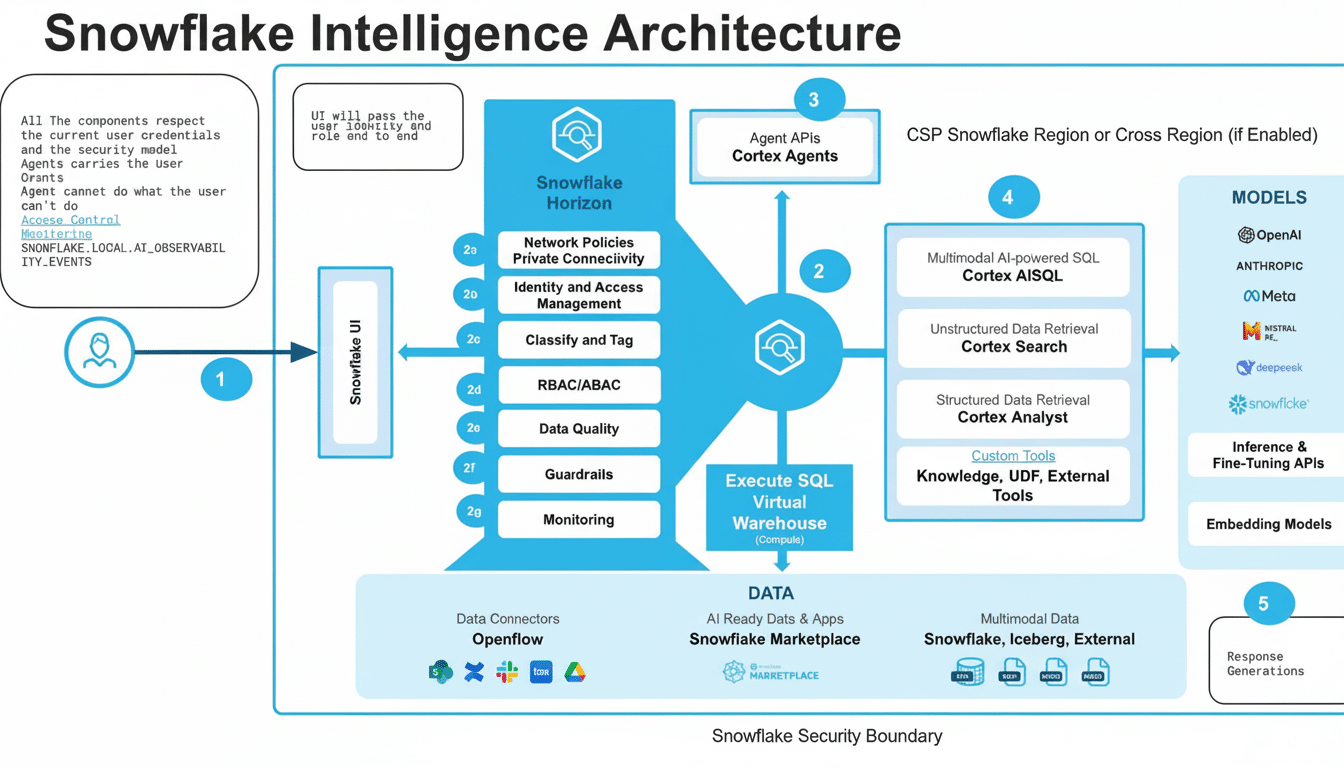
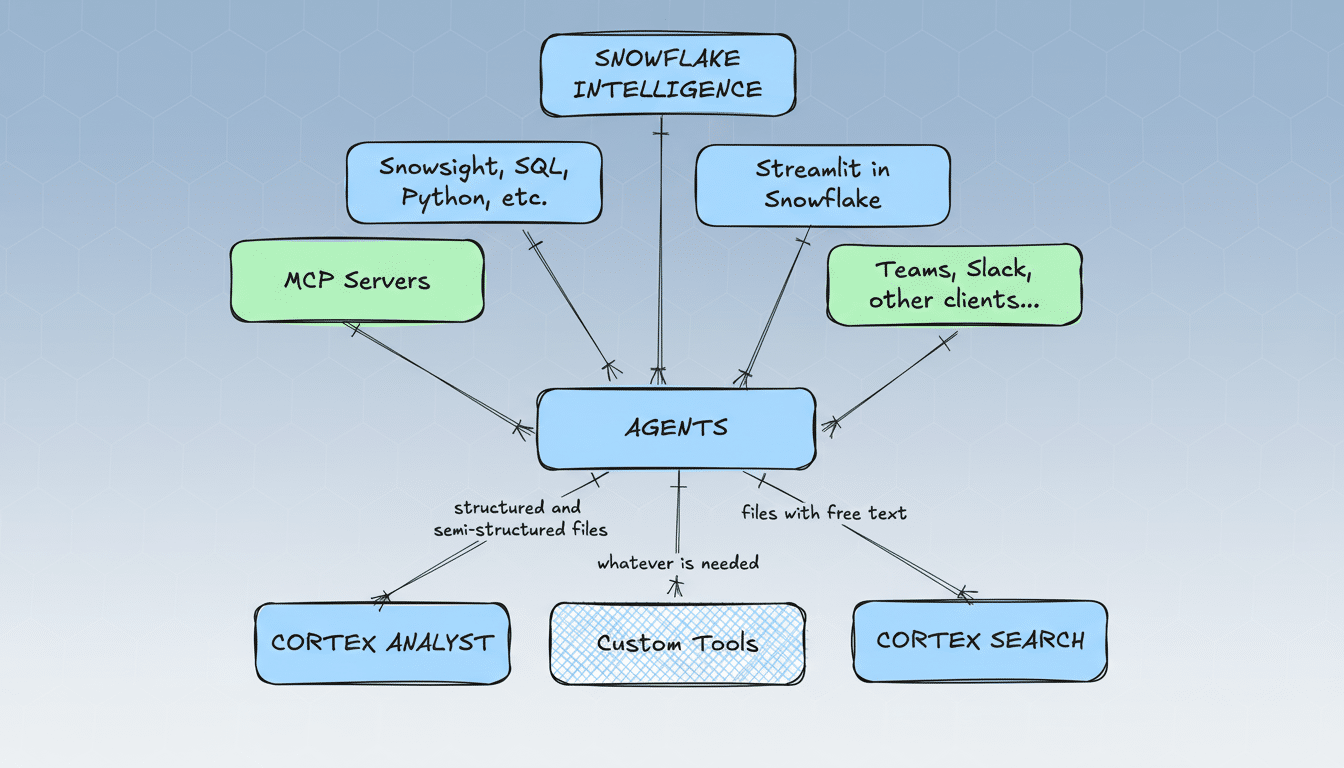
In addition to chat and summarization, the integration addresses practical agent-assisted workflows. Teams can develop custom agents that reason over first-party data, coordinate tasks, and invoke action calls on analytics or other applications. Consider fraud teams correlating transactions and KYC files, retailers blending sales signals with product imagery for demand forecasting, or pharma analysts mining trial reports alongside sensor feeds — all inside Snowflake’s security perimeter.
Operationally, Snowflake AI services including Cortex and Snowpark Container Services provide model access, but with enterprise controls such as role-based governance, data masking and auditability under the hood.
The consequence is reduced data egress, faster time-to-insight, and an easier deployment path for retrieval-augmented generation on realistic datasets.
Why This Anthropic–Snowflake AI Deal Matters to Enterprises
Enterprises have spent years building compliant, trusted data stacks; moving that data to AI endpoints elsewhere in our network adds both cost and latency — and introduces new risks. And embedding Claude inside Snowflake meets a fundamental buyer demand: make state-of-the-art models come to the data, not the other way around. This is particularly impactful for regulated industries, where data residency, lineage and compliance with access controls is not optional.
The economics are equally important. By placing the inference where the data is stored, running on unified governance further simplifies the operation and reduces the added operational tax on data and security teams (no need to maintain separate costly pipelines or copy storage). For Snowflake, which counts thousands of businesses across financial services, health care, retail and the government as its customers, turnkey access to Claude could help broaden the reach of AI and essential data workloads alike.
Strategic Context in the AI Platform Wars
The deal highlights Anthropic’s approach of being enterprise-first. In recent months the company has unveiled massive partnerships with Deloitte, which bring Claude to a potential labor force of more than 500,000 workers, and IBM, in order to embed technology within enterprise software. Those alliances are complemented by support from marquee cloud players, including a multibillion-dollar commitment from Amazon, which trust Anthropic’s roadmap for safe models.
For Snowflake, the shift solidifies its standing in the rapidly developing market for AI data platforms. The company has launched its own model efforts (such as Arctic) and collaborates on an ecosystem of third-party models, providing premium access to Claude that extends the upper limit of reasoning-heavy, context-aware workflows. It also further hones competitive differentiation against Databricks, which has doubled down on open models and released DBRX to drive code and analytics workloads.
Signals from the Market on Enterprise AI Adoption
Independent analyses have consistently positioned Claude among the top performers in reasoning and safety alignment, which also resonates with enterprise buyers. Analysis by Menlo Ventures, which surveyed corporate AI decision-makers in mid-2025, also found Anthropic models were commonly chosen due to their reliability and guardrails. IDC has forecast that worldwide spend on generative AI will exceed $140B by 2027. It’s a fast-growing space, with platform integrations in the existing data estate likely to be a significant portion.
Practically and pragmatically, companies are looking for configurable guardrails, predictable cost and measurable ROI. By combining model access with governed data and observability, the Snowflake–Anthropic alignment seeks to help turn proofs of concept into production systems—accelerating documentation-laden processes, enhancing analytics throughput, and mitigating risk in customer-facing AI.
What to Watch Next as the Partnership Rolls Out
Among the major questions are to which classes of models pricing tiers map, how to enforce data residency across regions and how quickly agentic features mature for complex workflows. Anticipate vertical solutions to flow from consulting and software partners, ramping adoption in finance, health care and retail. You should also be on the lookout for deeper joint telemetry—observability, evaluation benchmarks and cost controls—to assist enterprises in tuning quality and spend.
The headline number is attention-getting, but the bigger story here is operational: a clear path for thousands of Snowflake customers to pilot, govern and scale Claude-powered applications without retooling their data strategy. If the execution is as good as the ambition, this collaboration could serve as a model for how frontier models infiltrate the enterprise mainstream.
