


Anthropic is rolling out interactive apps inside Claude, bringing tools like Slack, Canva, Figma, Box, and Clay directly into the chatbot interface. The integrations let logged-in users act inside those services without leaving a conversation, from sending a Slack message to tweaking a Figma mock or pulling files from Box.
What’s New in Claude: Embedded Interactive Workspace Apps
The new capability turns Claude from a text-only assistant into a workspace with embedded, visual apps. Each app runs as an authenticated instance tied to the user, so Claude can perform actions on their behalf in context—compose and post a status update to a project channel, generate a chart in Canva, or surface the latest research folder from cloud storage.
- What’s New in Claude: Embedded Interactive Workspace Apps
- How the Apps Work: Model Context Protocol in Claude
- Agentic Workflows with Cowork for Multi-Step Tasks
- Security and Governance for Apps and Agentic Actions
- Why It Matters for the Workplace and Team Productivity
- Early Use Cases and Outlook for Claude’s App Integrations
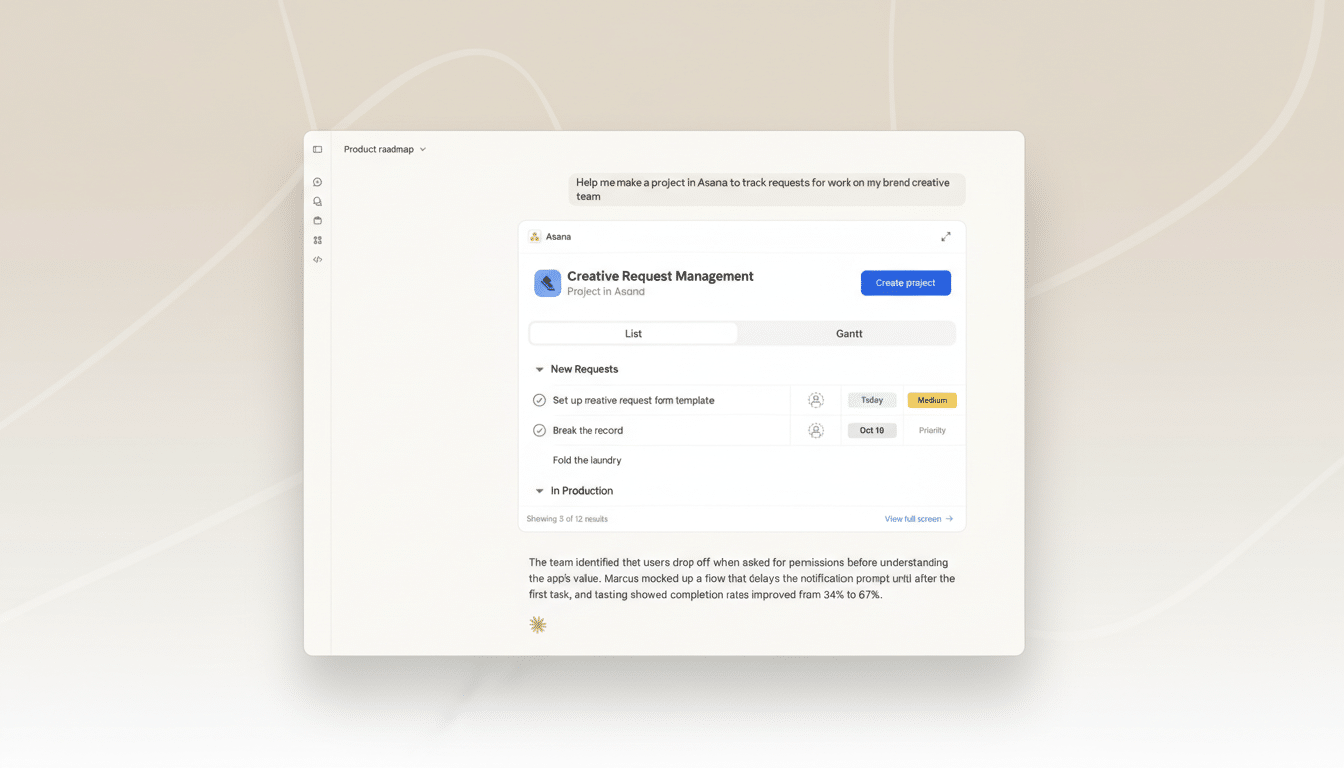
Access rolls out to Claude Pro, Max, Team, and Enterprise customers. Free tiers are excluded. Eligible users can enable integrations through the Claude app directory and then toggle permissions inside the chat as needed.
How the Apps Work: Model Context Protocol in Claude
Under the hood, Claude’s apps are built on the Model Context Protocol, an open standard for connecting AI systems to external tools and data. MCP lets models request capabilities—like reading a document or posting to a service—through a consistent, auditable interface, rather than relying on brittle, one-off connectors.
The approach echoes a broader industry shift toward interactive agents. OpenAI has introduced a comparable Apps system that similarly enables third-party tools inside chat. Both implementations use MCP to streamline how models discover, request, and execute actions, reducing custom integration work for developers while giving enterprises clearer guardrails.
Agentic Workflows with Cowork for Multi-Step Tasks
The launch pairs naturally with Claude Cowork, Anthropic’s new agent that handles multi-step tasks over large, evolving datasets. Cowork is designed to plan, iterate, and report progress as it works—think “assemble a competitive brief, update the design assets, and notify the team when it’s ready” rather than isolated, single prompts.
While app integrations are not live inside Cowork at release, Anthropic says support is coming. Once available, teams could assign Cowork to, for example, pull fresh data from Box, update marketing visuals in Figma, and share draft collateral back to a Slack channel, all tracked within a single agentic workflow.
Security and Governance for Apps and Agentic Actions
Anthropic is emphasizing permissioning and oversight. Apps run with user-granted scopes, and the company advises least-privilege access, especially for sensitive artifacts like financial records, credentials, or HR files. Recommended practices include creating dedicated working folders for Claude and explicitly reviewing actions before granting broader access.
Agentic systems can be powerful but unpredictable if left unchecked. Anthropic’s guidance mirrors enterprise AI governance norms: constrain tools, log activity, and require human sign-off for high-impact tasks. That approach aligns with policies many security teams already apply to SaaS automation and RPA tools.
Why It Matters for the Workplace and Team Productivity
Embedding apps inside Claude closes the loop between reasoning and doing. Instead of getting a smart suggestion and then switching tabs to implement it, users can ask Claude to take the next step—post the update, render the concept, attach the file—without losing context. The result is fewer hops, faster iteration, and clearer provenance of changes.
The choice of launch partners underscores the enterprise angle. Slack remains the nervous system for many teams; Figma and Canva cover design and brand execution; Box anchors document workflows; Clay targets go-to-market research. With a Salesforce integration on the horizon, the roadmap points toward end-to-end sales and marketing cycles that can be orchestrated from within Claude.
Industry analysts have flagged “agentic AI” as a key enterprise trend, driven by demand to convert generative suggestions into measurable actions inside core systems. IDC and other research firms expect sustained double-digit growth in spending on generative AI platforms and tooling, particularly where integrations shorten time-to-value and reduce change management.
Early Use Cases and Outlook for Claude’s App Integrations
Consider a product launch: Claude can draft messaging, generate a comparison chart in Canva, pull the latest pricing sheet from Box, and push a checklist into Slack for stakeholder review—all within a single thread. For design teams, quick iterations in Figma guided by Claude’s feedback can tighten review cycles from days to hours. Sales and marketing teams using Clay for prospecting can have Claude enrich and triage lists before syncing updates back to the CRM.
The open question is how quickly enterprises will trust agentic actions beyond low-risk tasks. Clear permission scopes and transparent execution logs should help. If Anthropic delivers smooth Cowork integration and keeps expanding the app directory, Claude could become a practical command center for daily work—less a chatbot, more a co-pilot that acts where the work already lives.
