


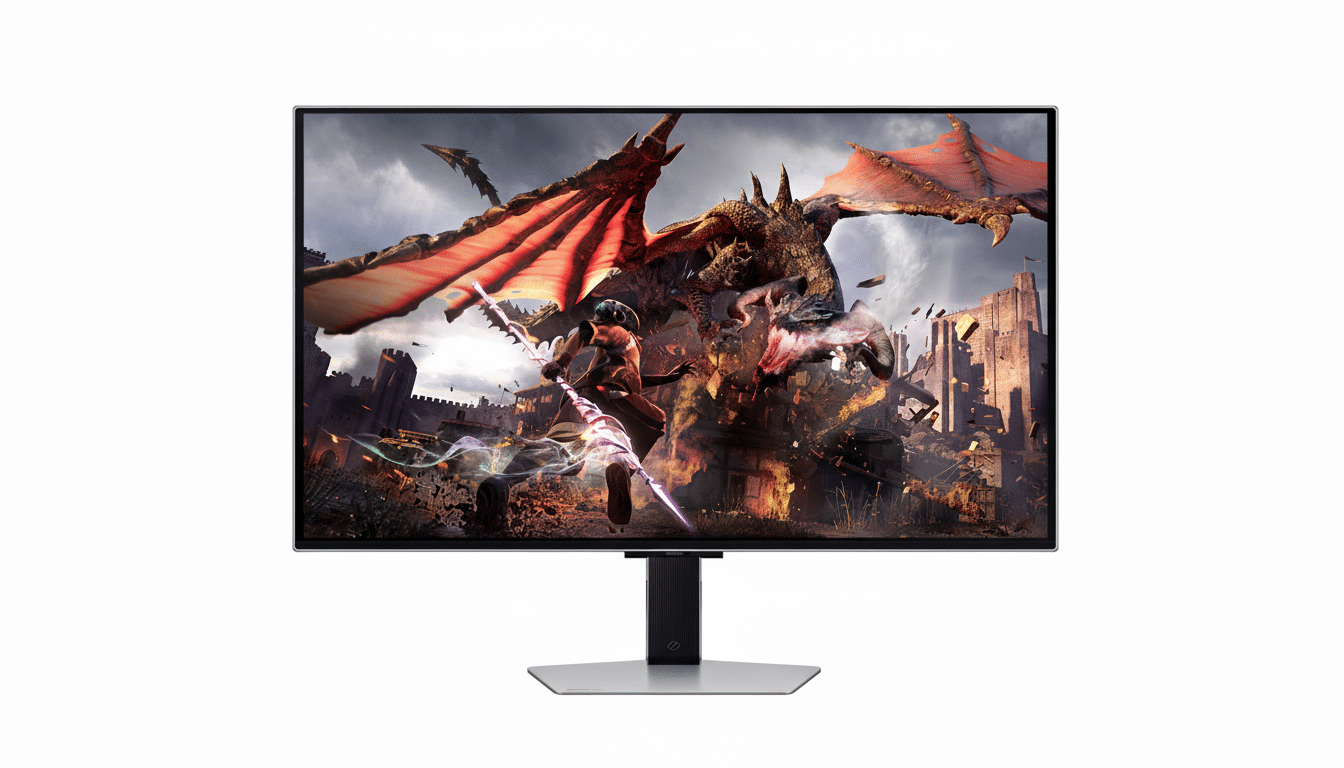
Amazon has just marked down the 32-inch Samsung Odyssey G8 OLED to $899.99, $400 off its original list price of $1,299.99. That’s 31 percent off for one of the few 4K OLED gaming monitors that supports 240Hz, and it’s also the lowest price we’ve seen the model sell for at a major retailer.
The trade-off is aimed at enthusiasts who desire both uncompromised motion clarity and HDR without having to downgrade to 1440p. Delivering a QD-OLED panel, 0.03ms response time, and AMD FreeSync Premium Pro/NVIDIA G-Sync Compatible support, the G8 brings high-end specs into a price bracket that had previously skewed toward LCD contenders.

Why This Samsung Odyssey G8 OLED Deal Is So Notable
The price of 32-inch 4K OLED monitors has stubbornly remained stuck at or above the four-figure threshold most of this year. Subtract $400, and the Odyssey G8 slots into a category that other fast IPS panels used to dominate, significantly reducing the cost-versus-visual-advantages trade-off of OLED. There have only been nominal drop-offs on this model per price trackers, but $899.99 undercuts significant past sales, and there’s a new value barometer at 4K/240Hz that sets the stage for comparison moving forward.
That’s not just a QD-OLED screen for you but one with an anti-glare matte finish to boot. And that’s important: Earlier OLED monitors could look spectacular in the dark, but they could struggle in a brightly lit room. The Samsung anti-reflective technology provides top image quality, even in direct light from the sun or overhead lights, so you can game throughout the day. Color coverage is also wide, with QD-OLED panels notably measuring almost full DCI-P3 coverage according to independent lab tests from sources like RTINGS, which translates into richer highlights and punchier game worlds.
Gaming Performance Specs That Truly Matter on G8
The G8’s headline spec is 4K resolution at a blisteringly fast 240Hz, with a gray-to-gray response time of just 0.03ms. The combination keeps motion blur and ghosting to a minimum while preserving pin-sharp detail. 120Hz is highly responsive, and by way of reference, plenty of PC gamers don’t notice returns from pushing beyond 240Hz — a ceiling that’s more than enough for competitive shooters and racing sims but still offers pristine single-player visuals at native 4K, according to PCMag.
HDR is certified by VESA DisplayHDR True Black 400 to guarantee deep blacks down to around 0.0005 nit, made possible by OLED per-pixel local dimming. In use, that near-infinite contrast reveals shadow detail without haloing — handy for tactical games where spotting an enemy shape in a dark corridor can be the difference between life and death. The fast pixel response of QD-OLED also reduces smearing in dark transitions, which can be a source of problems for some LCDs.
Considerations When Setting Up PC and Consoles
It will take some serious GPU horsepower — say a GeForce RTX 4080/4099 or Radeon RX 7900 XTX — to push modern AAA games all the way to 240fps at 4K, and even then you’re probably leaning on DLSS 3 or FSR 3 with frame generation. Esports titles such as Valorant, CS2, and Rocket League are most likely to utilize the full refresh rate with high-end rigs. The high-bandwidth connections on the monitor — including HDMI 2.1 and DisplayPort with DSC on comparable G8 models — allow for 4K 120Hz over PS5 and Xbox Series X using VRR, while PC users can scale up to as much as 4K 240Hz when their GPU and settings allow.
Variable refresh rate is supported not just on the AMD FreeSync Premium Pro side that reduces tearing, but also as NVIDIA G-Sync Compatible to eliminate stutter and smooth out gaming with both vendors’ cards. OLED care features such as pixel shift and panel refresh routines, which are standard on modern OLED monitors, help prevent static UI elements from games and desktop work from causing burn-in during long sessions.
How Samsung’s Odyssey G8 Compares With Its Rivals
Alienware’s AW3225QF and Asus’s ROG Swift PG32UCDM are the G8’s most direct 32-inch 4K/240Hz OLED competitors. They typically sell for $1,099 to $1,499 depending on stock and promos. Alienware takes a curved-panel approach that some gamers love for immersion, while the Samsung is flatter — good for gaming and productivity. It doesn’t get any more affordable than that, and at $899.99 the G8 undercuts them both while promising to deliver much of the same core experience: 4K clarity, elite motion handling, and OLED-level HDR contrast.
If you’re coming from a 1440p 240Hz IPS, the upgrade path is obvious: keep your high-refresh fluidity and gain pixel density and HDR punch that even upmarket IPS displays struggle to match. And if you’re on a 60–120Hz TV at your desk right now, the difference in responsiveness is profound, particularly in shooters and racers where input latency and motion clarity directly equate to performance.
Bottom Line: A Strong Value for 4K 240Hz OLED Gaming
Samsung’s Odyssey G8 might be the light at the end of the tunnel for anyone who wants a 4K OLED gaming monitor but can’t stomach spending $1,299. If you have a high-end recent GPU or spend half your gaming time on PC and current-gen consoles, this is an all-star purchase. Inventory and pricing for high-demand OLEDs can change rapidly, so if the spec sheet lines up with your setup, pull that trigger right now.
