


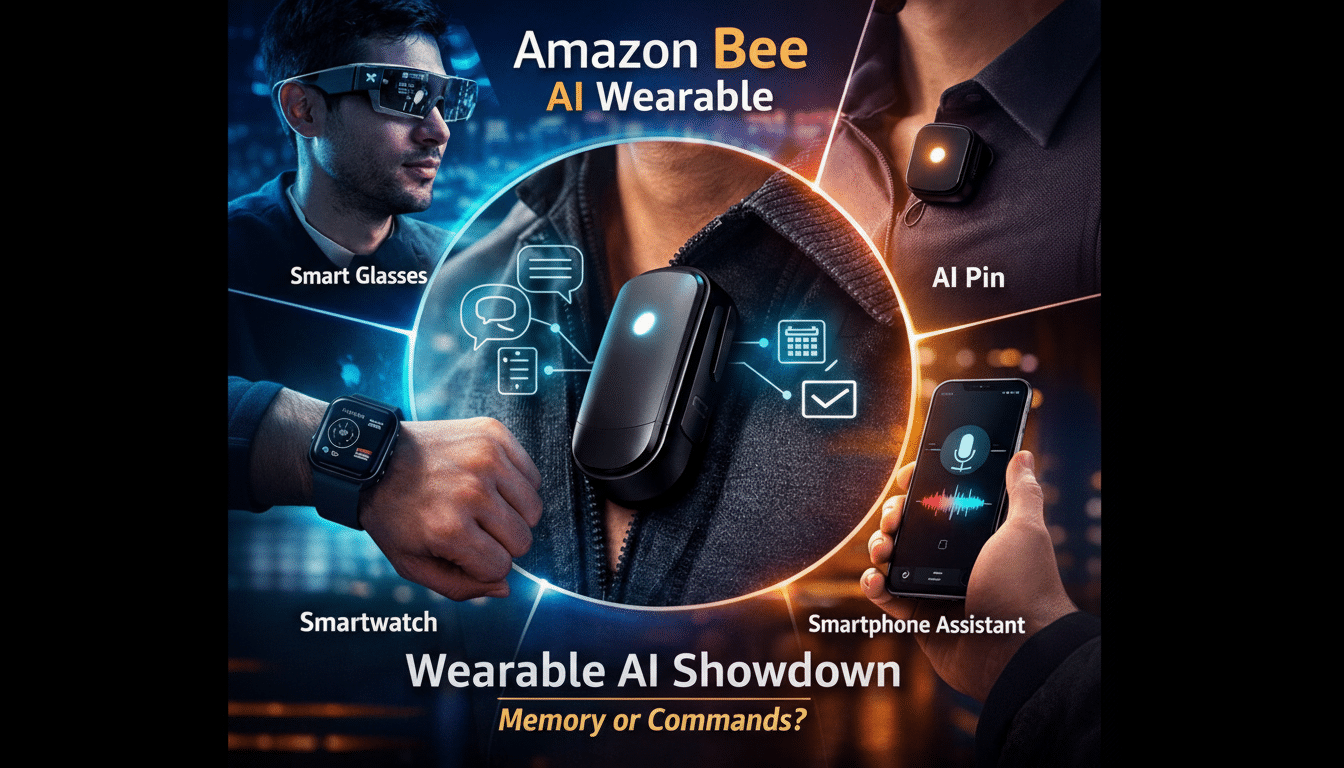
Amazon’s purchase of Bee, a clip-on or wrist-worn AI device built for capturing and summarizing real-world moments, signals a deliberate push to extend Alexa’s reach beyond the home and into the flow of daily life. The deal gives Amazon a purpose-built, wearable-first assistant that records, transcribes, and structures what you say and hear, then turns it into actionable memory and context.
Why Bee fits Amazon’s AI strategy for everyday assistive use
Amazon already runs a massive installed base with Alexa, and the company has said its enhanced assistant can operate on roughly 97% of Amazon’s shipped hardware. What it has lacked is persistent context when people leave their living rooms. Bee plugs that gap with a lightweight device designed to capture conversations, lectures, meetings, and passing thoughts, then translate them into follow-ups, summaries, and reminders powered by a personal knowledge graph.
- Why Bee fits Amazon’s AI strategy for everyday assistive use
- Outside the home remains the missing context layer
- Data synergy and building a durable personal graph
- Monetization and distribution advantages for Bee
- Risks, privacy, and trust in continuous audio capture
- What Bee adds on day one for Alexa and customers
- The bottom line on Amazon’s acquisition of Bee wearable

Strategically, Bee is less about another “voice gadget” and more about continuity. It gives Amazon a way to carry understanding from one environment to the next, so recommendations, tasks, and assistance feel continuous rather than siloed by device or location. That continuity is the connective tissue modern assistants have been missing.
Outside the home remains the missing context layer
Alexa dominates fixed endpoints like speakers, TVs, and smart displays. But mobile-first assistants have won the out-of-home hours—think AirPods paired with Siri, or Ray-Ban’s camera glasses with on-board assistants. Amazon’s previous forays—the Echo Buds and Echo Frames—never broke through against those incumbents. Bee offers a cleaner lane: a small, socially acceptable recorder-plus-assistant that’s designed for information capture rather than entertainment or camera-heavy experiences.
Importantly, Bee’s use cases are concrete: students compressing lectures into study notes, professionals turning meetings into tasks, and older adults offloading memory burdens. Where other AI pins have struggled with heat, battery, or vague “do-everything” positioning, Bee leans into a narrow job where AI shines—summarization and retrieval—then expands from there.
Data synergy and building a durable personal graph
Bee learns by fusing on-device captures with opt-in services such as email, calendar, contacts, and health signals, then structures those inputs into a living model of the user’s priorities and habits. That “personal graph” is the gold Amazon is pursuing: a permissioned, continuously updated map of what matters to you, wherever you are.
Fold that into Amazon’s broader AI stack—spanning Alexa’s upgraded models, Bedrock-hosted foundation models, and on-device acceleration—and you get a pathway to lower-latency, lower-cost inference and more reliable recall. Even before deep integration, Amazon can improve Bee’s transcription, summarization, and tasking with its own models, then let Alexa tap Bee’s context to hand off routines when you arrive home.
The business upside is real. A wearable that captures the “why” behind your day can power better scheduling, shopping lists, and health nudges. Bloomberg Intelligence estimates the broader generative AI economy could surpass $1.3 trillion by 2032, and assistants with durable personal context are positioned to capture an outsize slice of that value.
Monetization and distribution advantages for Bee
Bee likely fits Amazon’s classic flywheel: sell well-designed hardware at aggressive price points, monetize via subscriptions and services, and scale through Prime and Amazon’s retail channels. Subscriptions for transcription, storage, and premium AI features are an intuitive path; bundling with Prime or Alexa tiers could collapse customer acquisition costs and speed adoption. Amazon’s logistics, customer support, and retail merchandising solve the hardest part of hardware: reach.
This acquisition also gives Amazon a clean second act in wearables after discontinuing Halo. Rather than competing in crowded fitness bands or camera glasses, Bee positions Amazon in the productivity and memory-assistance lane that’s adjacent to, but not directly at odds with, Apple and Meta.
Risks, privacy, and trust in continuous audio capture
Constant recording, even for benign note-taking, triggers privacy alarms. Bee’s current approach—transcribe, then discard audio—addresses some concerns but limits use cases that require playback for accuracy or compliance. Expect granular consent controls, visible recording indicators, and enterprise-focused modes with opt-in retention and governance to surface as the platform matures.
Amazon has learned hard lessons here. Past regulatory actions and settlements involving voice and video products underscored the need for rigorous data minimization and deletion policies. Bee’s success will hinge on transparent settings, clear value exchange, and default-private design that respects workplaces and public spaces with strict two-party consent rules.
What Bee adds on day one for Alexa and customers
Bee’s eight-person team brings a focused product: a compact wearable that captures in-the-moment speech, turns it into structured notes, and surfaces daily insights and templates. Early adopters are already using it to remember commitments, plan follow-ups, and track changing routines. Company leaders have described Bee as complementing Alexa’s home-centric strengths by supplying out-of-home awareness, with eventual convergence expected rather than immediate replacement.
If Amazon stitches Bee’s personal graph to Alexa’s home automations and notifications, the result is a more coherent assistant that knows what you said in a meeting, reminds you at the right time in the right room, and can act on your behalf across devices without repeating yourself. That’s the assistant consumers have been promised for a decade—and the one Amazon now has a clearer path to deliver.
The bottom line on Amazon’s acquisition of Bee wearable
Amazon didn’t buy Bee to chase another gadget trend; it bought a missing layer of context. In a market where wearables succeed by doing one critical job exceptionally well, Bee’s job is memory and meaning. Tie that to Alexa’s ubiquity and Amazon’s AI infrastructure, and the acquisition looks less like a bet on pins and more like a bid to own the continuous assistant—inside the home, outside it, and everywhere in between.
