


It was meant to be a feel-good photo-op. When India’s prime minister invited top executives on stage to join hands in a symbolic show of unity at the India AI Impact Summit, everyone linked up—except OpenAI’s Sam Altman and Anthropic’s Dario Amodei. The two leaders, standing shoulder to shoulder yet keeping their hands apart, delivered a split-second metaphor for the most watched rivalry in artificial intelligence.
What Happened on Stage Between Altman and Amodei at India’s AI Summit
The gesture was simple; the optics were anything but. Cameras caught Altman and Amodei visibly declining to clasp hands, even as other tech chiefs complied. The moment landed because it captured an uncomfortable truth: cooperation and competition now coexist uneasily in frontier AI, and even ceremonial calls for solidarity can’t paper over strategic fault lines.
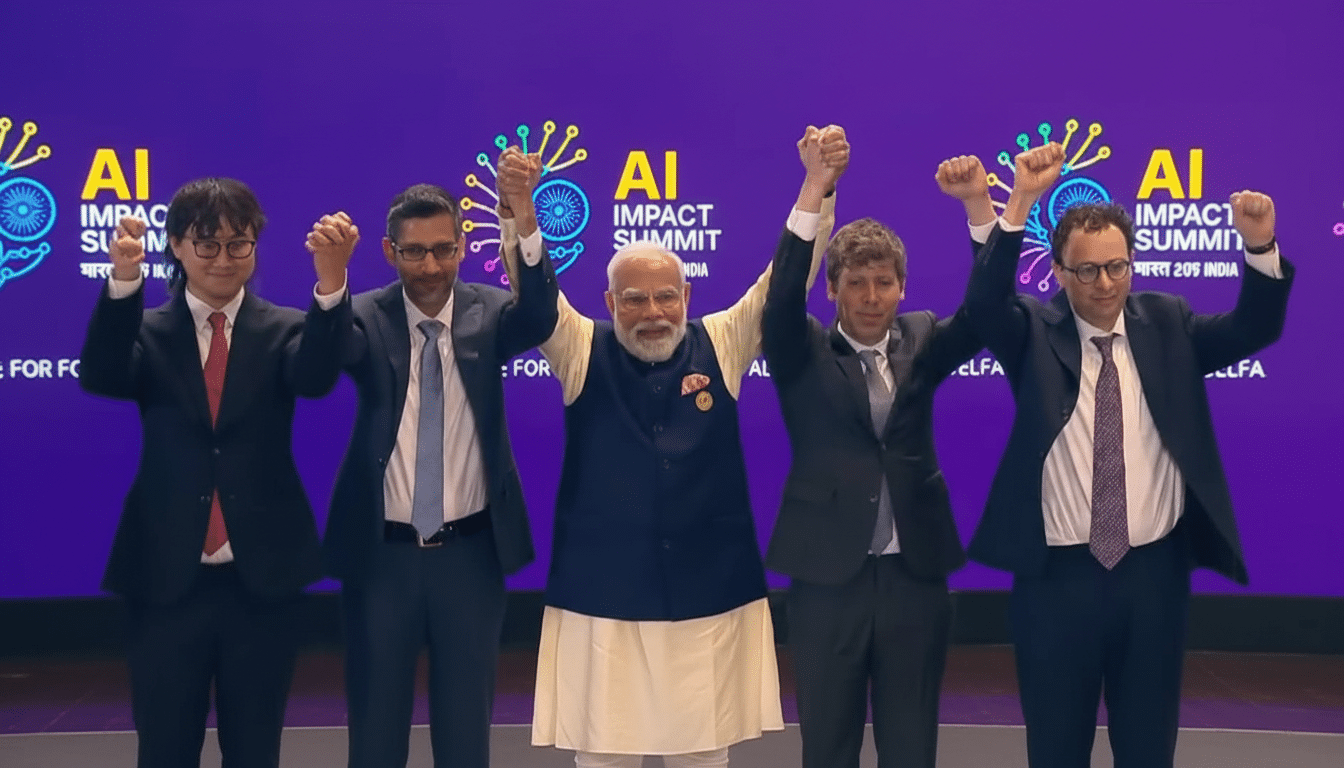
OpenAI and Anthropic Rivalry Spills Into the Spotlight
OpenAI and Anthropic have increasingly divergent playbooks. OpenAI has been testing advertising in ChatGPT, a move aimed at subsidizing inference costs at scale and broadening monetization beyond API and enterprise tiers. Anthropic pounced on that decision with high-profile spots during the Big Game, promising that Claude would never run ads—a brand-level swipe that framed the debate as one of trust and product integrity.
Altman shot back, labeling Anthropic’s framing as “dishonest” and “authoritarian,” arguing that the ads depicted were not how OpenAI would implement them and that users would reject invasive formats. The public tit-for-tat didn’t just surface philosophical differences; it clarified business-model bets in a market where inference costs, safety mitigations, and user experience are in constant tension.
India Becomes Shared Ground for Both AI Labs’ Expansion
Both companies used the New Delhi stage to court India’s developers and enterprises. OpenAI announced two new offices in India, a partnership with Tata Consultancy Services, and tools targeting higher education. Anthropic confirmed an India office and a collaboration with Infosys for internal use and client deployments. Those alliances matter: TCS employs well over 600,000 people globally and serves blue-chip clients across industries, while Infosys has a workforce north of 300,000—distribution channels of this scale can accelerate real-world adoption.
The push aligns with India’s wider AI agenda. The government’s IndiaAI Mission, overseen by the Ministry of Electronics and Information Technology, targets public compute infrastructure on the order of 10,000+ GPUs, open datasets, and skilling at national scale. NASSCOM has estimated that India hosts one of the world’s largest pools of AI and analytics talent, topping 400,000 professionals, and GitHub’s Octoverse has repeatedly ranked India as the fastest-growing developer community. For model labs seeking talent density and enterprise demand, the fit is obvious.
More Than a Photo Op: Policy Optics and Unresolved Questions
To policymakers, the hand-holding tableau was supposed to broadcast alignment on safety and innovation. Yet the non-gesture from Altman and Amodei underlined unresolved questions: how to pay for frontier-scale inference without eroding user trust; how to balance speed with safeguards; and whether voluntary industry compacts can keep pace with rapidly scaling capabilities. Both companies signed earlier safety commitments in the United States and sent delegates to global safety forums, but commercial pressures are pushing them down distinct paths.
India’s challenge—and opportunity—is to convene these paths productively. Enterprise buyers here are pragmatic: they will mix and match providers, run pilots across stacks, and demand measurable ROI on tasks like customer support, code modernization, and knowledge retrieval. Services firms will be kingmakers, translating foundation model capabilities into vertical-specific workflows at scale.
Signals for the Road Ahead in AI Business Models and Trust
For OpenAI, experiments with ads hint at a willingness to diversify revenue beyond subscriptions and enterprise licenses—useful in markets where price sensitivity is high and unit economics are unforgiving. For Anthropic, the no-ads stance is a differentiator anchored in trust, safety, and a premium positioning. Both strategies can win, but they will likely attract different user segments and partner ecosystems.
In that light, the awkward beat on stage wasn’t merely awkward. It was instructive. India is assembling the pipes—compute, talent, and enterprise scale—that could determine which philosophies thrive. If the country succeeds in pairing robust guardrails with market-driven experimentation, moments of dissonance like this one may be the growing pains of a market that ultimately raises the bar for everyone.
