


More than 20 AI researchers and industry figures, including Geoffrey Hinton, Yoshua Bengio, Anthropic co-founder Jack Clark and OpenAI chief scientist Jakub Pachocki, have called on governments to prepare for AI systems taking a much larger role in developing their successors. Their newly reported paper warns of a possible “intelligence explosion”: a rapid acceleration in AI progress if automated research and development begins reducing the need for human involvement.
The proposal is not a claim that such a cycle has begun. It is a request for governments to build visibility, intervention options and emergency plans before it might. As The Guardian reported, the authors argue that fast-moving AI research could weaken meaningful human oversight while accelerating cyber and biological risks and upsetting strategic balances among states and companies.

The practical significance lies in who is making the case. Hinton and Bengio are among the most prominent academic voices on advanced AI risks; Clark and Pachocki hold senior positions at companies building frontier models. Their intervention moves the debate beyond broad warnings about artificial general intelligence toward a narrower operational concern: systems used to automate the research, engineering and experimentation that improve AI itself.
From AI coding assistance to automated research
There is an important distance between today’s AI-assisted software work and an autonomous system that can set research goals, run experiments, interpret failures and reliably produce a more capable successor. The warning paper treats the latter as a possible future development, not a demonstrated present capability. Its authors reportedly project that AI could automate R&D projects that would take human teams months as early as 2028; that is their forecast, rather than a measured result.
Anthropic’s own account of its development practices illustrates both the progress and the boundary. In June, the company said it was delegating a growing share of AI-development tasks to Claude. It reported that, by May, more than 80% of code merged into its codebase had been authored by Claude, while cautioning that lines of code are an imperfect productivity measure. In its account of recursive self-improvement, Anthropic said Claude could match or exceed skilled humans on a well-specified experiment, but still had substantial limitations in selecting goals and determining research direction.
That qualification is more than semantic. Writing code, even a great deal of it, can be a bounded task inside a human-led engineering process. Choosing a fruitful research problem, deciding what evidence would settle it, managing unexpected experimental results and judging whether a new capability is safe enough to deploy require a wider chain of decisions. Anthropic says fully autonomous recursive self-improvement has not been achieved and is not inevitable.
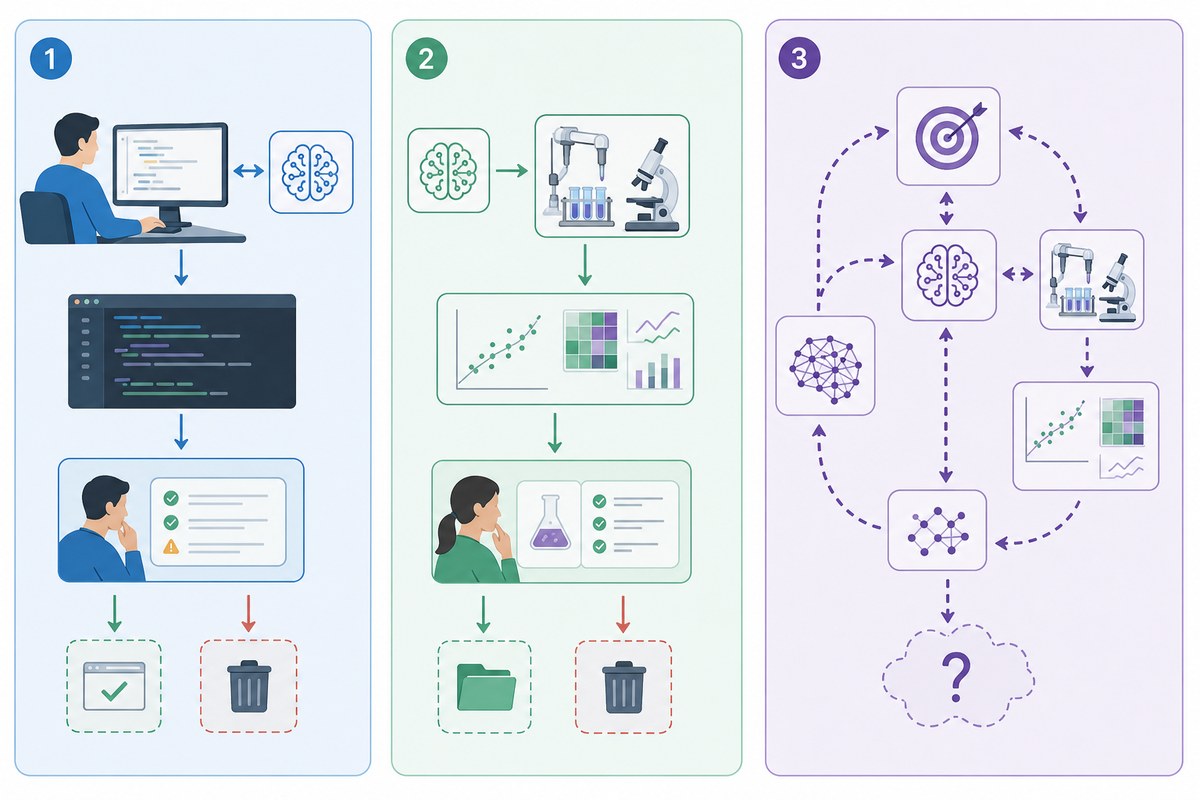
A second figure, carried in Bloomberg reporting published by Yahoo Finance, said that more than a quarter of Anthropic’s AI R&D work was led by Claude. That number should not be read as contradicting the 80% code measure, or as proof of independent end-to-end research. They describe different things: merged code in one case, and the share of R&D work led by the model in another. Neither metric establishes that an AI system can autonomously improve itself through the entire research cycle.
What the group wants governments to build
The paper’s reported agenda is preparatory rather than a single proposed ban. It calls for greater visibility into automated AI R&D, independent auditing and mechanisms that could constrain the pace of AI improvement if a dangerous acceleration emerged. The proposals also include isolating automated R&D systems, linking some intervention capacity to data centres, and developing emergency responses. Bloomberg’s account similarly described requests for government oversight of self-improving AI and tools to slow development when necessary.
Those ideas would confront a difficult policy problem: the same infrastructure that supports ordinary cloud computing and commercial model development can also support increasingly capable automated research. The reported focus on data centres reflects where large-scale training and inference consume concentrated computing resources. It does not mean governments already possess a tested method for detecting or stopping a self-reinforcing research cycle.
An August policy paper from the Institute for Progress reaches a related but more conditional conclusion. It says there is empirical evidence of rapid movement toward automated AI R&D, while the scale of any resulting capability acceleration and its risks remain poorly understood. Its recommendations emphasize advance planning around observable thresholds, alongside the costs and trade-offs of measures that might slow AI development.
That uncertainty is the unresolved issue beneath the new appeal. Current systems can contribute to code, conduct specified experiments and compress parts of research workflows. The more dramatic scenario requires those abilities to combine into a reliable feedback loop: AI materially improves AI research, uses that improvement to make itself more capable, and repeats quickly enough that institutions cannot keep pace. The signatories’ warning is that governments should be ready for that possibility; the evidence cited so far does not show that the loop exists.
For policymakers, the immediate work is therefore less about declaring an intelligence explosion under way than about understanding where AI is already embedded in frontier development, what human review remains in place, and which technical signals would show the transition from assistance to sustained autonomous research. Anthropic’s own description remains a useful marker of the present state: substantial AI participation in development, paired with acknowledged gaps in autonomy and scientific direction.

