


I spent weeks living with three of the most talked-about XR display glasses, and the set I kept reaching for was not the priciest. In head-to-head testing, the Xreal 1S outperformed the more expensive Viture Beast and outmaneuvered the bargain-focused RayNeo Air 3s Pro, thanks to a rare mix of reliability, comfort, and ready-to-use features.
How I Tested Wearable Displays Across Devices
These are tethered wearable displays that plug into phones, laptops, or gaming handhelds via USB-C DisplayPort Alt Mode. I evaluated them as personal monitors for work, gaming, and media, not as standalone AR headsets. Testing covered display clarity and brightness, field of view, motion stability, comfort over long sessions, and the maturity of spatial features like head tracking and dimming.
They were used with a MacBook Pro, a Windows laptop, a Galaxy S series phone, and handhelds including Steam Deck and ROG Ally. I paid special attention to motion-to-photon behavior, the feel of on-head weight, real-world brightness in mixed lighting, and whether each pair delivered its advertised features without waiting on firmware roadmaps.
Viture Beast: A Big Screen With Big Caveats
On paper, the Viture Beast is an easy pick: a claimed 58° field of view, peak brightness of roughly 1,250 nits, built-in 3DoF tracking via VisionPair, a front camera for future 6DoF, and nine-step electrochromic dimming. It’s also the heaviest at about 94 grams, though the rounded frame distributes weight comfortably.
In practice, the Beast ships with marquee features pending firmware. Support for 1200p at 120Hz is disabled at the moment, leaving 1080p at 60Hz. The camera-enabled 6DoF isn’t live yet either. Motion locking was acceptable in my tests, but tapping the frames sometimes produced a ripple across the display that broke immersion more than on rivals. For a product around $549, asking buyers to trust what’s coming rather than what’s working now is a difficult sell.
That said, the generous FOV and extensive dimming controls hint at serious potential. If you prioritize the widest virtual screen and can wait for updates, the Beast could become the class leader—just not today.
Xreal 1S: The Feature-Complete All-Rounder
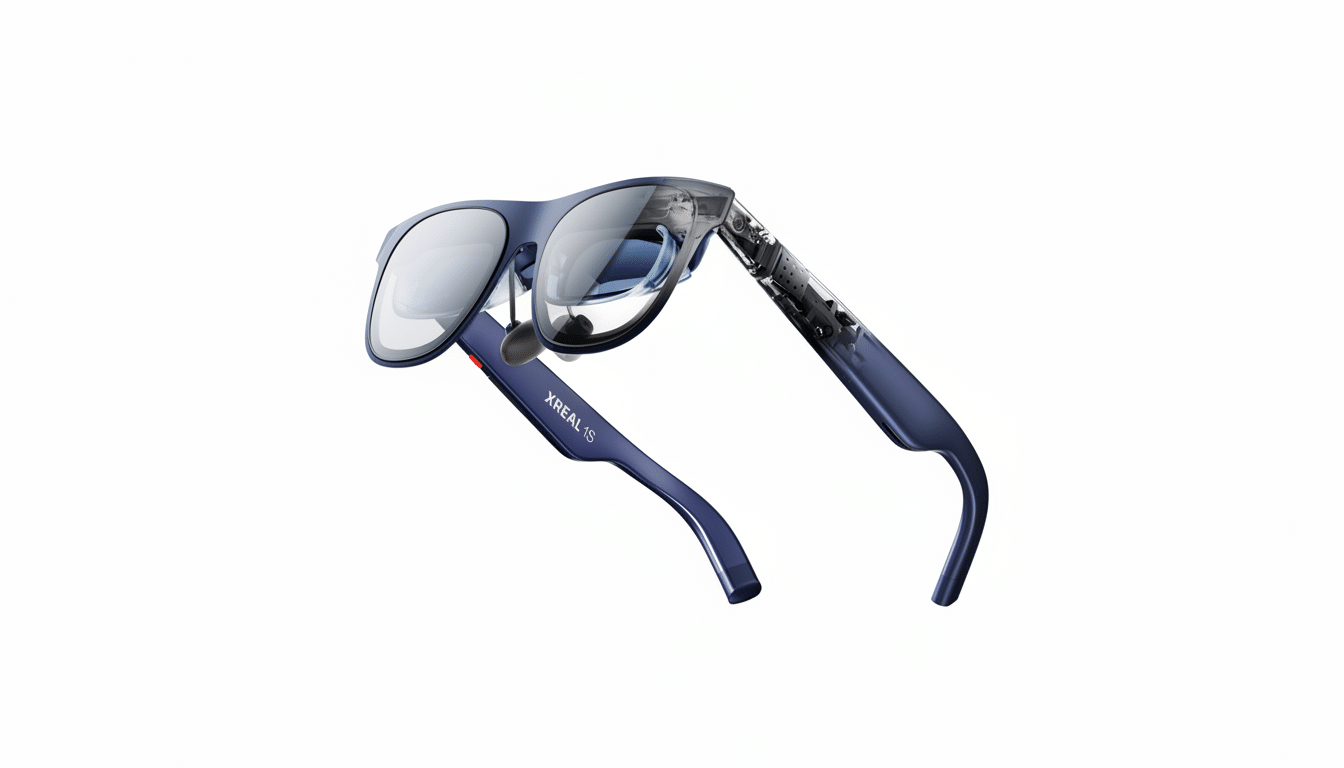
The Xreal 1S nails the fundamentals. You get a 1200p image with a 52° FOV and a productivity-friendly 16:10 aspect ratio in a package that weighs about 82 grams. The secret sauce is Xreal’s X1 Spatial Computing Chip, which handles 3DoF tracking with a claimed 3ms motion-to-photon latency. In real use, the virtual screen stays anchored even during quick head turns, with none of the jitter that derails extended sessions.
Brightness is the main trade-off at around 700 nits—noticeably dimmer than the others. Three-step electrochromic dimming helps indoors, and I rarely felt limited under typical office lighting. Heat from the on-board chip is perceptible on the forehead, especially during long movies or game streams, but it never crossed into discomfort in my testing.
Real 3D, Xreal’s live 2D-to-3D conversion, proved better than expected on well-lit, high-contrast footage and slower games; it’s less convincing on fast, noisy content. Crucially, everything meaningful is available out of the box. No waiting, no workaround apps, just a stable, portable screen that works across phones, laptops, and handhelds.
RayNeo Air 3s Pro Is a Bright Budget Pick
RayNeo’s Air 3s Pro is a value play that trades advanced spatial features for brightness and speed. It delivers a sharp 1080p image at 120Hz, a narrower 46° FOV, and impressive peak brightness near 1,200 nits, all in the lightest chassis of the group at roughly 76 grams. Outdoors, that luminance makes a real difference, preserving contrast when ambient light would wash out dimmer micro‑OLEDs.
The compromise: no native 3DoF tracking and no electrochromic dimming. The image is head‑locked, which can feel like the screen is moving with you rather than pinned in space. The constant sunglass tint also makes glancing down at a keyboard or phone trickier. RayNeo’s smartphone app tries to add limited tracking, but it was too inconsistent to rely on for work.
If you want a simple, plug‑and‑play wearable monitor—especially for travel videos or games in bright environments—the Air 3s Pro is a smart, affordable choice.
Why Price Isn’t the Best Predictor of XR Value
In XR wearables, cost often reflects extra sensors and ambitious roadmaps rather than guaranteed day‑one performance. Analysts at IDC and Counterpoint Research have noted that comfort, reliability, and ecosystem readiness drive adoption more than headline specs. Meanwhile, Display Supply Chain Consultants has highlighted rapid gains in micro‑OLED efficiency and yields, which help midrange models punch above their weight without ballooning price.
That dynamic explains this year’s landscape: the most expensive pair brings a broader feature list, but the midrange option delivers the most complete experience right now.
Verdict: The Best XR Glasses You Can Buy Now
The Xreal 1S is the clear winner for most people. It’s lighter than the Viture Beast, more stable in tracking, and ships with its best features ready to go—while costing roughly $100 less than Viture’s flagship. The RayNeo Air 3s Pro is the brightness champ and a great travel companion if you don’t need spatial pinning. The Viture Beast shows promise with its wide FOV and deep dimming, but it’s hard to recommend it at its current price until the promised updates land.
Bottom line: if you need a dependable, portable screen today, pick Xreal. If you crave the biggest FOV and are comfortable betting on firmware, Viture could become your play. If your budget and outdoor viewing top the list, RayNeo gets the job done with fewer frills.
