


Wi‑Fi has been playing catch-up with headline speeds for the last few generations. Wi‑Fi 8, or what’s known inside the IEEE standards body as the 802.11bn Ultra High Reliability WLAN, flips that script. Rather than catering for peak throughput bragging rights, the new standard should produce steadier links, less jitter, and fewer dropouts — just the ticket for increasingly crowded and mission-critical home, office, and IoT‑soaked environments.
Reliability Is the Upgrade in the Wi‑Fi 8 Standard
From a high level, Wi‑Fi 8 retains the same old spectrum — the 2.4 GHz, 5 GHz, and 6 GHz triple threat — and has a peak physical rate ceiling similar to where Wi‑Fi 7 tops out. It’s not what spectrum it can use — the difference is in how intelligently it uses that spectrum. The IEEE working group’s focus on “ultra high reliability” is directed toward performance that makes a real difference to users: even mid‑range throughput, a stable mesh backhaul, less obnoxious roaming among access points, and predictably low tail latency (the frustrating slowest 1% of packets).
- Reliability Is the Upgrade in the Wi‑Fi 8 Standard
- The Speed Myth and the Practical mmWave Reality
- Early Silicon and Routers Are Arriving Ahead of Certification
- How Wi‑Fi 8 Keeps More Calls on the Line
- Why Stability Is Trumping Raw Speed at the Track
- What to Expect from Wi‑Fi 8 and Who Should Upgrade First
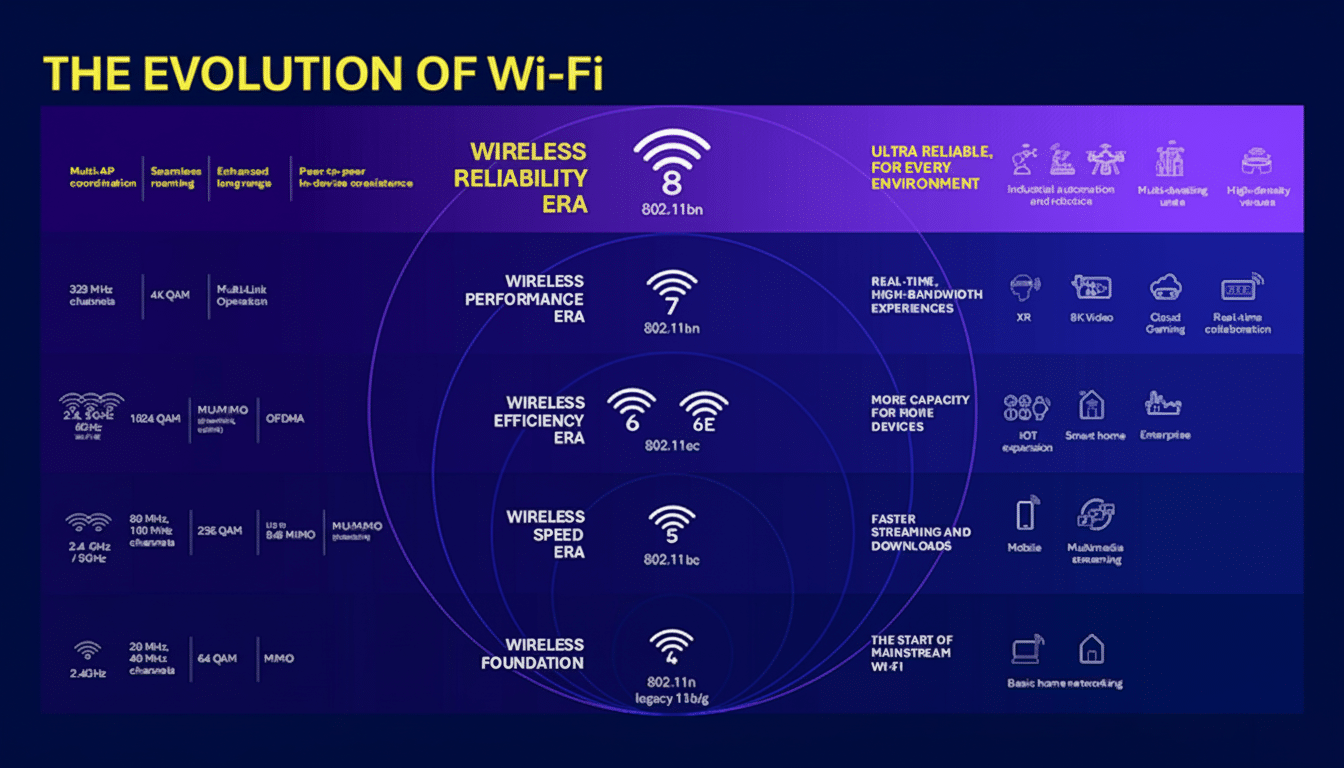
Think of it as graduating from periodic bursts of greatness to consistent excellence. It is anticipated that working group objectives can be achieved with approximately 25% improvement in throughput under the same signal conditions, reduced Media Access Control (MAC) frame loss, and significantly more stringent latency percentile distribution. That’s the difference between a video call that stutters now and then, and one that doesn’t.
The Speed Myth and the Practical mmWave Reality
You will see some splashy reports that Wi‑Fi 8, let’s not even call it 6 GHz or whatever it may become, goes up to 100 Gbps. Those numbers rely on millimeter‑wave (mmWave) operation — short‑range, very high directional links which are infamously sensitive to obstacles and motion. Crucially, mmWave isn’t included in the core Wi‑Fi 8 specification and is expected to see release on a later timescale as an extension track of the base standard. In other words: don’t buy Wi‑Fi 8 for moon‑shot peaks. Purchase it for less turbulence at the speeds you actually use.
Early Silicon and Routers Are Arriving Ahead of Certification
Pre‑standard hardware is already beginning to appear, as vendors scramble to plant flags. A full Wi‑Fi 8 chipset family has been unveiled by MediaTek as part of its Filogic 8000 line. In a different direction, Qualcomm has publicly showcased an interoperable Wi‑Fi 8 physical layer validated by wireless test and measurement specialist LitePoint. On the router front, Asus has already teased a “pre‑standard” Wi‑Fi 8 unit under the firm’s ROG NeoCore brand, and that’s probably where these gaming‑oriented products are headed.
One practical note here: when gear ships before IEEE ratification and Wi‑Fi Alliance certification, it will often require firmware updates to catch up with the final spec. That can work like a charm or not at all. Customers with very strict interoperability requirements normally wait for certification, while enthusiasts might jump in a little earlier.

How Wi‑Fi 8 Keeps More Calls on the Line
The reliability push takes form not just in what’s new, but in some advanced cooperative features that make access points act less like lone wolves and more as a coordinated system.
- Coordinated Spatial Reuse (Co‑SR): Dynamically configures transmit power and channel reuse in a subset of nearby access points to minimize interference and congestion. Lab and vendor data indicate that this alone can boost system throughput by between 15% to 25% in a dense deployment.
- Coordinated Beamforming (Co‑BF): Multiple APs mold and direct energy towards active devices rather than shouting over each other. In mesh networks and multi‑AP setups, this often translates to 20–50% higher effective throughput on a per‑link basis, as well as much cleaner links at the coverage edge.
- DSO (Dynamic Spectrum Orchestration): Tactical allocation of channels and bandwidth based on device capability and existing demand, further shaping scheduling with the aim of reducing queueing times. Some vendors claim up to an 80% improvement in perfect conditions; real‑world gains will vary, but even half of that would smooth out streaming and cloud gaming significantly — e.g., Asus is claiming max 2x mid‑range throughput, up to twice as much IoT coverage, and potentially six times lower P99 latency in its pre‑standard router marketing.
- Under‑the‑hood refinements: Improved link adaptation to avoid jarring rate changes, more robust mesh backhaul in noisy environments, and smarter management of control traffic so the management frames won’t get squished when networks become crowded.
Why Stability Is Trumping Raw Speed at the Track
At home, the bottleneck is generally not the maximum speed your router can reach in an empty room, but what happens when you’re carrying a signal through walls and people while competing with neighbors wielding their own routers or broadcast systems. Reliability improvements mean fewer buffering wheels, less audio breakup during calls, sturdier smart‑home sensors, and more responsive cloud apps.
A headline use case is coordinated multi‑AP behavior in offices. Wi‑Fi 8’s method ought to cut down on co‑channel interference between floors and in conference rooms, giving capacity a boost without the need for ripping‑and‑replacing cable. Shorter, tighter latency tails are also a win for AR/VR training, real‑time control systems, and latency‑sensitive collaboration tools.
What to Expect from Wi‑Fi 8 and Who Should Upgrade First
The IEEE 802.11bn effort is still in flight, with Wi‑Fi Alliance certification set to follow ratification. Look for more chip announcements before and around notable industry events and a trickle of “Wi‑Fi 8 ready” routers leading up to official certification. If you value predictability and multi‑vendor interoperability, waiting on certified gear is your safest bet. For those of us chasing lowest P99 latency and the most stable mesh links, some early hardware will have an appeal if you know what to expect for firmware maturity.
Bottom line: this is not a Wi‑Fi war for bragging rights. It is the transformation of wireless into a utility that behaves like one, covering what happens when Mom and Dad try to pull down 108 megabytes of data on a packed Tuesday afternoon as well as in a lab. That transition — from peak speed to reliable performance — is the difference most people are going to feel day‑to‑day.
