


Britons are rushing to sign up to VPNs in record numbers as age checks go live on adult sites, and early figures indicate a sharp dip in adult traffic. New numbers from Ofcom’s Online Nation report suggest a fast behavioral change: users are finding ways around new roadblocks, while the largest porn platforms receive fewer visits from Britain.
What Ofcom’s data shows about VPNs and adult site traffic
In the UK, daily VPN usage went from about 650,000 connections to almost 1.5 million almost immediately after enforcement started—a spike of around 131%, according to Ofcom. While use eventually declined to roughly 900,000 daily, this still reflects a significantly higher baseline compared to pre-age gates going live.
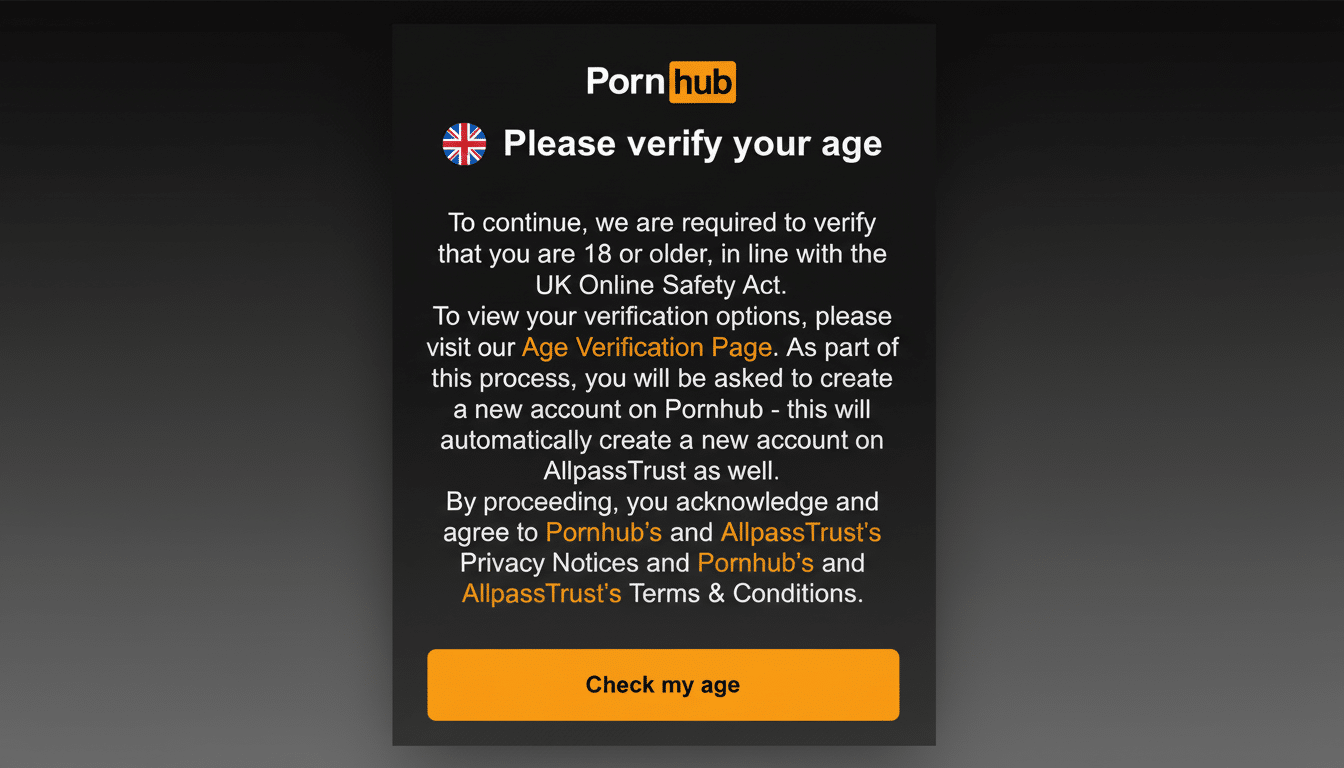
Meanwhile, Ofcom noted that traffic to adult sites fell dramatically. Visits to Pornhub, the most visited adult site in Britain, dropped by about 1.5 million in the first month after checks were adopted, a decrease of roughly 13% compared with numbers from the previous year. Traffic to the top 10 adult sites has stayed at a “lower level” since that time, indicating the original shock was not simply a one-week blip.
The Age Verification Providers Association says there are around five million age checks now performed every day in the UK. Ofcom also reports that 7.8 million visitors from the UK are registering for services that have implemented age checks, demonstrating how rapidly verification has become an established part of adult content interaction online.
Circumvention and compliance across sites and services
VPNs are the most widely used workaround. A VPN can obscure a user’s location, making it seem like the user is accessing a service in an area that has no enforced checks. The post-enforcement surge in VPN usage is consistent with previous cycles of governments imposing new content restrictions—both India’s porn blocks and Indonesia’s platform bans, for instance, have resulted in documented upticks in VPN use, according to several industry trackers.
And in the meantime, a larger variety of platforms outside of traditional adult sites are participating. The framework from Ofcom under the Online Safety Act relates to services hosting explicit content, causing companies including Substack to announce that it is verifying UK users. Some of the biggest dating apps in existence, including Tinder, Bumble, Hinge and Feeld, have also said they will take steps to comply with the law.
The stakes are significant. The services would be fined up to £18 million or 10 percent of global revenue under the Online Safety Act, should they fail to comply with the new law. Ofcom can apply for intermediary access restrictions, press ancillary services to side with it, and lobby social media companies to do the same, exercising pressure by these different means.
Risks to privacy and technical choice in age checks
How platforms verify age matters. Providers employ a smorgasbord of approaches: third-party identity checks, confirmation via credit card or mobile carrier, age estimation through facial analysis and privacy-preserving “age tokens” that verify eligibility without divulging identity. UK companies such as Yoti have also pushed facial age estimation, which purports not to store images, in an effort to satisfy the data minimization demands of the Information Commissioner’s Office.
Civil society groups, such as the Open Rights Group and the Electronic Frontier Foundation, caution that badly implemented systems risk creating honeypots of slimy data and driving identity association across websites. Their point is simple: age assurance should not be de facto identity validation. Assessing whether Ofcom’s guidance and the ICO’s oversight can be trusted to keep age checks focussed, secure and privacy-protective will be essential.
One of the trade-offs is usability, too. With privacy-oriented options in place, friction leads some users to abandon the service or game it. The decline in traffic indicates, in part, that some users did neither: they simply stopped coming. Another portion adopted VPNs. The rest complied. Where in this unstable, shifting equilibrium it lands will depend on how easy providers make the experience and how reliably enforcement falls on both large and long-tail sites.
Early results and what to watch as UK enforcement evolves
In the short term, brace for further VPN normalization and more complete industry compliance. The early spike in VPN use flattened out but has not returned to anything resembling its pre-enforcement baseline, suggesting a lasting shift in behavior for certain users. Meanwhile, continued sluggish traffic to the largest adult platforms suggests a lasting impact of added friction.
But the larger issues are policy ones: Do age checks actually reduce underage exposure? Can we expect that privacy-by-design becomes common practice, and that Ofcom does a good job corralling noncompliant sites aside from mainstream ones? For now at least, one thing is certain from the numbers: verification is reshaping UK user behavior at scale, shoving millions towards VPNs but equally pulling a large portion of traffic out of adult platforms.
