


Uber and London autonomous-driving company Wayve began offering supervised autonomous rides to some passengers in the capital on September 3, putting 15 specially licensed electric vehicles into the ride-hailing network. It is a public-facing deployment in one of Europe’s most demanding urban traffic environments, but it is not yet a driverless taxi service: a licensed human safety driver remains in every car.
Passengers requesting UberX, Uber Electric or Uber Comfort may be matched with a Wayve-equipped Ford Mustang Mach-E. They cannot order the vehicle specifically, and may decline the match or switch to a conventional car. The price is intended to match the equivalent standard Uber fare and is displayed before the trip. The arrangement makes autonomous driving an option inside an established consumer app, while leaving the service’s most consequential operational responsibility with the human in the front seat.
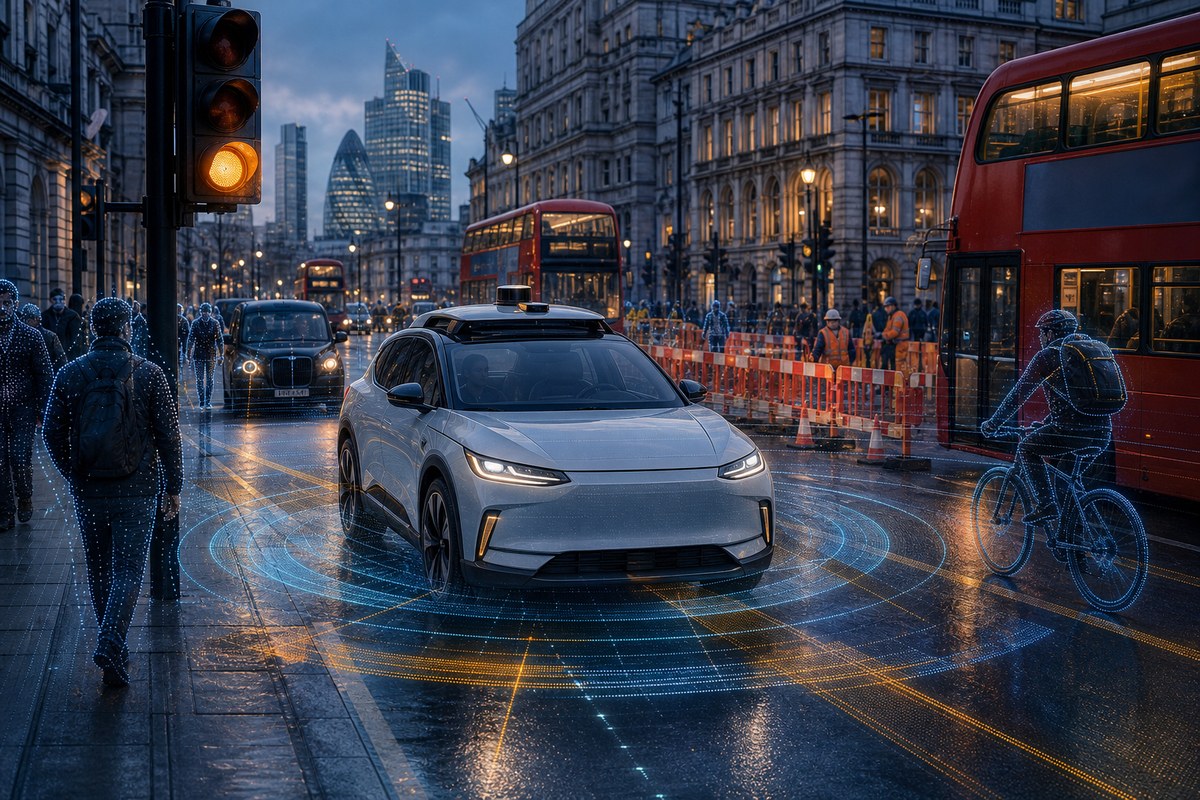
How the London service works
The vehicles are private-hire cars modified with Wayve’s driving system. The Guardian reported that Transport for London licensed 15 of them in August under conditions requiring a safety driver. Other launch accounts described the fleet as fewer than 20, a broader figure consistent with the more specific 15-vehicle licence count.
That small scale is useful context for descriptions of the launch as London’s first robotaxi service. “Robotaxi” and “self-driving taxi” are often used as product categories, but the detailed accounts agree on the important limitation: the current operation is supervised. The person in the driver’s seat is licensed, monitors the journey and can assume control when necessary. Riders are buying a conventional private-hire journey whose steering, braking and route decisions may be handled by software for portions of the trip.
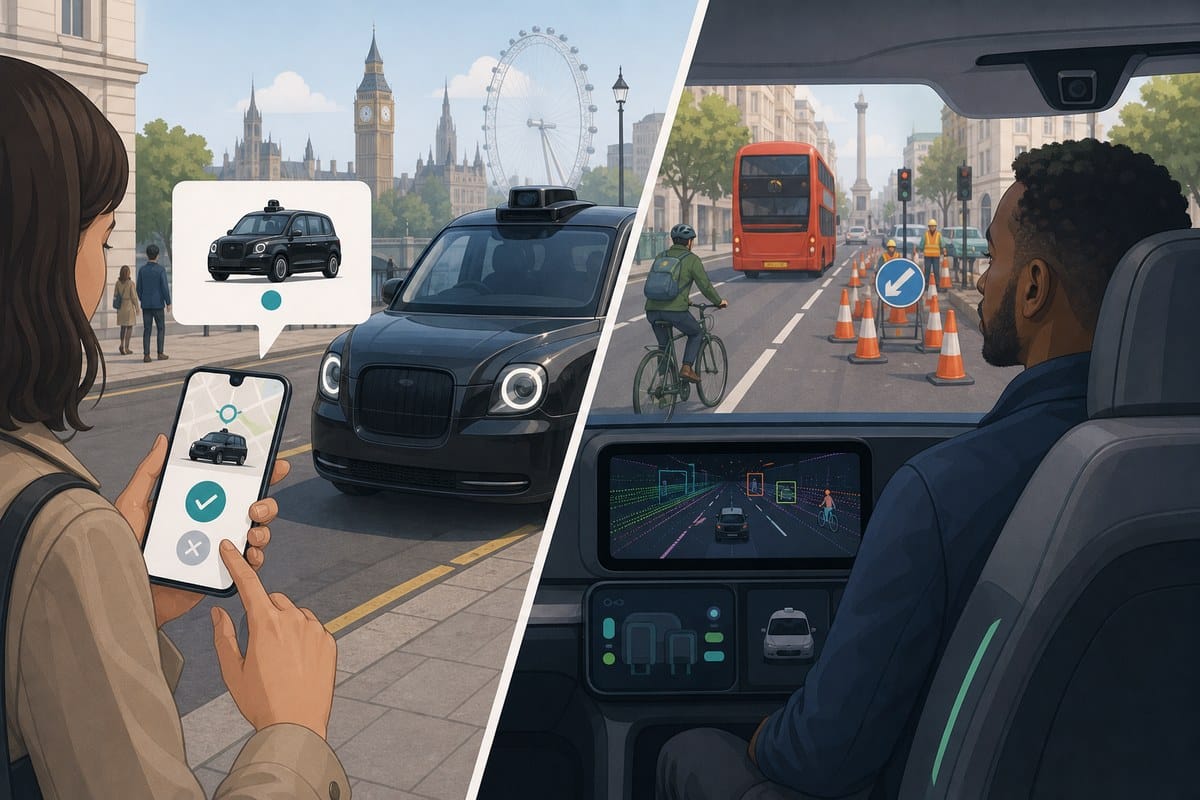
Uber’s matching model also avoids creating a separate autonomous-vehicle booking class. It lets the company expose regular customers to the technology without requiring them to seek it out, while preserving an immediate opt-out. AP reporting carried by WRAL likewise described standard app matching, normal pricing and an initial rollout below 20 vehicles.
What the early rides show
The public launch follows demonstration and early journeys reported a day earlier. In a BBC ride report, the human operator intervened after the vehicle hesitated around a cyclist and roadworks. The BBC reported Wayve’s position that its system could have handled the situation, but the episode illustrates why an onboard supervisor is more than a ceremonial presence in a dense city street setting.
An AFP report carried by The Star also described an operator takeover during an early journey. Two reports observing interventions do not amount to a safety comparison with human-driven taxis, and neither establishes how frequently such takeovers occur across the fleet. They do, however, make clear that the launch should be judged as a controlled operational trial with paying passengers, not evidence that the cars have dispensed with human fallback.
Wayve characterizes its AI Driver as a system that learns from driving experience rather than relying on traditional high-definition maps and extensive hand-coded rules. That approach is designed to make the software adaptable across changing streets and cities, but it remains a company claim rather than an independently demonstrated measure of safety or scalability. London’s mix of buses, cyclists, construction, narrow roads and unpredictable stopping traffic will offer a demanding real-world test.
Separate route to driverless approval
The current private-hire licences and permission for a no-driver commercial service are different regulatory questions. The Guardian reported that fully autonomous operation requires a separate government process involving the Driver and Vehicle Standards Agency. The Department for Transport told the BBC that autonomous services would be introduced carefully, subject to rigorous testing, regulatory approval and local consent.
The government is working toward an autonomous-vehicle regulatory framework for 2027, according to the BBC, but that is not a launch date for Uber or Wayve. Nor has either company set a firm date for removing the safety driver in London. Wayve chief executive Alex Kendall told the Guardian that the company intends to do so only after validating safety measures on manufacturer-produced vehicles and obtaining approval.
The distinction is particularly relevant to Uber’s business case. A supervised autonomous car may help the company and Wayve test customer acceptance and software performance in live service, but it does not remove the trained person needed to oversee the trip. Uber’s global head of autonomous mobility, Sarfraz Maredia, told the BBC that the company expected human drivers to remain on its London platform for a long time.
For now, London riders may encounter a car that drives itself for part or much of a journey, but they are not boarding an empty-front-seat vehicle. The 15-car service remains supervised, and fully driverless commercial operation still requires separate approval.

