


A little-known but critical U.S. logistics software provider inadvertently left parts of its shipping platform and customer records exposed to the open internet, a lapse researchers say could have enabled hijacking of cargo operations and theft of sensitive data. The company, Bluspark Global, operates Bluvoyix, a platform used by major retailers, manufacturers, and affiliated providers to manage and track freight worldwide.
The exposure, uncovered by independent researcher Eaton Zveare, illustrates how a single weak link in logistics software can ripple across global supply chains. Zveare reported the flaws through an industry intermediary after initial attempts to reach the company went unanswered; Bluspark has since moved to remediate most of the issues and is pursuing an external security assessment, according to a law firm representing the company.
- Exposure Put Cargo Operations And Customer Data At Risk
- How The Researcher Stumbled Onto The Flaws
- Plaintext Passwords And Admin Creation Compound The Risk
- Disclosure Gaps Show A Persistent Industry Problem
- Logistics Platforms Are Prime Targets For Cybercrime
- What Logistics Tech Teams Should Do Right Now
Exposure Put Cargo Operations And Customer Data At Risk
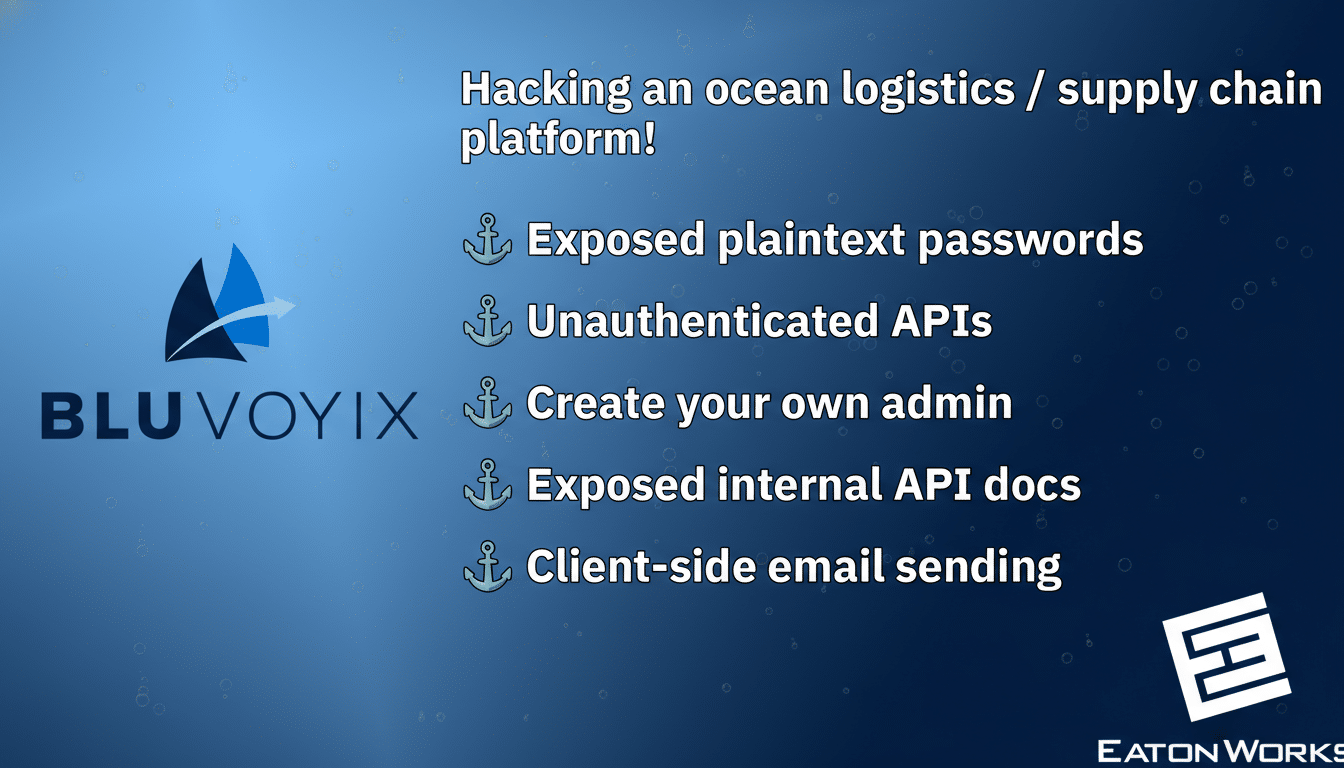
The core problem, Zveare found, was that Bluvoyix’s web-facing application programming interface (API) could be browsed and exercised by anyone, despite on-screen claims that authentication was required. The API’s auto-generated documentation acted as a roadmap of sensitive functions, including the ability to enumerate users, create new accounts, and access operational data without credentials.
From there, a malicious actor could have accessed records spanning years of shipments and user activity. Zveare said administrator-level access exposed customer data back to 2007, a window that could reveal routes, schedules, and counterparties—intelligence prized by organized cargo theft groups and fraudsters.
How The Researcher Stumbled Onto The Flaws
The discovery began with a customer of Bluspark whose website contact form relayed messages through Bluspark’s infrastructure. Because the email-sending script was embedded client-side, it was possible to tamper with the form and misuse it to send spoofed messages, a classic avenue for phishing attempts that appear to come from a trusted partner.
When Zveare navigated directly to the API’s documentation, the site not only revealed the full catalog of functions but also allowed “try it” testing that returned live data. Despite indications that the system required login tokens, requests completed successfully without them. That bypass effectively turned the API into an open door.
Plaintext Passwords And Admin Creation Compound The Risk
Among the most serious findings: user credentials were stored in plaintext within query results. This violates long-standing best practices from NIST, which call for hashing and salting passwords to prevent disclosure even if databases are accessed. Exposure of administrator credentials would allow complete takeover of tenant environments and impersonation of users.
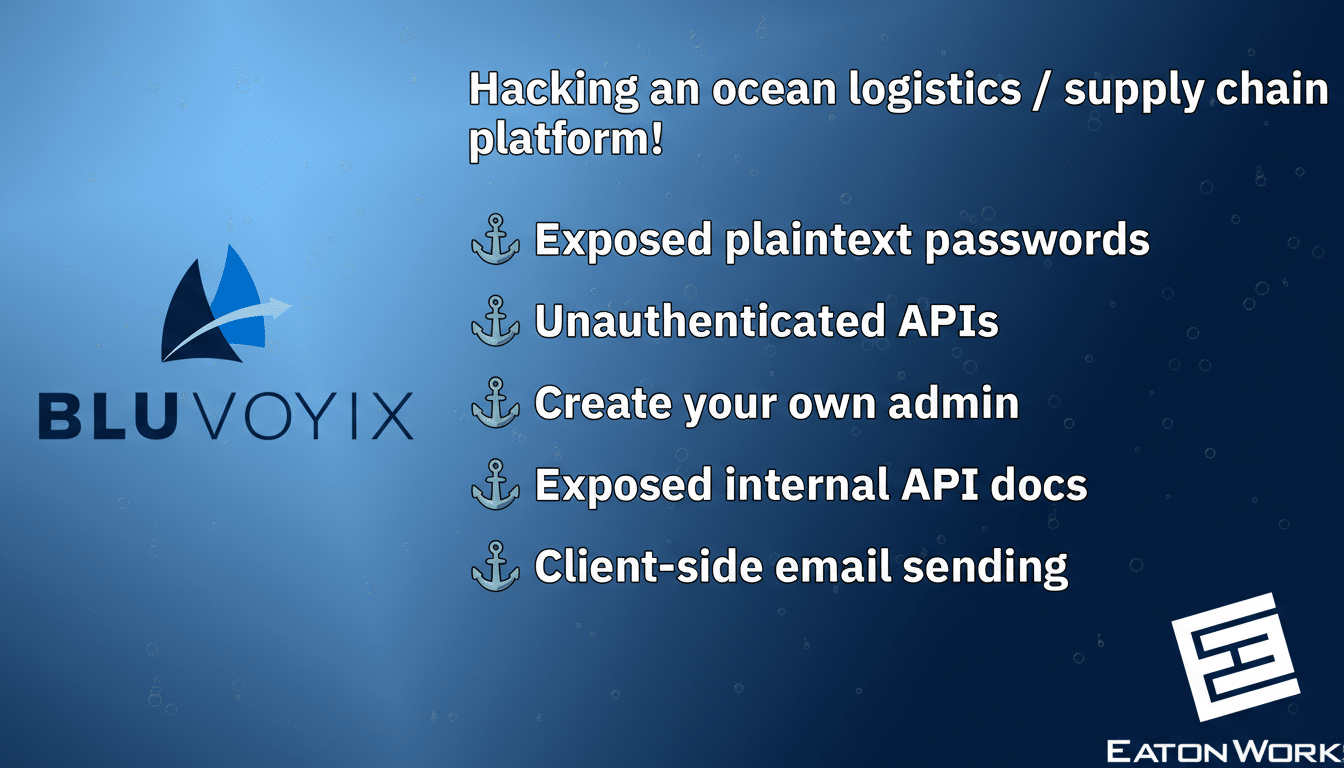
In keeping with legal and ethical norms, Zveare did not use any exposed passwords. However, the API provided a function to create a new administrator account without authentication, which he used to confirm the scope of exposure. The existence of multiple unauthenticated pathways—account creation, token bypass, and sensitive data retrieval—aligns with several items on the OWASP API Security Top 10, including broken authentication and excessive data exposure.
Disclosure Gaps Show A Persistent Industry Problem
Initial outreach to Bluspark took longer than the research itself. With no obvious security contact, Zveare turned to the Maritime Hacking Village, a nonprofit that facilitates responsible disclosure within the maritime and logistics sector. Weeks of emails, calls, and professional network messages followed before the company engaged via counsel and began remediation.
Bluspark is now working to establish a vulnerability disclosure program to accept reports from external researchers, according to discussions referenced by the researcher. Security teams and policymakers have repeatedly urged companies to publish a security.txt file and a monitored disclosure inbox—basic steps that can dramatically cut response times when critical flaws are discovered.
Logistics Platforms Are Prime Targets For Cybercrime
The timing could not be worse for an industry already under cyber pressure. CargoNet has reported a 57% year-over-year rise in cargo theft events, with losses totaling in the hundreds of millions. Investigators increasingly link physical theft to digital reconnaissance, where attackers harvest route data and identities to divert loads or impersonate carriers.
Broader breach trends underscore the risk. Verizon’s Data Breach Investigations Report cites the human element in 68% of breaches and stolen credentials in roughly 31%, while IBM Security’s Cost of a Data Breach report pegs the average global breach at nearly $4.9 million. For logistics, where even brief downtime strangles cash flow and erodes trust, the operational impact often eclipses headline breach costs.
What Logistics Tech Teams Should Do Right Now
- First, lock down developer tooling. Auto-generated API docs and “try it” consoles must be gated behind strong authentication, segmented from production, or disabled entirely. Enforce token validation on every endpoint, apply least-privilege scopes, and block anonymous access by default.
- Second, eliminate plaintext secrets. Store passwords only as salted, slow hash digests; rotate keys and tokens; and implement secret scanning in CI/CD. Monitor for anomalous API activity—spikes in enumeration calls, failed auth attempts, and large data exports—using behavioral analytics and immutable logs.
- Third, formalize the human loop. Publish a vulnerability disclosure policy, maintain a monitored security contact, and consider a managed bug bounty. Require suppliers and white-label partners to meet the same bar, since exposure via a customer portal is often where attackers start probing.
The Bluspark case is a stark reminder: in modern freight, software is part of the critical infrastructure. When it’s left unguarded, it isn’t just data at stake—it’s the movement of goods that keeps the economy running.
