


Thea Energy has lifted the veil on Helios, a software-defined fusion power plant that takes its pixel metaphor from digital displays. Instead of forging a single, arcane magnetic coil to wrangle superheated plasma, the company envisions an array of similar superconducting magnets that can be orchestrated on the fly, offering a faster, cheaper route to grid-scale fusion.
A Virtual Stellarator, Constructed From Pixels
Helios has another go at the stellarator, a magnetic confinement method prized for its steady-state nature but historically limited by wildly complex, one-off coils. Current flagships like Wendelstein 7-X have shown the stellarator’s promise, but their non-repeating geometries make for a slow and costly manufacturing process with no margin for error.
- A Virtual Stellarator, Constructed From Pixels
- Software-First Control With AI for Magnet Arrays
- Projected Output and Uptime for the Helios Power Plant
- Manufacturing and Cost Implications of Modular Magnets
- Where Fusion Fits in the Future Clean Energy Mix
- What Comes Next for Helios and Thea Energy’s Roadmap
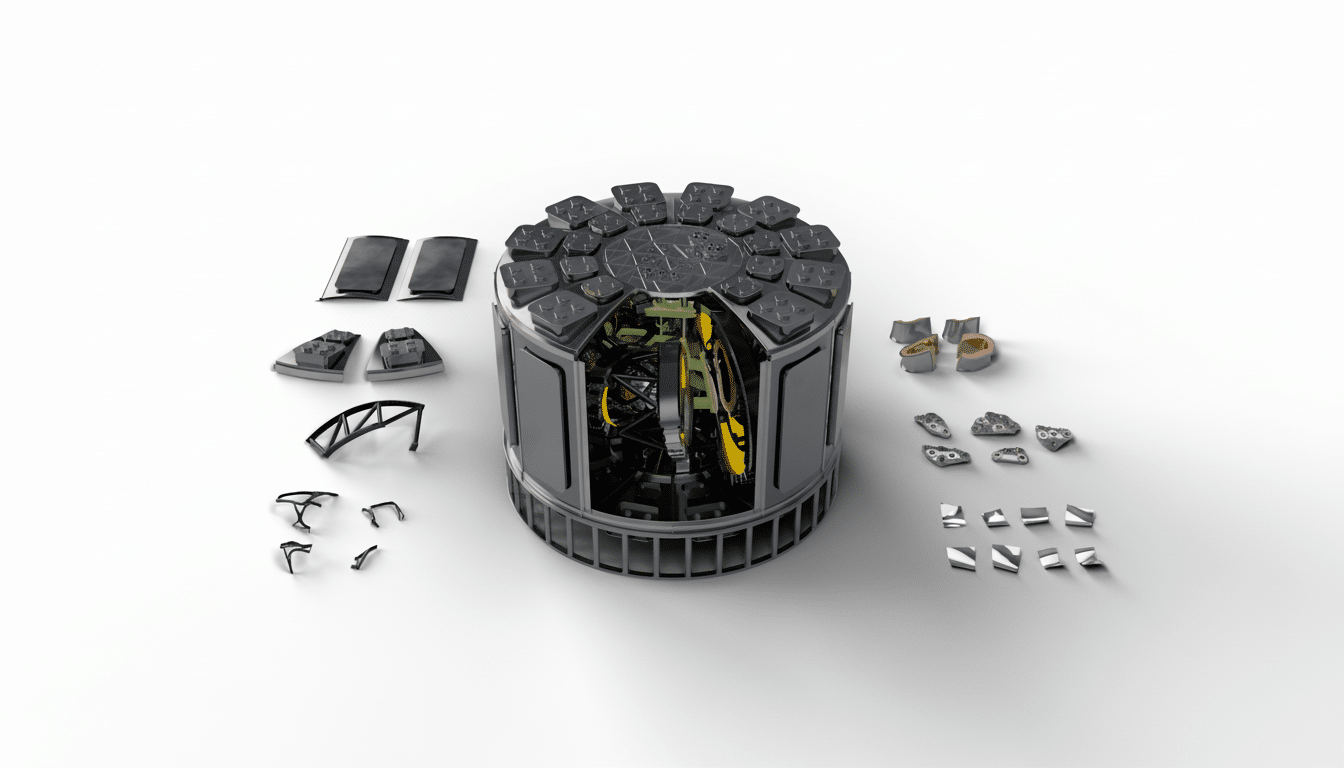
Thea’s solution is a “virtual” stellarator, meaning that the main confining field is provided by 12 large outer coils, while on the inside 324 small, identical circular-shaped superconducting magnets fine-tune the plasma shape. In much the same way that pixels can be used to build up a picture, imagine those smaller coils as pixels—each one individually addressable—and their combined fields replicating the twisty magnetic topology stellarators rely on without needing every bit to be an entirely bespoke work of art.
Modularity matters. The same pieces can be constructed side by side, cost-competitively and iterated rapidly. The company, which has already been through dozens of magnet design revisions in a fraction of the time it usually takes for car-sized coils, says it can pop out new prototypes literally overnight. That rate would be unthinkable with custom nonplanar magnets, which may take years to build and test.
Software-First Control With AI for Magnet Arrays
As with many high-tech systems, Thea’s control strategy is as important as the hardware. The idea is to embed sensors across an array of magnets and then drive each coil independently in order to compensate for manufacturing and installation tolerances in software. As a health check, the team stress-tests arrays by misaligning magnets by well over a centimeter and feeding in superconducting wire from different suppliers—including batches deliberately varied. In all instances, the control system rebalanced the fields and once again set the target configuration without any manual retuning.
Under the hood, the company pairs physics-based algorithms with reinforcement learning to steer through the stratospheric number of control states. In spirit, it’s closer to active optics in contemporary telescopes or adaptive control systems on some aerospace craft: measure slight imperfections and adjust for them the millisecond they appear. If successful on a full scale, Helios could loosen tolerances on how closely everything must match and still produce high-quality, plasma-producing confinement — a huge lever on cost and schedule risk.
Projected Output and Uptime for the Helios Power Plant
On paper, Helios would produce 1.1 gigawatts of thermal power, which would be converted by a steam cycle into about 390 megawatts of electricity. Scheduled maintenance is planned as an 84-day outage every two years, resulting in a projected 88% capacity factor. For reference, the U.S. Energy Information Administration estimates that combined-cycle gas plants generally operate at a capacity factor of less than 60%, while nuclear fleets often operate at 80–90%.
Capacity factor isn’t cost, but it influences revenue and grid value. If Helios can meet specified uptime targets at competitive capital costs, its economics may challenge firm, low-carbon resources, especially in markets that need clean baseload for balancing wind and solar.
Manufacturing and Cost Implications of Modular Magnets
Traditional stellarators get great physics but they give your balance sheet a spanking; custom coils, careful tolerances, restricted supplier pools and so on all ramp up the cost. Thea’s “pixels” methodology reverses that calculus: when you have arrays of identical superconducting magnets that can be tooled for volume production, when you are buying them from multiple vendors, and validating with software instead of tossing out for minor variations whose source is held in secret. It’s a tactic similar to power electronics and modular nuclear designs attacking cost and schedule overrun risk.
There are tradeoffs. Thousands of control channels, cryogenics for a forest of coils, and high-availability power electronics add their own complexity. But if the controls are solid — an area where peer-reviewed campaigns will need to weigh in — software-tunable magnets could make fusion construction go from artisanal to industrial.
Where Fusion Fits in the Future Clean Energy Mix
Helios is a mate to other magnetic-confinement bets, high-field tokamaks, for instance, that bet on simpler coil geometry at the expense of pulsed operation and large central solenoids. Inertial confinement programs, like those at the U.S. National Ignition Facility, address the issue with lasers and pellets instead of magnets. Both pathways are dealing different engineering headaches in exchange for different financial benefits; Thea’s wager is that modular hardware (with intelligent control) is the shortest path to commercial plants.
Independent analyses from groups including the International Energy Agency and the Fusion Industry Association underscore the need for reliable, zero-carbon power to maintain grid stability as variable renewables expand.
What Comes Next for Helios and Thea Energy’s Roadmap
Helios is a concept that still needs to prove out on a smaller scientific device called Eos. The company aims to pursue both paths in parallel—demonstrating the physics at demonstration scale while also maturing the plant design, supply chain and regulatory foundation. It’s a playbook followed by leading fusion developers, who want to collapse timelines without bypassing crucial learning benchmarks.
For the moment, though, the crucial questions are blunt ones: Can the control system be scaled up from nine magnets to several hundred? But the question remains: Will software filter out the uncoordinated mess of a construction site as reliably as it does so already with tools in a lab rig? And can the plant that results survive energy’s most merciless test — providing steady megawatts at a price people are willing to pay? Thea’s preview account of Helios indicates that the company knows where those goalposts are, and they intend to aim directly for them.
