


Tesla has filed a patent quietly describing the vehicle roof that can let radio signals through, and house antennas right within a car’s structure — a piece of design work that suggests future models might turn to Starlink for always-on satellite connectivity.
The application, filed in the U.S. and Europe, covers an RF-transparent polymer roof panel capable of accommodating electronic modules and antennas — a design that also enhances crash performance and cabin insulation.
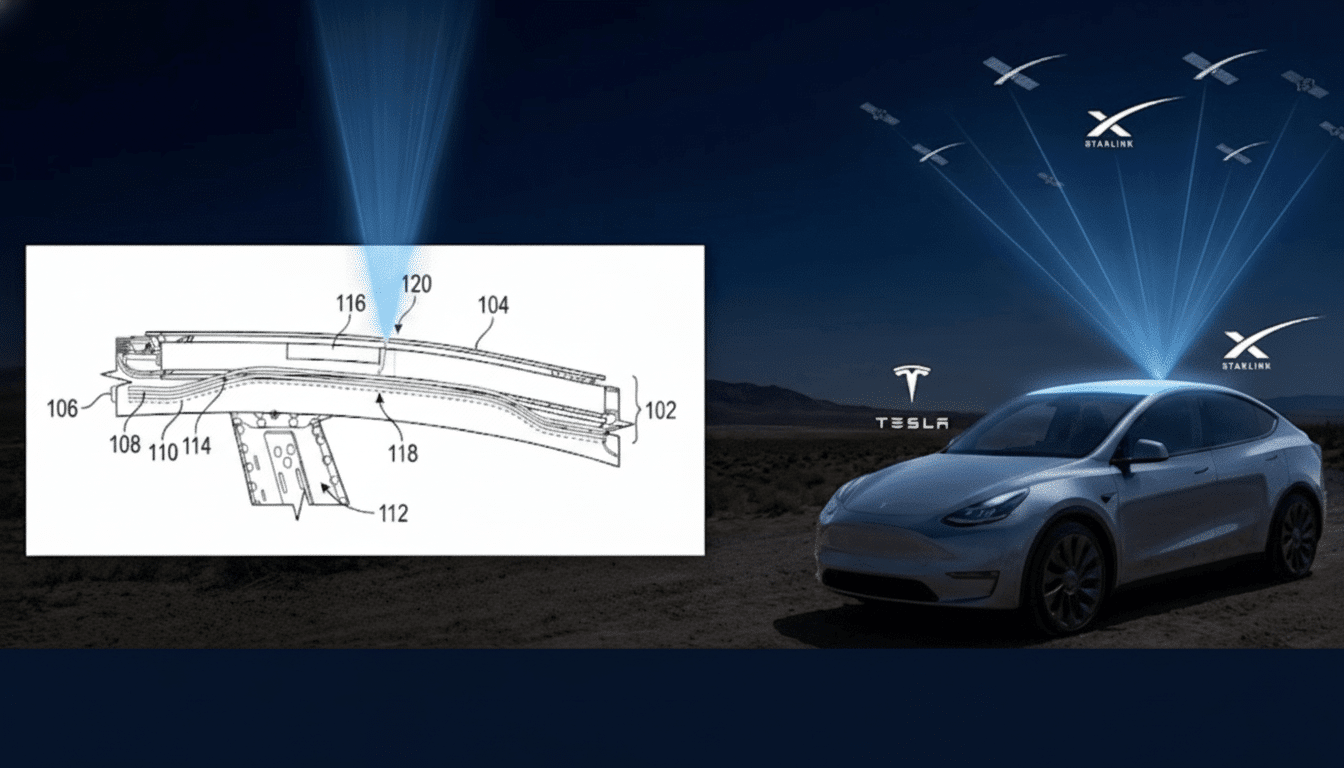
What the Tesla Patent Reveals About RF-Transparent Roofs
The filing outlines a “vehicle roof assembly” that is constructed with RF-transparent materials, such as polycarbonate, ABS or ASA. Unlike metal or metallized glass, which is used in many modern panoramic roofs and can block high-frequency radio signals, this panel operates like a window to radios. The design was also inspired by a membrane-like system for occupant safety, with layered foams for both thermal and acoustic advantages.
Most importantly, the assembly provides space for overhead electronics and antennas in the roof. In practice, that could house satellite-capable hardware — anywhere from small patch antennas to phased arrays — optimised for Ku/Ka bands or new direct-to-cell frequencies. Although the document doesn’t mention Starlink, it does describe the roof directly in terms of a solution for “clear communication with external devices and satellites,” with scant opportunity for misunderstanding what that implies: high-throughput connections coming down from on high.
The concept, which dovetails with enduring automotive pain points — metallized coatings that degrade reception of GPS and satellite radio signals, roof-mounted paraphernalia that sacrifices aerodynamics, aftermarket add-ons that induce drag and wind noise — is not quite as avant-garde as it sounds. By burying antennas under an RF-transparent skin, Tesla could maintain styling, lower drag and shield delicate components from the elements and road debris.
Why Connectivity Via Satellite Is Important In A Car
Tesla vehicles already use LTE and 5G for navigation, entertainment and over-the-air updates but those networks falter in remote areas and die during disasters. A Starlink-ready roof could provide coverage virtually anywhere in the world as long as there is sky to be seen, taking dependable maps, diagnostic and emergency services to backcountry drivers or storm-hit cities.
SpaceX’s Starlink, for example, has already deployed thousands of low‑Earth‑orbit satellites around the world and reported typical latencies in the 25-to-50-millisecond range with broadband-class throughput. The network extends beyond homes to RVs, boats and planes, and the company has already publicly tested direct-to-cell services for text messaging with terrestrial carriers. Integrated antennas hold out the possibility to deliver higher data rates and improved reliability within vehicles than a phone pressed against a window or a portable dish suction‑mounted to glass.
For Tesla, the upside is greater than streaming videos. Predictive maintenance, real-time traffic intelligence and software rollouts are enabled through uninterrupted connectivity. And it provides the foundation for safety features such as automatic crash notification when your phone doesn’t have any cellphone signal, a use case that users of satellite messengers and smartphone SOS services connectable over space networks will find familiar.
Engineering and Regulatory Hurdles for Satellite Car Roofs
Mounting satellite hardware above people poses difficult engineering questions. Antennas require clear views of the sky and must accurately point, while withstanding heat, vibration and crash loads. The number of RF losses should be minimized while maintaining the structural rigidity and shielding necessary to prevent interference with your car’s own electronics. And there is the matter of thermal management: Phased arrays generate heat, and a narrow dark roof in summer would tend to soak that heat up if you didn’t carefully duct it away or spread it out.
Energy draw is manageable. Even a 50–100 W satellite terminal adds little more than another few tenths of a percent to consumption at highway speeds for the average EV, which has a cruising figure ranging from 12–20 kW. The more challenging scenario is intelligent handoff: the car should prioritize 5G in cities, use a mix of satellite and cellular at the edge of coverage and revert to satellite only when out in bumfuck, all without any messy human intervention or visible signs of crappy connectivity.
Then there’s regulation. The Federal Communications Commission has approved Starlink for operation aboard moving vehicles, ships and aircraft under ESIM rules, but individual terminal designs must still be certified and interference managed. In some cases outside the United States, there are local regulators and conditions set by national regulators. Any Tesla-integrated solution would require a global compliance map, in particular if antennas at these power levels are capable of transmitting (like) satellite uplinks.
How It Fits the Competitive Map for Connected Vehicles
Automakers and suppliers are scrambling to connect the sky and the road: Smartphone manufacturers have got the appetite for satellite SOS via Globalstar, while telecoms standards bodies are pushing non-terrestrial networks and with it basic messaging onto regular phones. Meanwhile, satellite operators are wooing aviation, maritime and mobility customers to demonstrate the business case for high-velocity links on the go. A factory-installed system by Tesla would avoid the need to “bolt on” solar and batteries, something that could soon be a selling point for customers who roam off grid.
Caveat: patents are not marketing roadmaps. Companies frequently withhold concepts that never ship. Still, when a carmaker that already owns a satellite broadband provider develops a roof to foster radios that communicate with space, it’s difficult not to notice the signal. Getting from application to driveway would be complex, but the aim is not: Tesla wants the sky inside its car.
