


“Panther Lake”—Intel’s latest laptop architecture, which made a colorful splash at CES—wowed gamers at the show with the promise of frame rates that would have been sheer fantasy for iGPUs just a few short years ago, courtesy of its new integrated Arc B390 GPU. In live demos on preproduction notebooks, the chip topped 80 FPS in Cyberpunk 2077 at 1080p using XeSS—a meaningful leap for traditionally underpowered ultrabooks that tend to be limited to low settings or external graphics.
While show-floor numbers are never the end of the story, they indicate that we’re on the cusp of a generational bump that could make 1080p gameplay an expectation for integrated graphics, not an exception—especially if “reasonable” presets are being used and modern upscaling affects things.
What Intel Showed Off on the CES Show Floor
On laptops using the flagship Core Ultra X9 chip, the Arc B390 iGPU posted headline numbers in some modern titles.
- Cyberpunk 2077 fell around 81 FPS at 1080p High using XeSS, and its 1% lows stayed just below 60—the mark to make combat smooth when the shit hit the fan in the middle of a crowded street.
- Baldur’s Gate 3 hovered around 68 FPS for a 1200p High preset with XeSS Quality.
- Doom: The Dark Ages sailed up and over 50 FPS at 1080p High with a Balanced XeSS profile.
- F1 2025 burst into triple figures (just) at around 110 FPS on the same settings.
These were controlled demos on tuned systems, but they weren’t cherry-picking low-detail presets. As reported by third-party outlets on the ground, among them Tom’s Hardware, the setups leaned on XeSS but retained fidelity that was in fact high enough to represent what many gamers actually use.
Early Benchmarks Suggest 1080p-Capable Performance
It’s not the presence of a single 80+ FPS headline to quote, it’s just how consistent these results are between very different engines and genres. When an iGPU can win 60 FPS at or near 1080p High in several modern titles, the equation starts looking different for students, travelers, and anyone who wants a lighter notebook with no discrete graphics.
Traditionally, integrated solutions have aimed for 30–45 FPS at 1080p with loads of concessions.
Here, the average frame rates—and critically 1% lows—leave a little headroom for tweaks such as dialing back shadows or post-processing while maintaining smooth motion. That’s a new standard for casual competitive play on ultraportables.
The Architecture and Features Behind the Gains
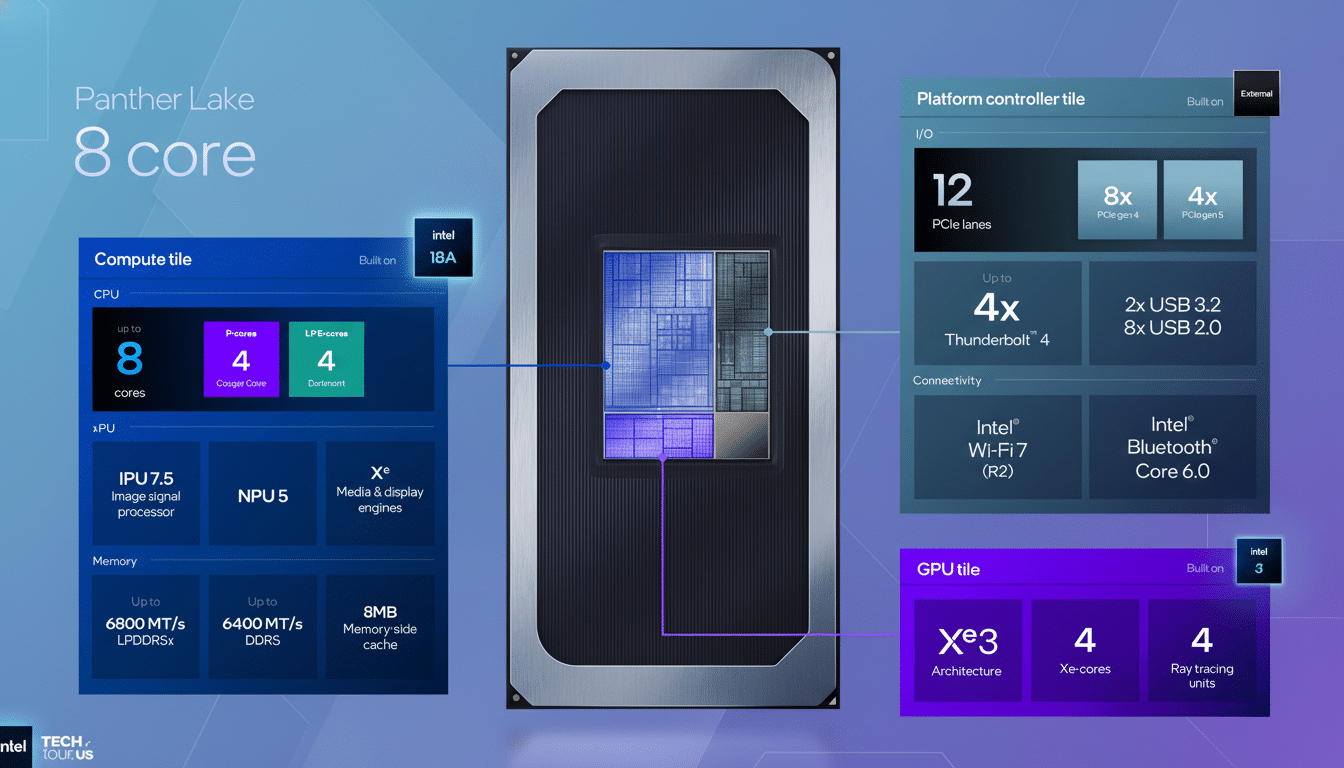
Flashing those good looks are the Xe3 LP (low power) graphics from Intel, which make up the most recent iteration of Intel’s Arc design. Xe3 is supposed to elevate per-core throughput and scheduling efficiency while continuing to mature its driver stack—a realm in which we’ve seen Intel make tangible progress over the past two years as more Arc features and optimizations have rolled into mainstream game updates.

Two techs are the stars of the demos. First up is XeSS, Intel’s AI-boosted upscaler that is ever-expanding its list of supported games and can provide massive FPS gains with only modest sharpness trade-offs at Quality or Balanced settings. Second to that is Intel’s upcoming multi-frame generation, which was not running on the show systems. Frame gen can juice headline FPS even higher, but may impose latency or create the occasional visual artifact—trade-offs competitive gamers will want to weigh carefully.
Don’t discount memory bandwidth either. For iGPUs, for better or worse, it’s all about system memory speed and configuration. Those are the kind of designs you can expect to get the best from with Arc B390, fast LPDDR5X in dual-channel, high-frequency modes that feed those Xe3 cores under extended load.
How It Compares with Entry-Level GPUs and Why It Matters
If those numbers bear out in independent testing, they mostly squeeze the low end of discrete graphics. dGPUs at the entry-level which do nothing more than remove the 1080p roadblock may face a battle for justification in mainstream notebooks soon, freeing up PCs to focus on improving battery life or thermals or slimness without becoming unplayable.
It expands the idea of what is feasible in small desktops and all-in-ones. Little-footprint systems that do everything a desktop can do—including playing new-release games at 1080p with ease. Desktops no longer make up the bulk of new PC purchases, but many people still like the idea of a tower they can easily expand. The industry has long observed that integrated graphics appear in larger numbers of volume shipments than discrete GPUs—those substantial iGPU increases could spread through the market with incredible speed.
Caveats and What to Watch Next for Real-World Use
Context matters. The demo units were based on the flagship X9 388H-class silicon, not mid-tier parts, and showpieces are often well tuned. Real-world performance will depend on OEM thermal solution, memory speed, power limits, and drivers. Thinner systems with a conservative power curve or single-channel memory will likely experience even greater variation.
Big questions for reviews:
- Do 1% lows remain near 60 FPS in extended gameplay?
- What is the sensitivity of performance to memory selection?
- Can we meaningfully assist in frame generation without sacrificing responsiveness?
- How does the Panther Lake mid-range build step down from the B390’s performance?
Even with those unknowns, the message from CES is clear. Intel’s Panther Lake with Arc B390 has pushed the needle for integrated gaming, and it did so across punishing titles at settings people actually use. Assuming OEM designs don’t kneecap the silicon, gamers might finally have a decent 1080p experience built into their next ultraportable.
