


T-Mobile is turning the screws on AT&T and Verizon with a new Better Value family plan that the carrier says can trim more than $1,000 a year off a comparable three-line setup. The offer centers on a limited-time $140 monthly price for three lines—about $46 per line—bundling streaming and safety perks while locking in the base rate for five years.
The move lands squarely in the sweet spot for families who stream a lot and want predictable bills. It also arrives after a year of industry price adjustments, making the notion of a multi-year price lock and baked-in perks more compelling than another round of à la carte add-ons.
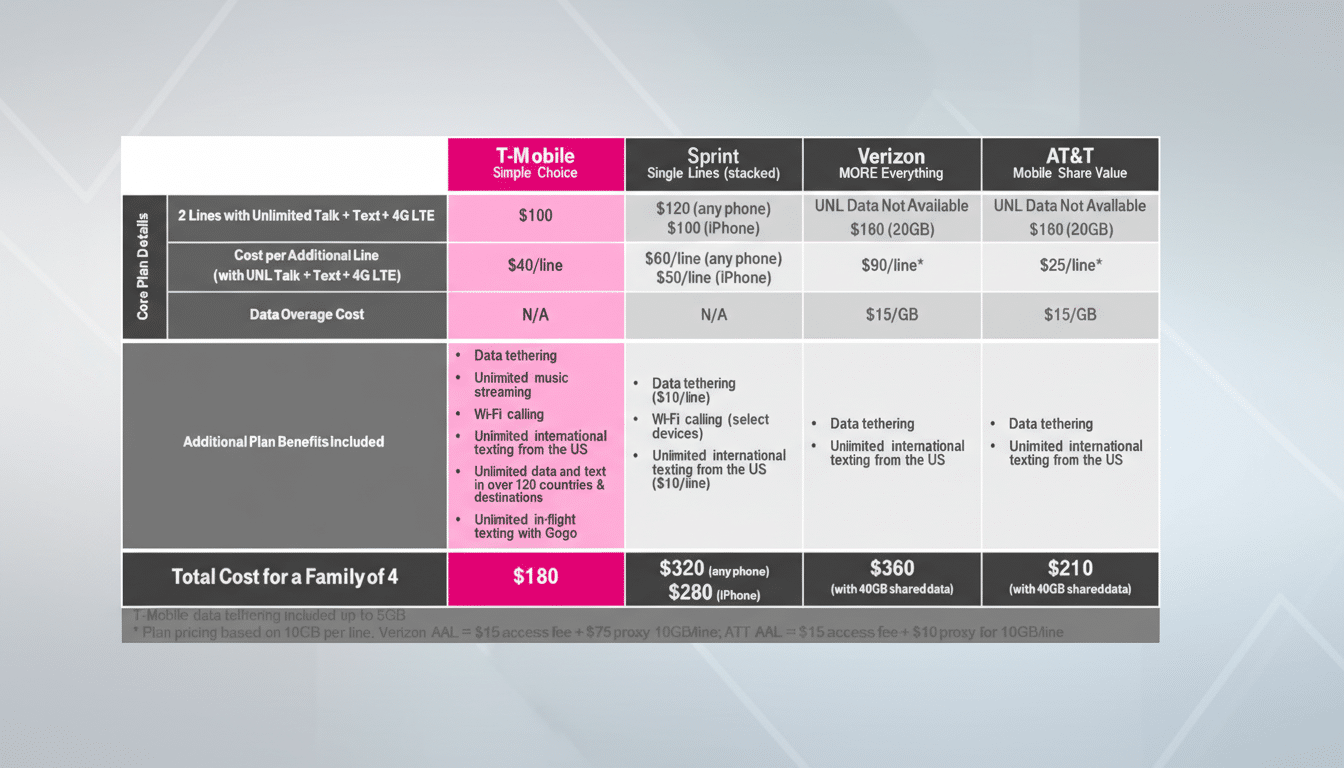
What the Better Value family plan actually costs
The Better Value plan lists at $140 per month for three lines with AutoPay, translating to roughly $46 per line. T-Mobile says that price is a limited-time promotion; the regular rate is $155 per month. Without AutoPay, expect an additional $5 per line per month.
Taxes and surcharges are extra, and there’s a device connection charge of up to $35 per line at activation. The offer includes a five-year price lock on the plan’s base rate, a notable pledge given the broader market’s recent fee creep.
How it beats AT&T and Verizon on price and perks
T-Mobile’s math hinges on two factors: a lower headline price for three lines and the value of included perks that competitors typically sell as add-ons. For many families, those add-ons—streaming bundles, safety tools, and travel-friendly features—can inflate a bill by $20 to $40 per month, per account, on other carriers.
Run a conservative example: If a comparable plan at AT&T or Verizon lands around $155 to $165 for three lines before add-ons, and you layer $20 to $30 in monthly extras to match streaming and protection benefits, the combined delta can exceed $80 per month. Over 12 months, that pencils out to savings north of $1,000. Real bills vary, but the direction of travel is clear—baked-in perks change the calculus.
This positioning mirrors recent network reports showing T-Mobile’s advantage in 5G availability and download speeds, which can matter when perks encourage more streaming. Opensignal’s 2024 reports and Ookla’s Speedtest Intelligence have repeatedly cited T-Mobile’s lead in 5G reach, which supports the plan’s value proposition when multiple lines lean on mobile data for video.
What’s included in the plan and why it matters
The headline perks include Netflix and Hulu, scam and identity protection features, and satellite connectivity capabilities designed to keep basic messaging alive in areas with no conventional signal. While satellite texting is still rolling out broadly, the inclusion signals where mainstream wireless is headed—resilience beyond cell towers.
Bundling streaming matters because families often pay for multiple services already. Two mainstream subscriptions can easily account for $15 to $25 in monthly value, before factoring any seasonal price bumps. By folding these into the plan, T-Mobile cuts the temptation to assemble a bespoke, pricier stack of add-ons elsewhere.
T-Mobile also pairs the plan with its broader 5G footprint, which, according to third-party testing from Opensignal and Ookla, offers strong availability and competitive speeds in many markets. For households that rely on hotspotting for school or work on the go, network reach plus included services can be a meaningful one-two punch.
Fine print, eligibility, and important restrictions
To qualify for the $140 promotional price, you need at least three lines and must enroll in AutoPay. The quoted price excludes taxes and fees and does not waive the up-to-$35 per-line device connection charge. The five-year price lock applies to the plan’s base rate, not to taxes or government surcharges.
Switching is designed to be quick—T-Mobile says the process can be completed online in about 15 minutes. If you’re bringing phones still under installment contracts at another carrier, T-Mobile will cover eligible device balances up to $800 per line for up to four lines via a prepaid Mastercard, subject to approval and port-in requirements.
Existing T-Mobile customers may be eligible, but restrictions apply. The company notes the three-line minimum for switchers and indicates eligibility paths for certain customers with lengthy tenure on T-Mobile postpaid plans. The Better Value plan sits alongside the carrier’s other options, including Experience Beyond and Experience More.
Who should consider switching to this family plan
This plan is tailored for families who stream frequently, want built-in scam protection, and value a long-term price lock. Travelers who venture off-grid may appreciate the satellite messaging capabilities as they mature.
If you’re on an older, heavily discounted T-Mobile plan with a legacy price guarantee, do the math before moving. Factor in: the $5 per-line AutoPay difference if you opt out, local taxes and fees, any trade-in credits you’d forfeit, and the real-world value of the included streaming subscriptions you would otherwise buy separately.
As a gut check, compare total annual costs rather than headline monthly rates. Consumer groups and analysts often recommend looking at the full bill—after add-ons, fees, and promotions. J.D. Power’s customer care studies and CTIA’s industry surveys also suggest service quality and support can be as important as raw price.
Bottom line: is T-Mobile’s Better Value plan worth it?
By bundling high-demand perks and locking the base rate for five years, T-Mobile’s Better Value plan delivers a credible undercut of AT&T and Verizon—more than $1,000 a year for many three-line families—without forcing a patchwork of add-ons. If the included services match what you already pay for, and coverage checks out in your area, this is one of the strongest mainstream family deals on the market right now.
