


SpaceX’s purchase of xAI instantly reshapes two of Elon Musk’s most audacious bets into one narrative arc: AI at scale and infrastructure in orbit. Officially, the rationale is power. With AI compute surging and grids straining, Musk argues that the long-term solution is to take data centers off-planet and run them in space.
There is substance behind the storyline. SpaceX recently sought Federal Communications Commission authority for satellites that would double as in-space data centers, a step that hints at near-term demonstrations. But the deal also locks in capital, talent, and investor attention at a moment when AI economics, launch cadence, and spectrum rights are converging in complicated ways.

The Power Crunch Framing the SpaceX–xAI Deal
AI’s thirst for electricity is real and accelerating. The International Energy Agency estimates data centers consumed roughly 460 TWh in 2022 and could rise to as high as about 1,000 TWh by the middle of the decade, effectively nearing a 100% increase if the upper bound is realized. Utilities across North America and Europe are already warning of multi-year interconnection queues and significant transmission upgrades.
This backdrop makes the idea of orbital compute appealing on paper. Solar power is abundant in space, and SpaceX controls a global LEO network in Starlink, complete with optical inter-satellite links that could route AI workloads worldwide. If you believe the grid is the bottleneck and bandwidth can be solved, moving some inference or preprocessing off Earth begins to look like a natural extension of SpaceX’s infrastructure play.
Skepticism and the Physics Problem in Orbit
Experts are split on the practicality. Tim Farrar of TMF Associates has compared the space data center pitch to a “Rorschach test” for investors, suggesting it enables impressive demos while pushing real revenue far into the future. It’s a useful caution: training or serving large models is not only about watts; it’s also about heat, radiation, latency, and data movement.
Heat rejection in vacuum is hard, demanding large radiators and mass penalties. Radiation-hardened components lag terrestrial accelerators in performance. Latency to ground may be acceptable for some inference, but moving petabytes for training is bandwidth-prohibitive compared to fiber. In other words, orbital AI is more plausible for niche inference at the edge—defense, disaster response, maritime—than for full-scale model training in the near term.
IPO Math and the AI Premium Driving Valuation
The merger also works as capital strategy. Financial outlets have reported that SpaceX is weighing an IPO of part of the business and could seek tens of billions in new capital at a valuation around the trillion range. Folding a buzzy AI unit into that equity story adds an “AI premium” investors currently reward, even as launch and satellite businesses follow more linear revenue curves.
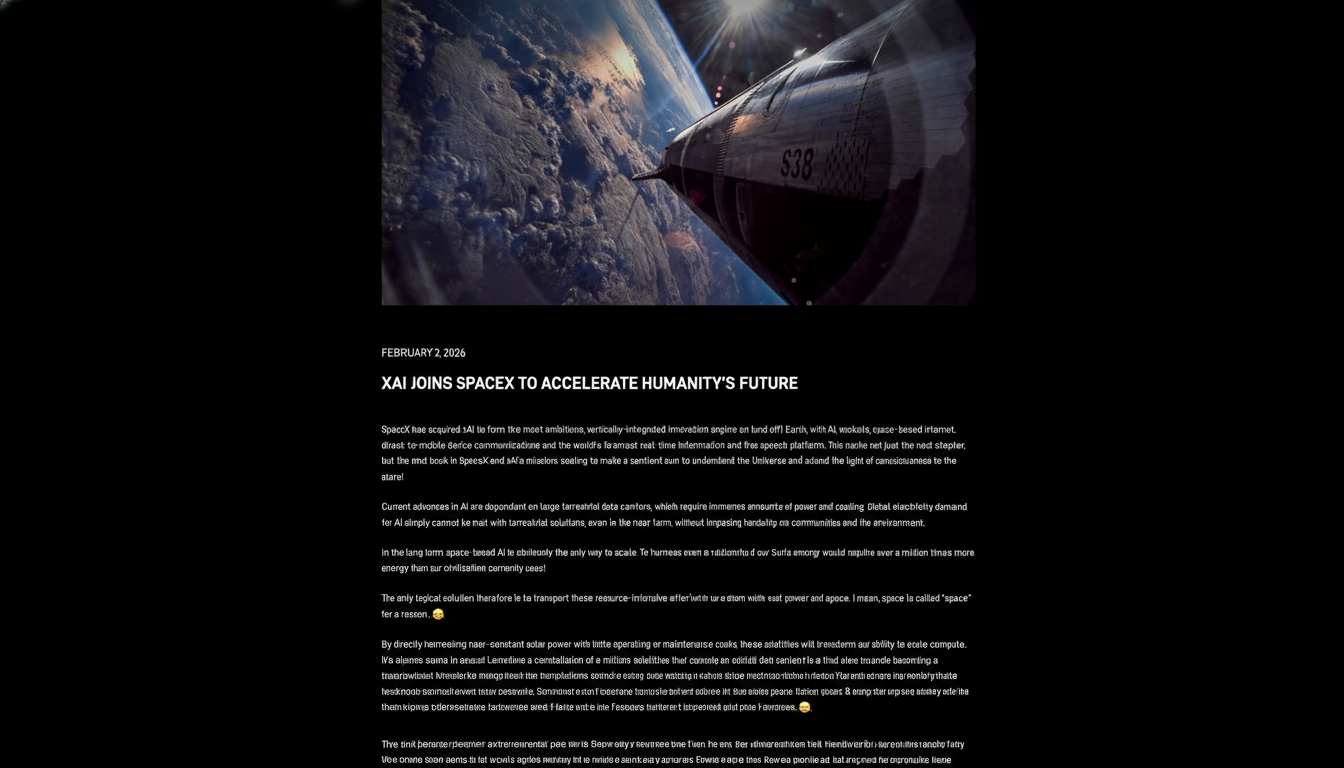
xAI, meanwhile, faces the familiar AI startup challenge: staggering burn. Bloomberg has reported it is spending on the order of $1 billion per month as it scales models and infrastructure amid a global arms race with OpenAI, Google, and Meta. Combining with SpaceX can stabilize runway, consolidate procurement for scarce accelerators, and ensure continuity of leadership and talent without the frictions of intercompany contracting.
Strategic Fit With Starlink And Government Work
SpaceX already fields a massive LEO network that reaches conflict zones, oceans, and disaster areas where terrestrial fiber is scarce. Embedding xAI’s models closer to that network could enable secure, on-orbit inference for imagery analysis, communications optimization, or autonomous vehicle support. Government and enterprise customers—already served under SpaceX’s Starshield programs—represent early adopters for such capabilities.
Vertical integration is another lever. Musk has publicly discussed ordering large quantities of AI accelerators, and a combined entity can standardize on hardware, cooling, and network fabrics across ground sites while designing space-qualified compute for orbital experiments. Shared engineering across avionics, photonics, and software optimization could bend unit economics faster than either company could alone.
What’s Real in the Next 24 Months for Orbital AI
Expect prototypes, not production, in orbit. Look for a handful of satellites hosting radiation-tolerant inference chips, tested over Starlink’s optical backbone with targeted workloads. On the ground, anticipate rapid expansion of conventional data centers powered by xAI’s training clusters, closer integration with Starlink gateways, and AI-enhanced network operations to extract more throughput per satellite.
Regulatory filings with the FCC and coordination at the International Telecommunication Union will signal spectrum strategy, while debris mitigation and power budgets will reveal engineering trade-offs. On the finance side, any IPO documents would clarify how much of SpaceX’s revenue mix is launch, Starlink, defense, and now AI, and whether the combined story can command tech’s highest multiples.
Bottom Line on SpaceX’s Acquisition of xAI
SpaceX didn’t buy xAI solely to loft data centers into orbit. It bought xAI to fuse a power-constrained AI future with a space infrastructure incumbent, to capture an investor premium, to secure scarce compute, and to seed a path—first on Earth, then in LEO—where AI and communications converge. The orbital data center is the moonshot; the near-term business is the plumbing that makes the shot possible.
