


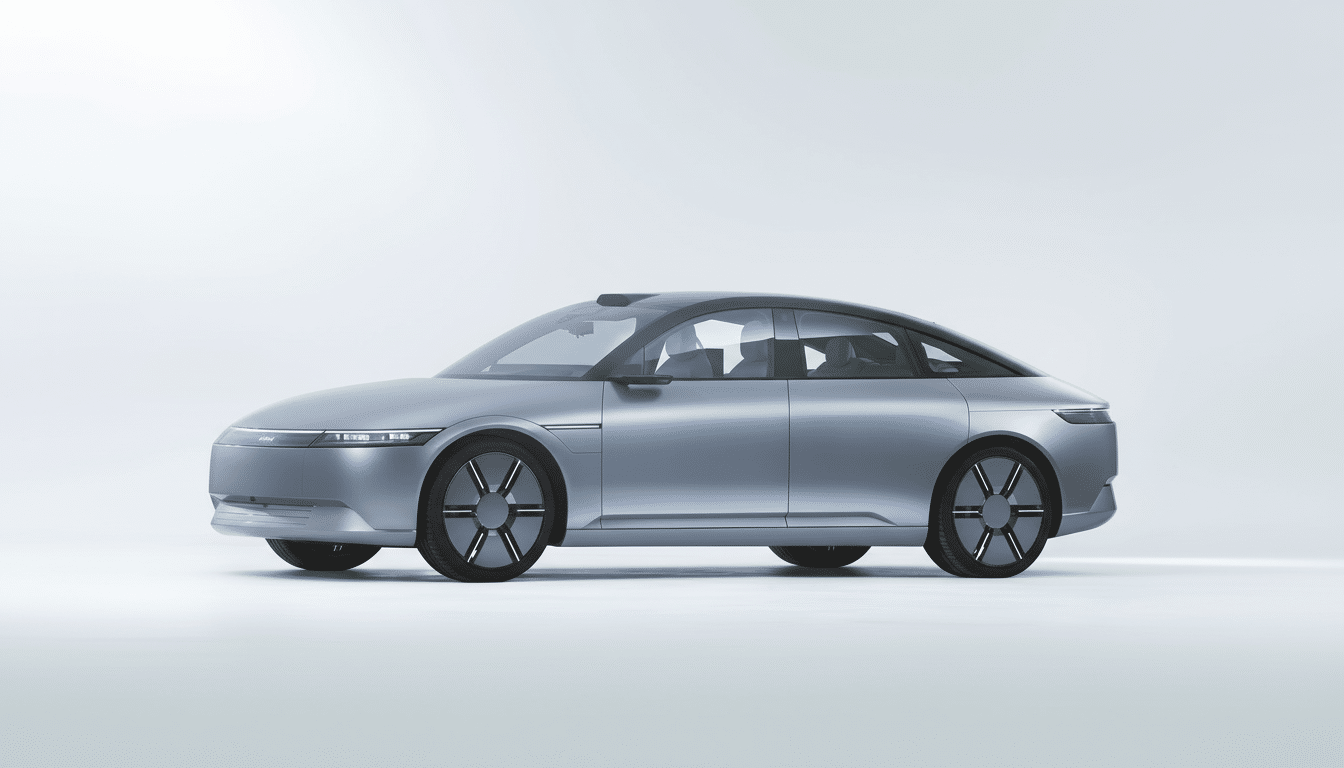
Sony Honda Mobility’s Afeela electric sedan will come with an option that makes the most old-school part of a car into software: digital license plates.
As first reported by TechRadar, Sony has teamed up with RPlate maker Reviver to provide Afeela owners a way to personalize plate appearance and message on the go through the use of a smartphone app, all while staying compliant with state regulations regarding proof of identity.
- Why Digital License Plates Matter for Sony’s Afeela
- How the RPlate Integration Works With Afeela
- Where It’s Legal and What You Can Actually Show
- Security and Privacy Considerations for Digital Plates
- Cost and Ownership Experience for Afeela’s RPlate Option
- What It Means for the Market and Connected Car Trends

Why Digital License Plates Matter for Sony’s Afeela
Afeela’s been positioned as a software-defined vehicle with particular focus on customization and connected services.
Introducing the plate into that ecosystem underscores the strategy: roll out from the cabin’s apps-and-services model to outside. It’s a minor detail that has outsize implications for convenience, compliance, and brand expression — especially among early adopters who use cars as rolling profiles.
How the RPlate Integration Works With Afeela
Reviver’s RPlate swaps out a conventional stamped plate with a monochrome electronic display that displays the state-issued alphanumeric ID all the time. Owners can toggle between light and dark backgrounds and overlay a custom message at the bottom (a company name, cause, or social handle), all through an app by Reviver. The hardware is updatable over the air, automatically renews registration where available, and supports plate transfer upon selling or leasing a new vehicle.
For fleets, RPlate can support add-ons such as telematics and geofencing, but consumer applications center on personalization and DMV workflows. Look for deep integration with Afeela’s connected services too — you’ll now find plate settings sitting next to things like themes, driver profiles, and charge schedules.
Where It’s Legal and What You Can Actually Show
Digital plates are regulated state by state. California opened them up for general use under AB 984 after a series of multi-year pilots. They’re also allowed in Arizona and Michigan, although some states restrict them to commercial or fleet vehicles. The rules vary on the requirement for a front plate, reflectivity, nighttime visibility, and how fonts are rendered, and those limitations determine what the display is capable of doing on public roads.
Customization isn’t a free-for-all. Many DMVs bar profanity, political ads, and anything that could obscure the characters assigned. In certain locations, different messages are only visible when the car is stationary. The Afeela integration will have to take into account the legibility standards of each locale and its enforcement tech, like the automated toll system E-ZPass and the license plate readers employed by law enforcement or parking operators.
Security and Privacy Considerations for Digital Plates
Digitalization of a plate is the process of establishing a new surface data. Reviver has said consumer users can agree to use features like location-based services for theft recovery, while compliance details related to its registration status are conveyed through secure channels with motor vehicle agencies. After independent researchers reported bugs in 2023, Reviver said it fixed the vulnerabilities and improved authentication protocols. Any implementation of Afeela will need to clear automaker-grade threat modeling, as well as adhere to privacy laws like California’s CCPA.
There is also the matter of fail-safes. Even if the vehicle or plate is powered down, the identifier must still be visible since digital plate systems are designed so that they fail in a readable state and have tamper alerts. Also look for Afeela’s integration to bring notices in the car and app if the plate has been taken, become damaged, or is otherwise offline.
Cost and Ownership Experience for Afeela’s RPlate Option
Owners of digital plates inherit a subscription-style layer to ownership. Typically, Reviver provides both one-off and monthly purchasing options, with the price of either model, connectivity, and state fees dependent. The tradeoff: no more DMV lines at tag renewal time in participating areas, and the ability to digitally update your banner or transfer the plate when you change cars — a benefit for lessees and fleet managers.
Practical perks have revealed themselves through real-world use. Fleet operators in California noted that renewals are quicker, plate-loss rates are lower, and drivers have enjoyed stolen vehicle situation status alerts as well as the ability to request a “STOLEN” issuance when reporting a vehicle theft. For Afeela’s tech-centric audience, these utilities augment the car’s larger connected suite as much as they serve as a novelty.
What It Means for the Market and Connected Car Trends
Automakers have been charging ahead, lassoing formerly analog aspects under the control of software — keys and mirrors and lights now, even suspension damping. You could bring erasable plates under that same logic to compliance and branding, something the vast majority of OEMs have left up to dealers and DMVs. By adopting an existing vendor’s product instead of developing its own, Sony Honda Mobility can deliver a feature that is legally murky without delaying the rollout of the vehicle.
The bottom line: the connected car and data center on wheels move from edge cases to product features. Afeela’s digital plate by itself won’t move the car, but it’s a telling way station on where the industry is heading — toward modular, software-driven ownership in which even the license plate gets an upgrade.
