


Qualcomm is making some noise with its AI PC initiative and the Snapdragon X2 Elite Extreme, leveraging an 18-core Oryon CPU coupled with an 80 TOPS neural processing unit, marking it as a true-to-form system-on-chip for laptops.
The company’s pitch is simple: more on-device intelligence, higher burst performance, and sharper efficiency inside premium thin-and-light machines.
Third‑Gen Oryon Cores Targeting Flagship Speeds
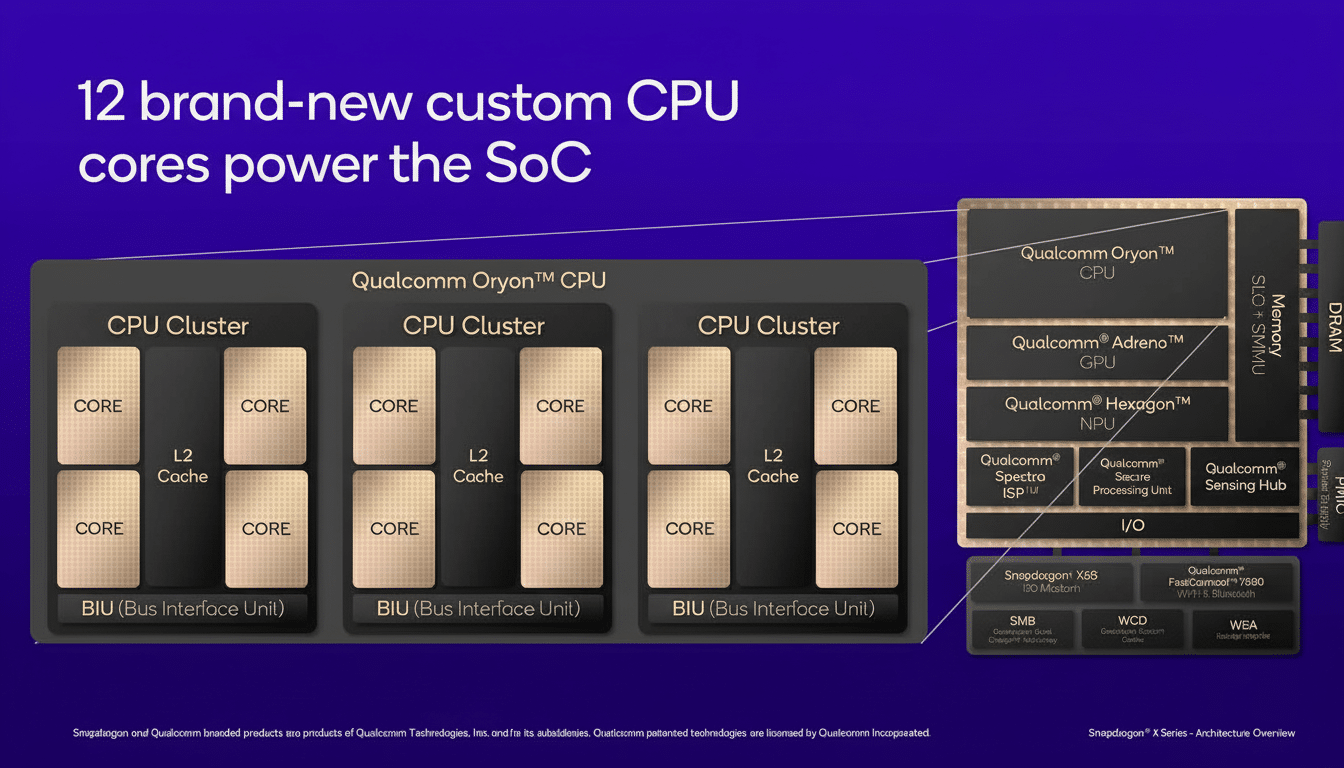
The X2 Elite Extreme brings together 12 “Prime” cores with six “Performance” cores, a configuration engineered to deliver heavy multitasking while reaching impressive single-threaded peaks. Qualcomm claims the top cores can hit 4.4GHz, and have two Prime cores that super-briefly boost to 5GHz — which the company says is a first for an Arm laptop CPU. The secondary cores are optimized for efficiency, which could help preserve battery life while the Surface Pro 7 is in sleep mode or during video calls.
Rounding out the stack are two more X2 Elite models: one that mirrors the 18-core layout at slightly lower clocks and another with 12 cores (six Prime, six Performance). All are fabbed on a 3nm process, which should deliver better performance per watt and higher sustained clocks under thin thermals.
An 80 TOPS NPU Designed for On-Device Local AI Workloads
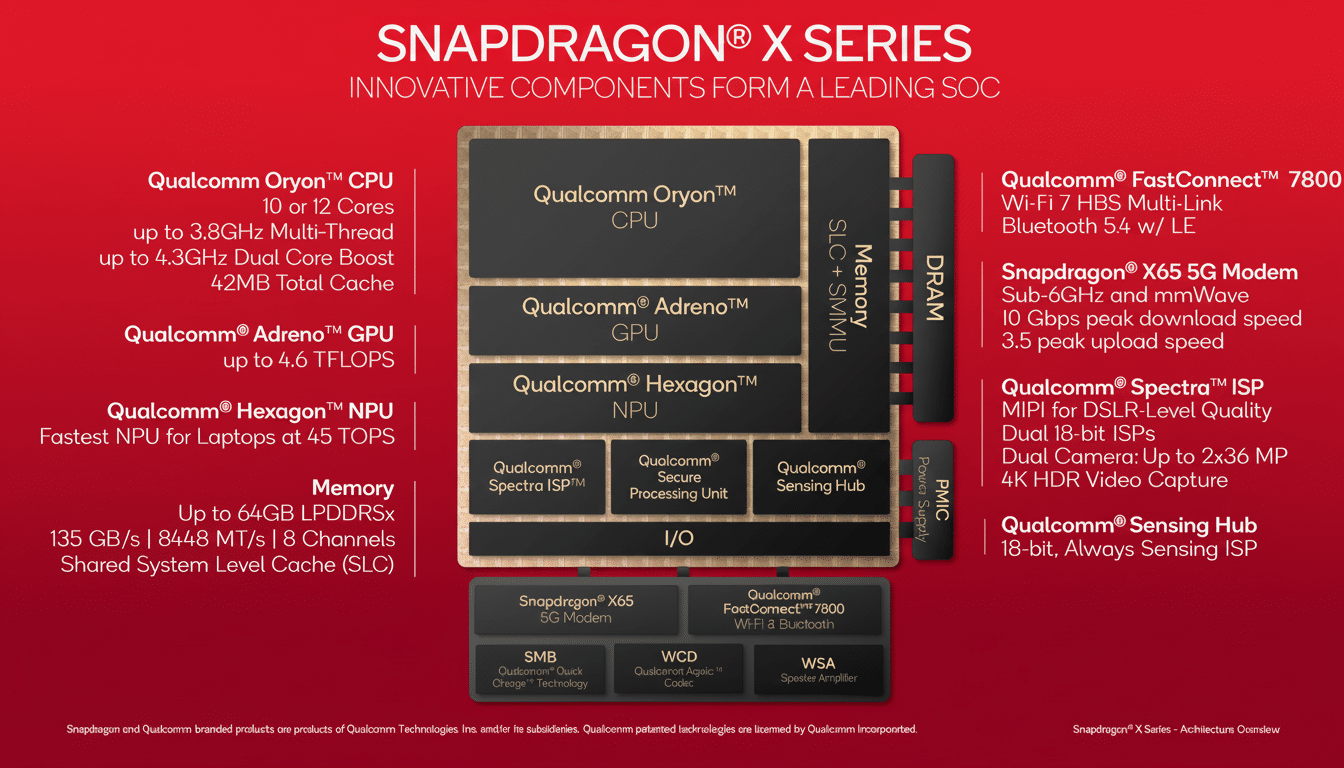
The star figure is the 80 TOPS (INT8) from the Hexagon NPU, which is a number that surpasses what we’ve seen as ~50 TOPS class targets talked about by AMD and Intel for leading-edge mobile in recent years.
Microsoft pegged the AI Jobs and Research Workload at 40 TOPS on a Copilot+ PC, so there’s some headroom for larger device-side models or more simultaneous AI tasks, or higher-quality settings without necessitating a punt to the cloud in Qualcomm’s ambitious figures.
The real-world gains here depend on a piece of software. Hope for acceleration on transcription, image generation, on-device assistants and small-to-medium LLMs with quantization. And for users relying on ONNX Runtime or DirectML, whose layer placement decisions are inferred by the underlying technology stack, there’s more generous on-chip memory and bandwidth to keep those same layers local—the result is lower latency and better privacy. MLCommons has demonstrated in MLPerf results several times that memory feeds and data movement can be the bottlenecks to AI performance; it would seem like Qualcomm is going after that bottleneck with increased NPU throughput and unified memory.
Adreno Graphics: Efficiency Over Raw Watts
Qualcomm’s freshly announced Adreno iGPU did not miss an opportunity to take a shot at NVIDIA and AMD for allowing their products to lag behind in terms of perf-per-watt, quoting the metric as being 2.3x better than that of the initial Snapdragon X gen.
The company claims support for up-to-date APIs like Vulkan, OpenCL 3.0 and DirectX 12 Ultimate, plus multi-display prowess that can push three 4K displays at a 144Hz refresh rate or three 5K screens at 60Hz — good news for creators and two-heads who live in spreadsheets and timelines.
And while integrated graphics won’t unseat a top-end discrete GPU for hardcore 3D or CUDA-class compute, the efficiency hyperbole does matter for battery-first laptops that need smooth UI, accelerated media, and occasional gaming without sounding like funnel-less wind tunnel fans.
Memory Capacity, I/O Connectivity, and Platform Features
The Extreme SKU combines the SoC with 48GB of LPDDR5X integrated directly on-package for lower latency and power draw and more headroom in local AI models. Other X2 Elite variants will also permit device manufacturers to adjust memory levels. Storage gets PCIe Gen 4 and Gen 5 lanes with NVMe support, and systems can use as many as three USB4 ports at 40Gbps for fast external drives and docks.
These are Arm-based Windows machines, and the story is not just silicon. App availability matters. Productivity and creative tools are growing native ports, and Microsoft’s emulation layer has made enormous strides supporting legacy x86 and x64 apps. The higher single-thread peaks here should contribute to a snappier responsiveness in mixed workloads.
Security and Manageability, Even Mobile-Style
Qualcomm is packaging a new umbrella layer called Snapdragon Guardian Technology as well. Think smartphone-style device management for PCs: Locate, lock or wipe a machine over Wi‑Fi or 5G with a mix of hardware roots of trust and cloud services. For IT teams accustomed to mobile MDM, that confluence could help close the management disparity between laptops and phones.
Competitive Outlook and Key Areas to Watch Next
On paper, the X2 Elite Extreme’s mixture of 18 Oryon cores, an 80 TOPS NPU and big Adreno efficiency claims certainly puts some real pressure on AI PC platform rivals. AMD and Intel have cranked out their own NPUs, Apple’s silicon is still seen as a beard-on-fire battery-life reference point; but Qualcomm seems to be bent on front-loading NPU throughput and relying on unified memory access patterns to sustain local models.
Independent testing will answer whether those 5GHz bursts translate into better responsiveness in everyday apps, how well the NPU scales across frameworks and if the 2.3x graphics efficiency gain shows up during game dev workflows and casual gaming.
IDC analysts have claimed that AI PC value is local, not just TOPS; if Qualcomm’s hardware meets compelling software experiences, then the X2 Elite family could become the home of the reference-point-bound Arm notebook for AI-first work.
